

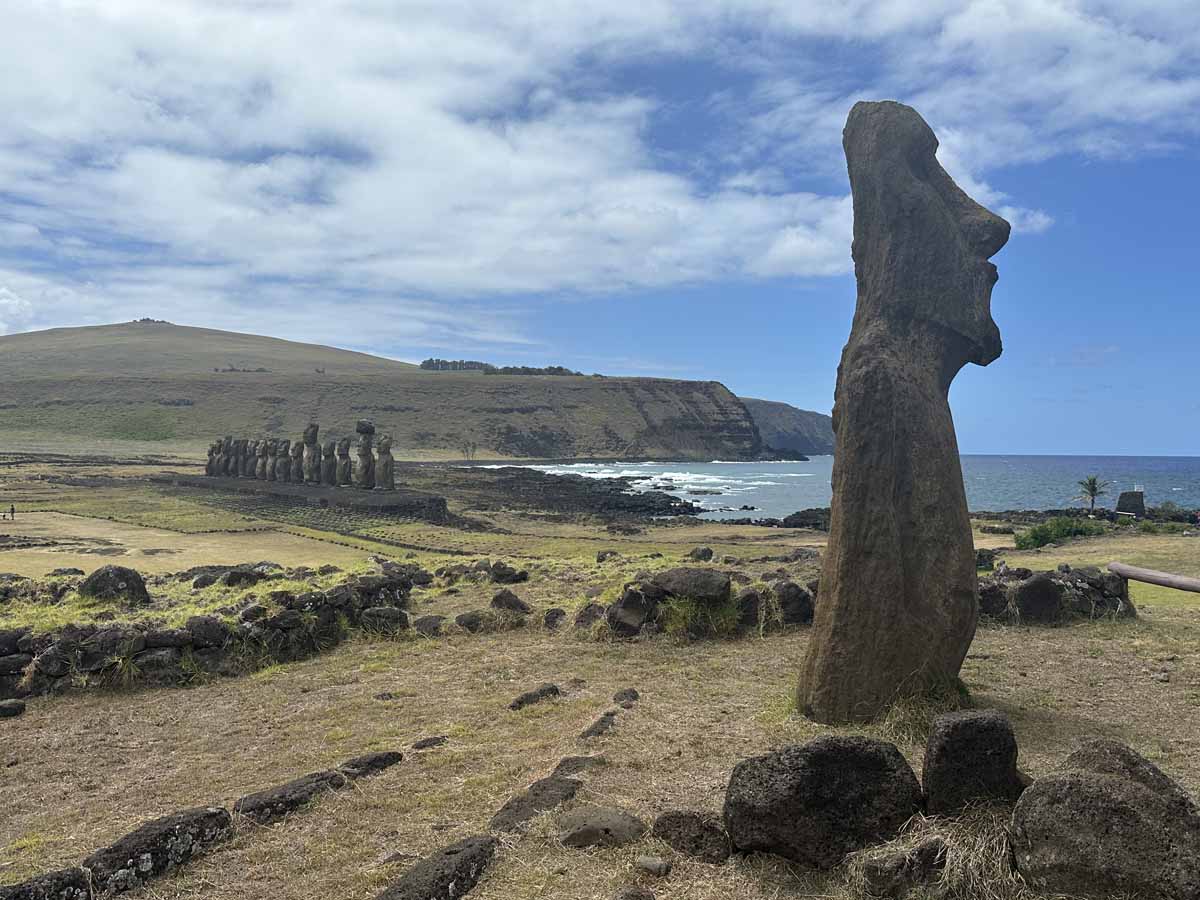
Easter Island, also known as Rapa Nui, is one of the most remote inhabited places on Earth. This small volcanic island in the South Pacific Ocean is famed for its many mysterious moai – monumental stone statues carved by its early Polynesian inhabitants.
Rapa Nui is one of the planet’s top bucket list destinations – and it certainly was on mine! So, it was a thrill to finally visit Rapa Nui this year (in mid-February). And this amazing place truly stole my heart – which is why I want to share this very special destination with you!
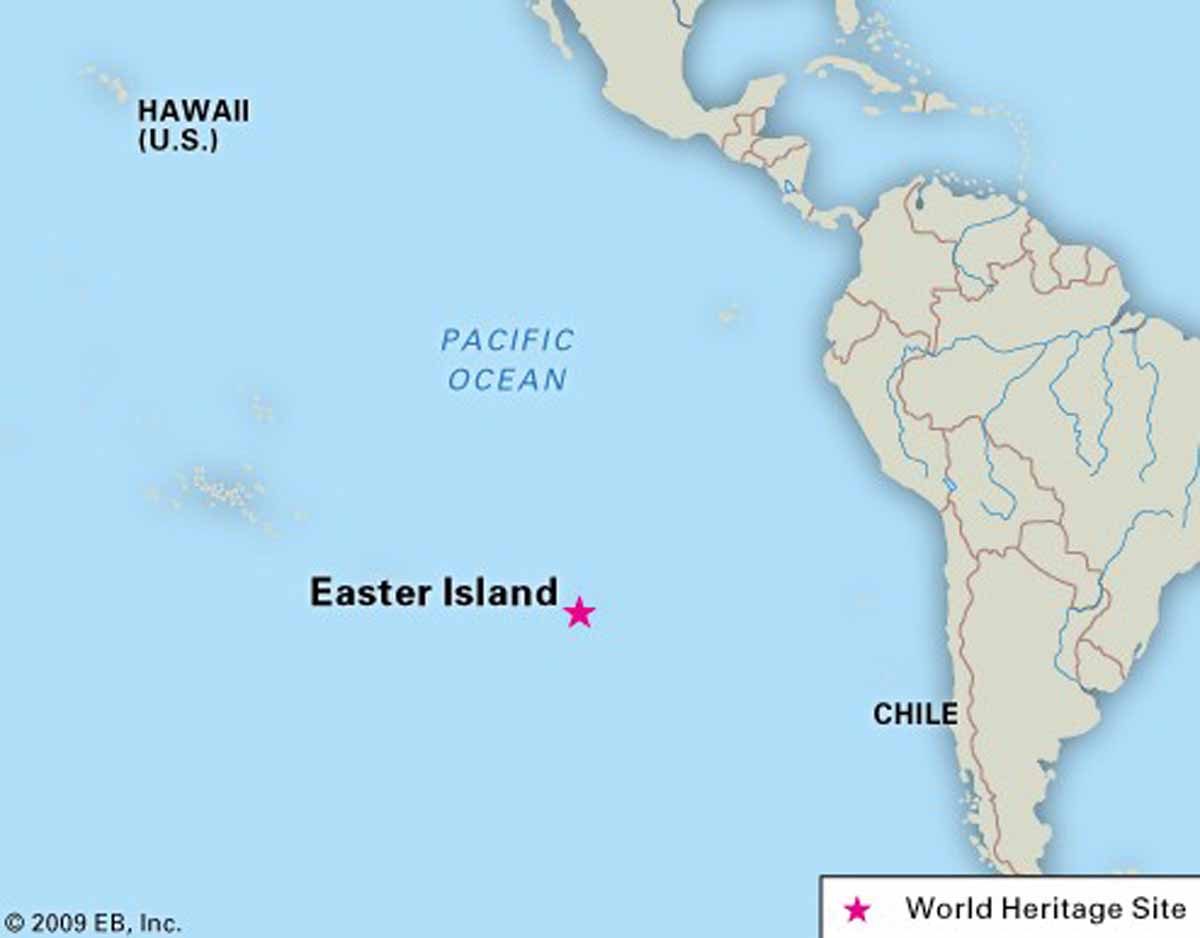
Map Credit: Encyclopedia Britannica / Click on all photos to enlarge
My Easter Island visit was the pre-trip portion of a South America / Patagonia tour with Overseas Adventure Travel (OAT) in February/March 2026. The pre-trip started in Santiago, Chile and included 3 nights/3 full days on Rapa Nui.
Easter Island sits in the middle of a vast ocean – around 3,500 kilometers (2,200 miles) west of continental Chile. Only one airline – Chile’s national airline LATAM – flies to the island. The flight from Santiago on a widebody Boeing 787 Dreamliner takes a full 5 hours. Yep, the remote island is that far away!
About Rapa Nui – The Island
Easter Island is incredibly small – only 14 miles (22.5 km) by 7 miles (11 km), with a total area of 63 square miles. It was formed when eruptions from its three main volcanoes coalesced together into one island.
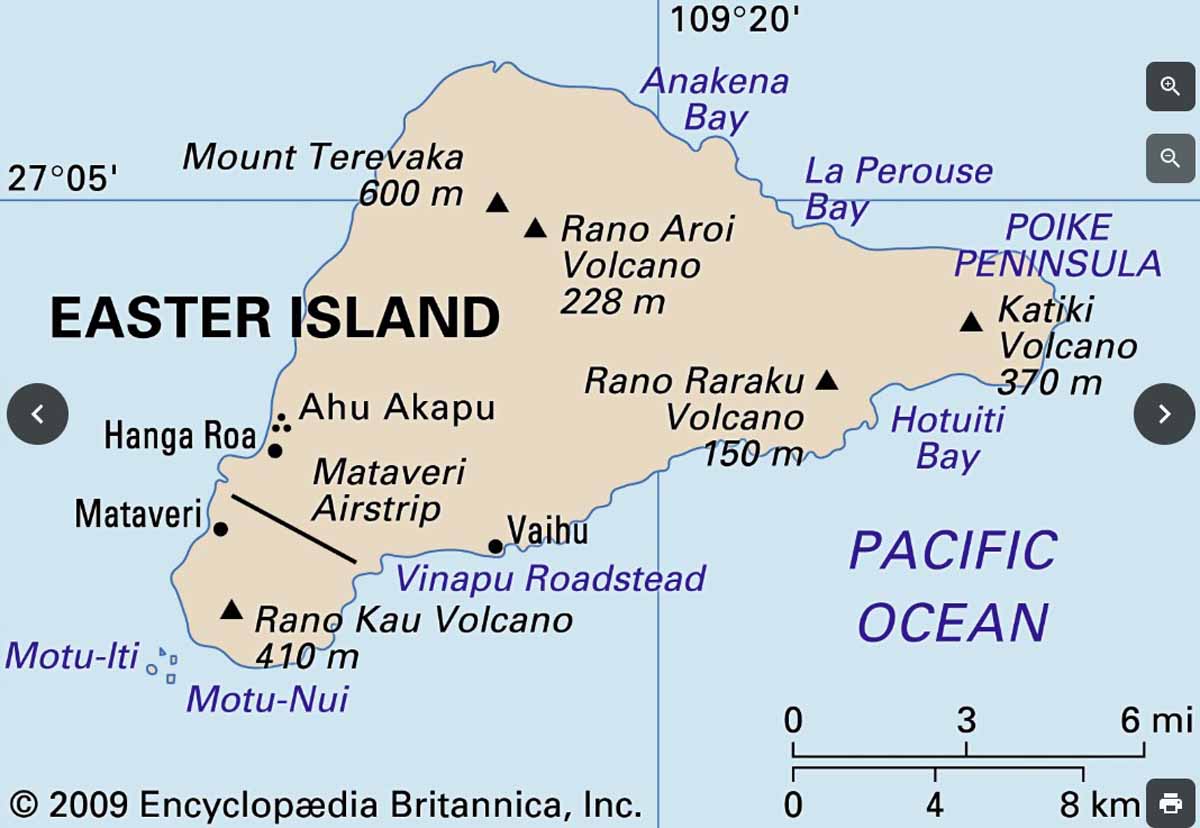
Map Credit: Encyclopedia Britannica / Click to enlarge
Rapa Nui has a raw, unspoiled beauty with windswept volcanic rock coastlines, gentle, treeless hills, and a lush interior. Unlike most Polynesian islands, golden beaches and coconut palms are not common here. Nearly half of the island is a protected national park, as well as a World Heritage site (from 1995).
Rapa Nui is the local language, the name of the island (in this language), and the name of the indigenous Polynesian people. In Spanish, it’s known as Isla de Pascua. For purposes of this blog post, I will generally refer to Easter Island as Rapa Nui.
Rapa Nui was once the most isolated place on earth. But in recent decades, the incredible moai statues have drawn the world’s attention. So today, the island welcomes over 100,000 visitors per year – more than ten times its resident population.
What Makes Rapa Nui So Special
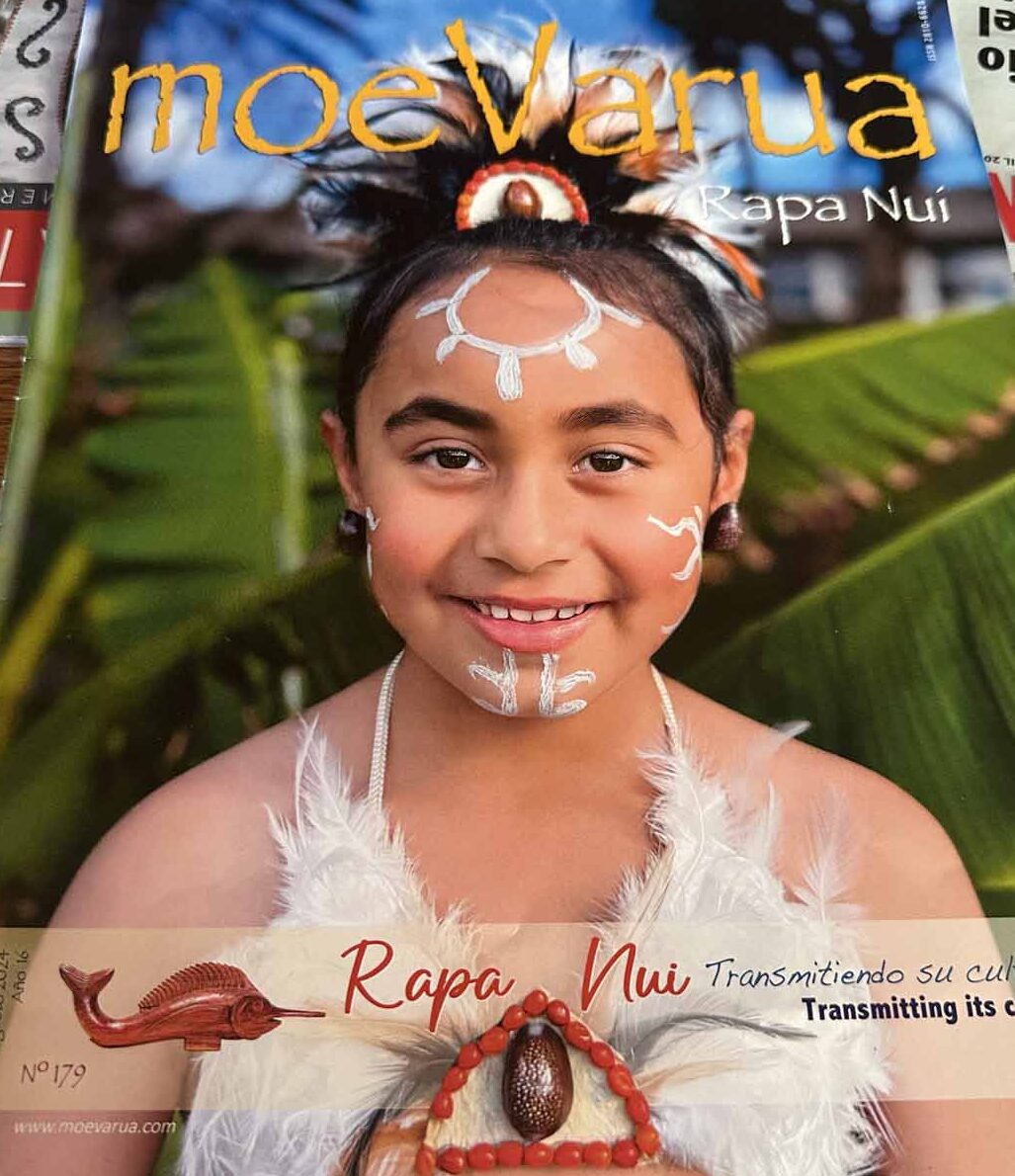
Magazine cover of Rapa Nui girl
Before my visit, I will confess I didn’t know much about Easter Island, except for seeing a few interesting photos of the moai. I certainly wasn’t expecting to fall in love with the island like I did.
Visitors describe Rapa Nui as a magical & mystical place. My Chilean OAT Trip Leader Luis has visited around 50 times and never tires of the island. My American friend Dennis (from Florida) has been to Rapa Nui 9 times!
Dennis states “The island is amazing. It has a certain mystique, a calm feeling which one feels upon stepping off the plane. It’s hard to define but the island’s power, its mana, gives one calm tranquility and a sense of fulfillment.”
Key Reasons Why Rapa Nui Dazzles:
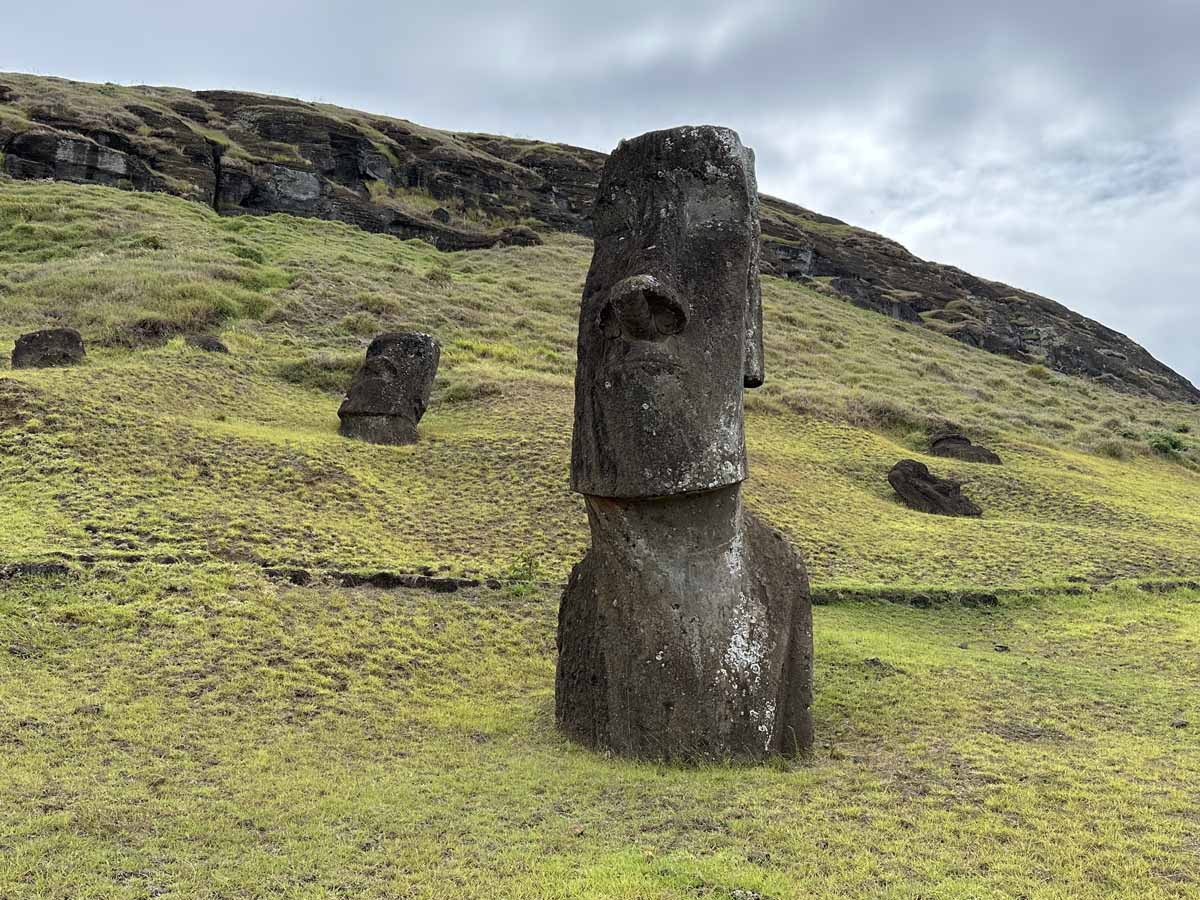
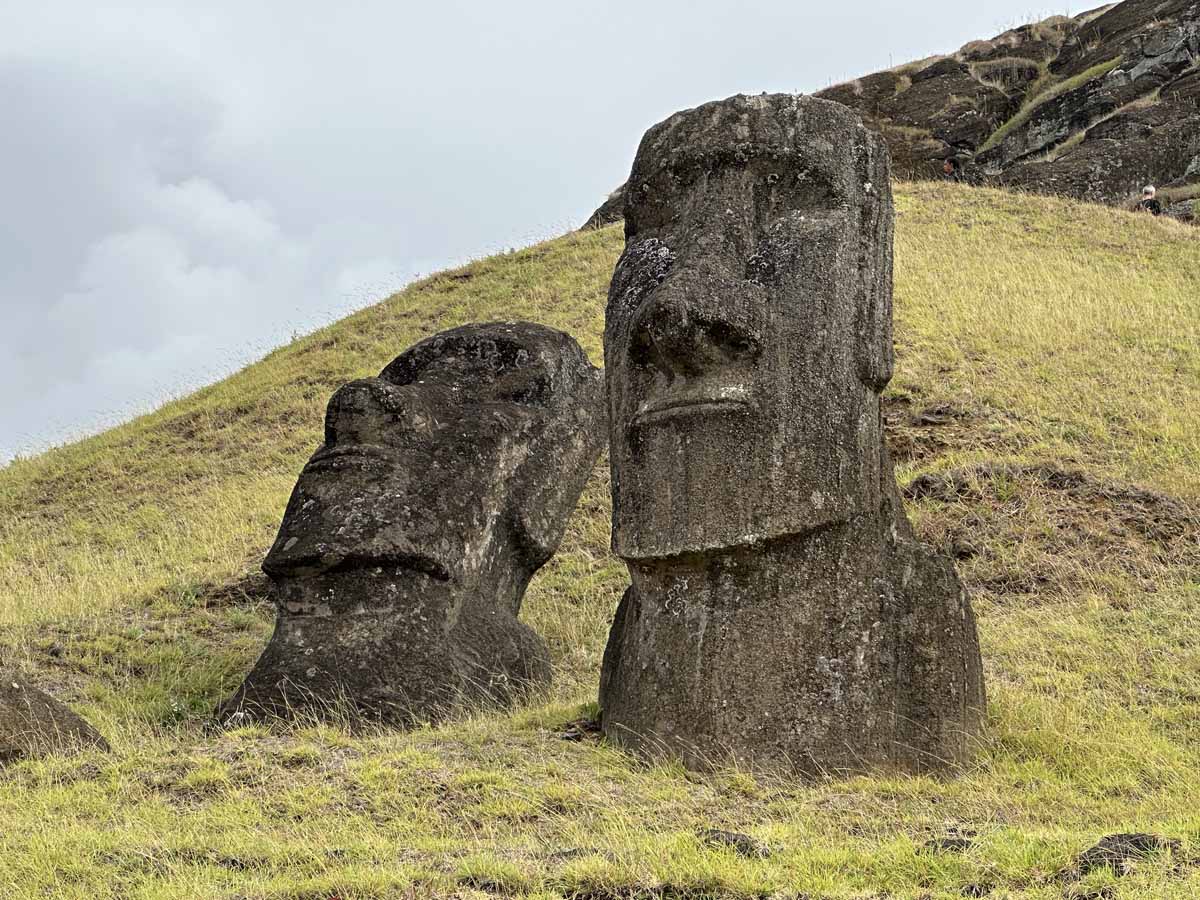
 The Moai – Of course, these iconic giant stone statues are the island’s main draw – with nearly 1,000 moai carved by the Rapa Nui people. Seeing the moai in person is genuinely awe-inspiring.
- The Island’s Incredible Remoteness – It’s truly sobering to think that you are standing on a small speck of land in the middle of a vast ocean, with the nearest inhabited neighbor (Pitcairn Island) over 2,000 km (1,243 miles) away.
- The Island’s Rugged Beauty – The landscape has a windswept, stark and rugged beauty including dramatic black volcanic rock coastlines.
- Authentic Polynesian Culture – The local people still proudly maintain their Rapa Nui culture & traditions. You can feel their genuine Polynesian warmth & soul, starting with a friendly lei greeting at the airport.
- A Feeling of Intimate, “Unspoiled” Quality – The island feels authentic, tranquil & laid-back, and not over-commercialized like so many tourist locations these days. Happily, the islanders seem committed to keeping it that way!
- Spectacular Sunsets & Sunrises Seen Among the Moai – Experienced travelers consistently rank the dramatic sun viewings on Rapa Nui as among the finest of their lives – and I would tend to agree they are spectacular (having witnessed both!
Rapa Nui Quick History
In the past, archeologists believed that Rapa Nui may have been populated as long ago as 400 AD. However, the very latest scientific consensus is that the first settlers arrived around 1200 AD. Advanced, modern scientific methodologies (like radiocarbon dating) have substantially narrowed this arrival timeline.
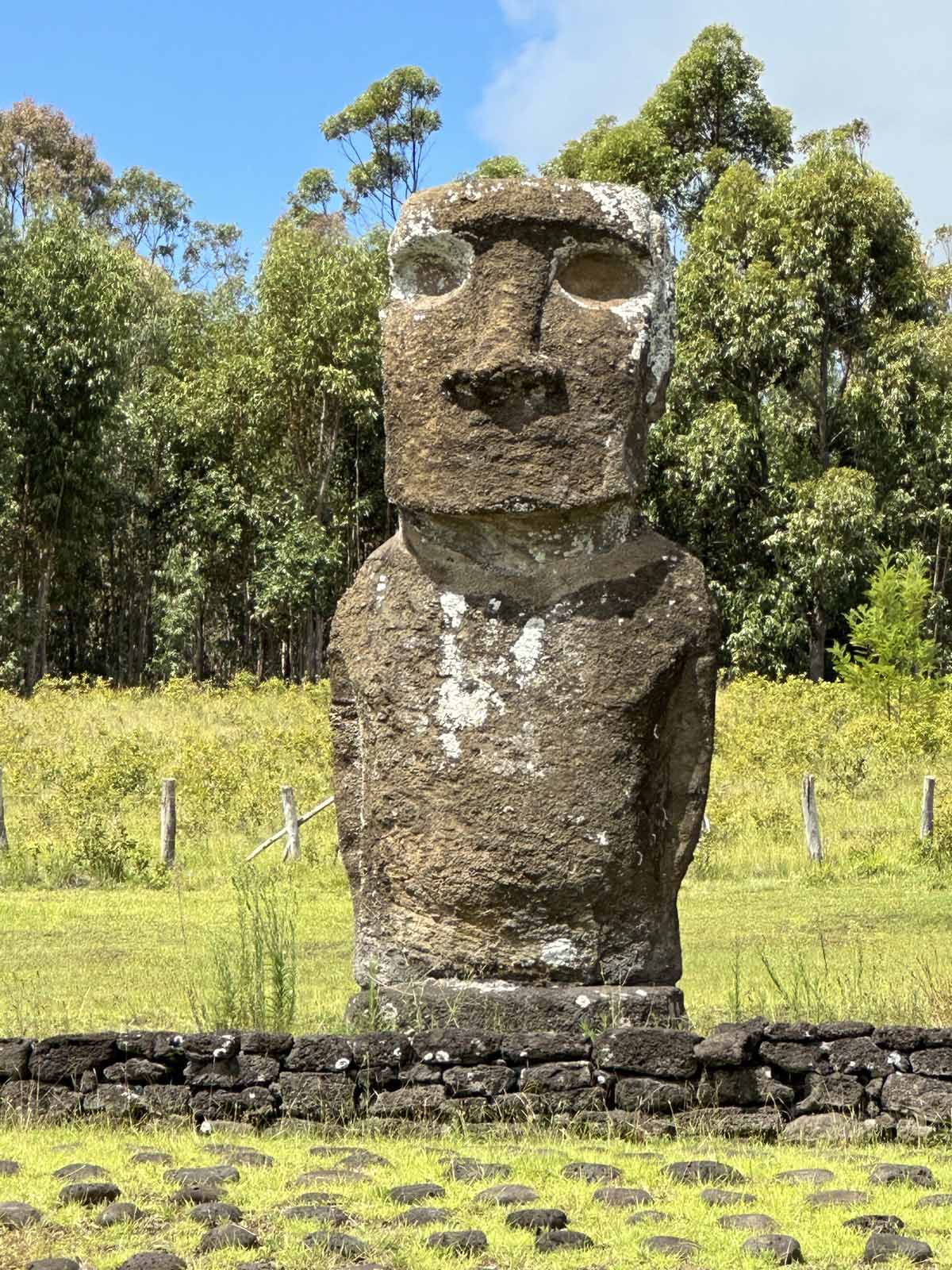 Plus, most academics now agree that the first Rapa Nui settlers came from Polynesia – likely from the Marquesas Islands. That’s a remarkable distance of 2,400 miles (3,850 km) – traveling in a traditional Polynesian double-hulled canoe! They brought sweet potato, sugar cane, and bananas with them.
Left in total isolation for centuries, the initial settlement prospered and spread. By the 15th & 16th centuries – the height of the moai building period – the island was divided into 10 or 11 competing clans, also called tribes or polities. They were each building ever larger moai to honor their ancestors and assert their power.
The first Europeans arrived in 1722 on Easter Sunday, which is what gave Easter Island its name. Chile annexed the island in 1888. After much mistreatment over the years, the Rapa Nui people finally received full Chilean citizenship in 1966 (with all accompanying rights). Soon after, the first airport opened in 1967, and tourism began to increase.
The Mysterious Moai – Their Building & Their Toppling
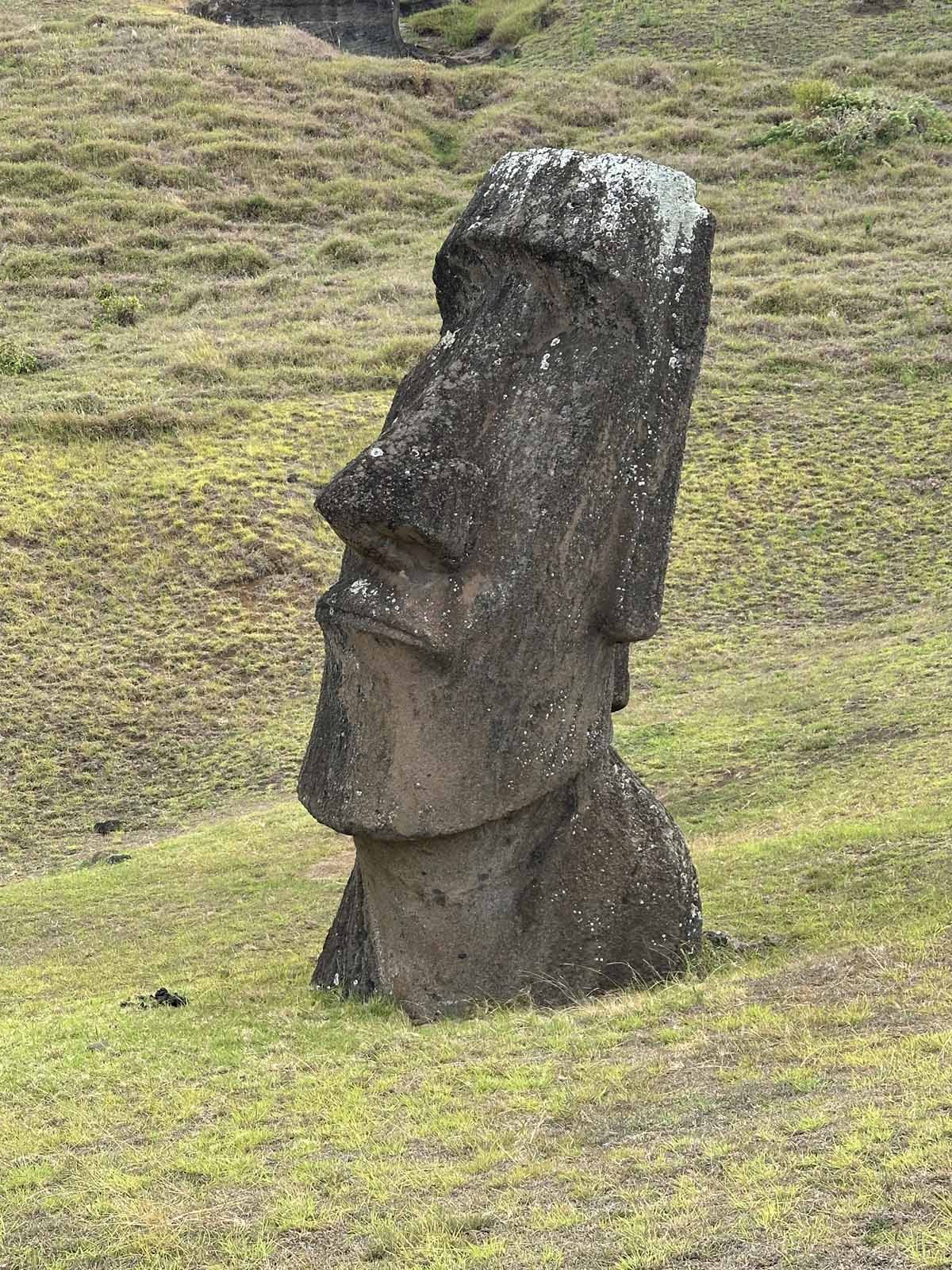
To be specific, there are 887 moai statues documented across Rapa Nui. However, the total number can approach 1,000 when including fragments and unfinished moai still embedded in the quarry walls at Rano Raraku.
Click on all photos to enlarge
These large moai were carved out of soft volcanic rock and vary greatly in size. The statues range from 6 to 65 feet tall (roughly 2 to 20 meters). Impressive!
Quick FYI: In case you’d like to know how to pronounce moai (like I did), here you go: MOH-eye. Plus, moai is both singular and plural.
So, what was the purpose of these moai? It is believed that they were expressions of ancestor worship – each moai representing a specific deceased chief or important tribal member whose spiritual power (mana) would protect the living members of the community.
In addition, there are more than 300 ceremonial platforms (ahu) on the island. Most were built to display the moai. However, some ahu served purely as burial platforms without statues, and others were ceremonial spaces without moai.
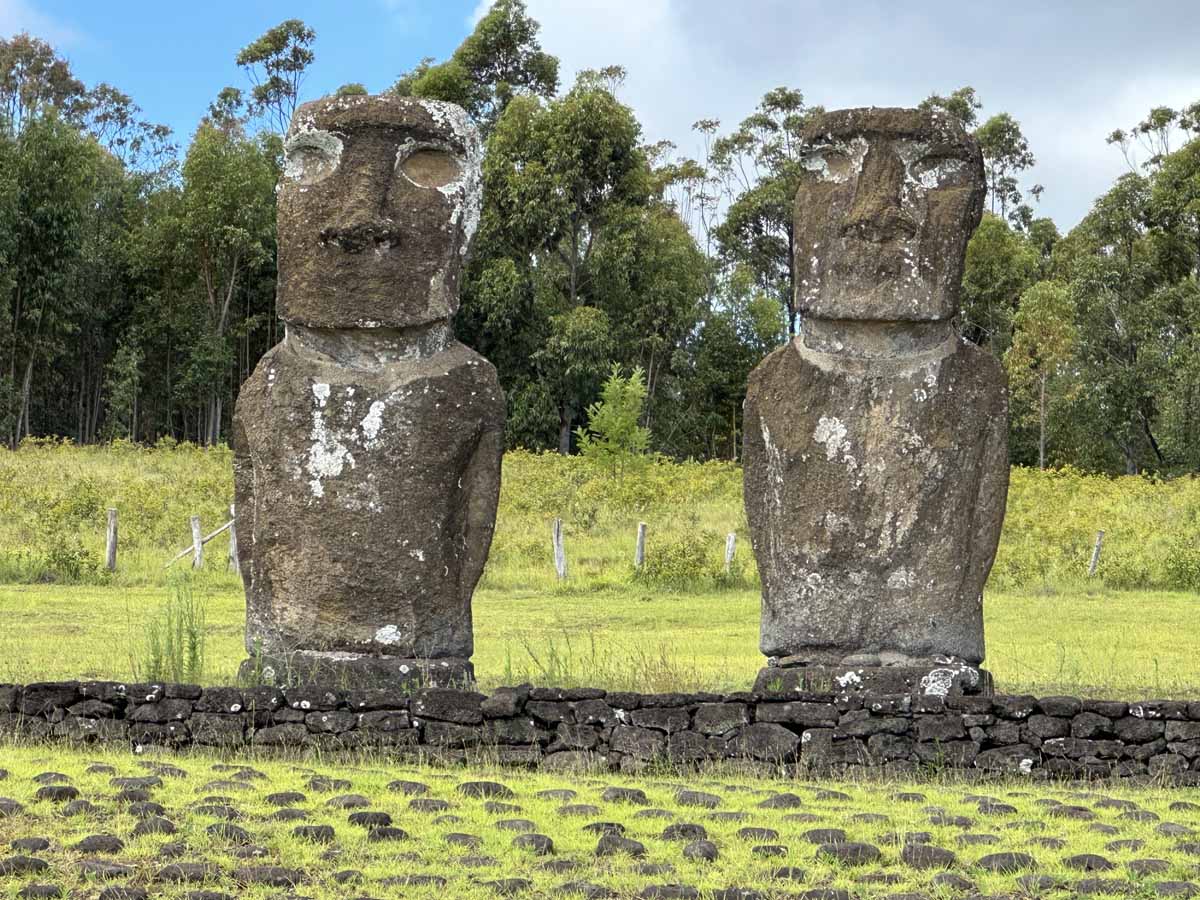 All standing moai you see today on Rapa Nui have been re-erected in modern times. That’s because during the period of the tribal wars, all the moai were toppled, presumably to break the “mana” of the family chief they protected.
The exact specifics are still being debated, but destruction of the moai unfolded over roughly 150 years – from the late 1600s through the mid-1800s. The causes were a complex mix of internal clan conflict, ecological collapse, and the catastrophic impact of European contact.
Our Arrival on Rapa Nui
My OAT group of 6 excited travelers flew the 5 hours on LATAM airlines from Santiago, Chile to Rapa Nui’s Mataveri International Airport. We were accompanied by our excellent OAT Trip Leader Luis (a Chilean who now lives in Buenos Aires).
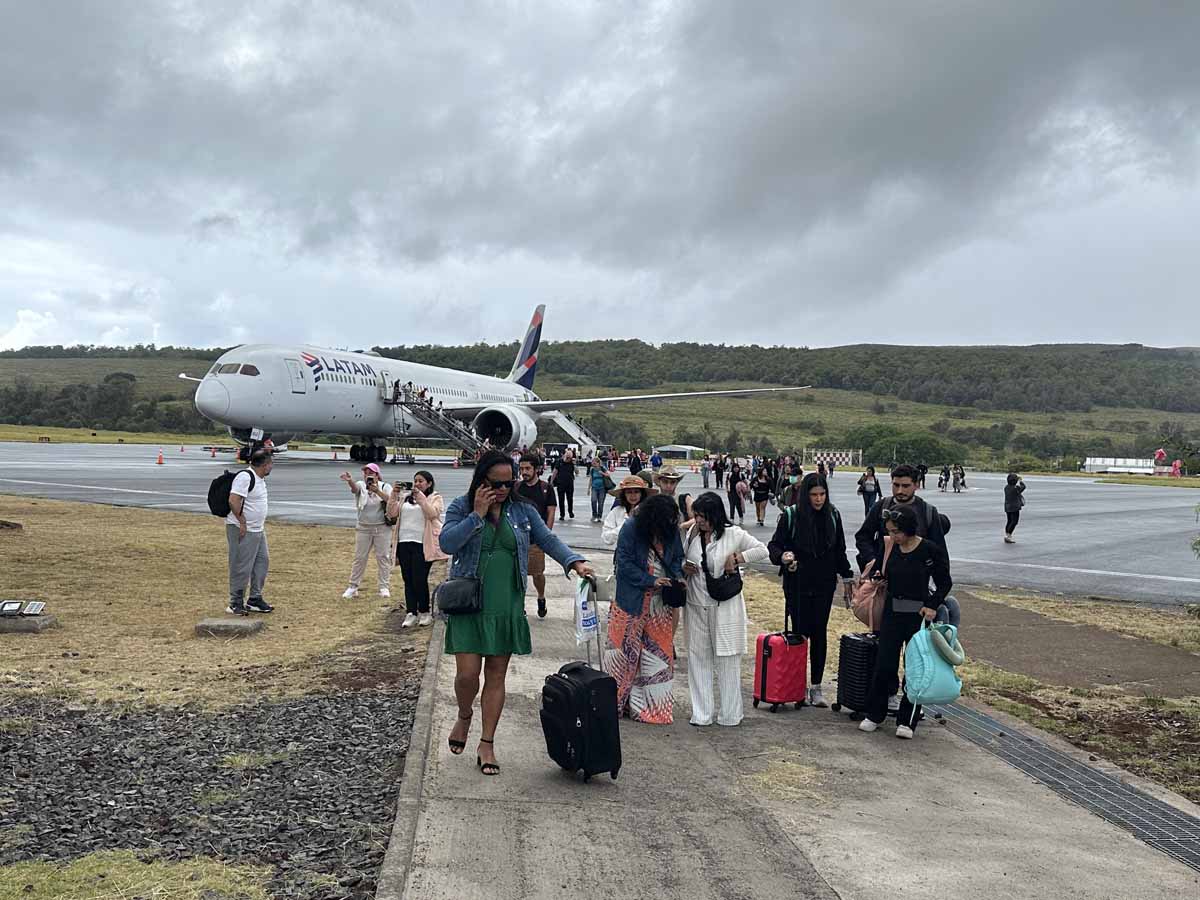
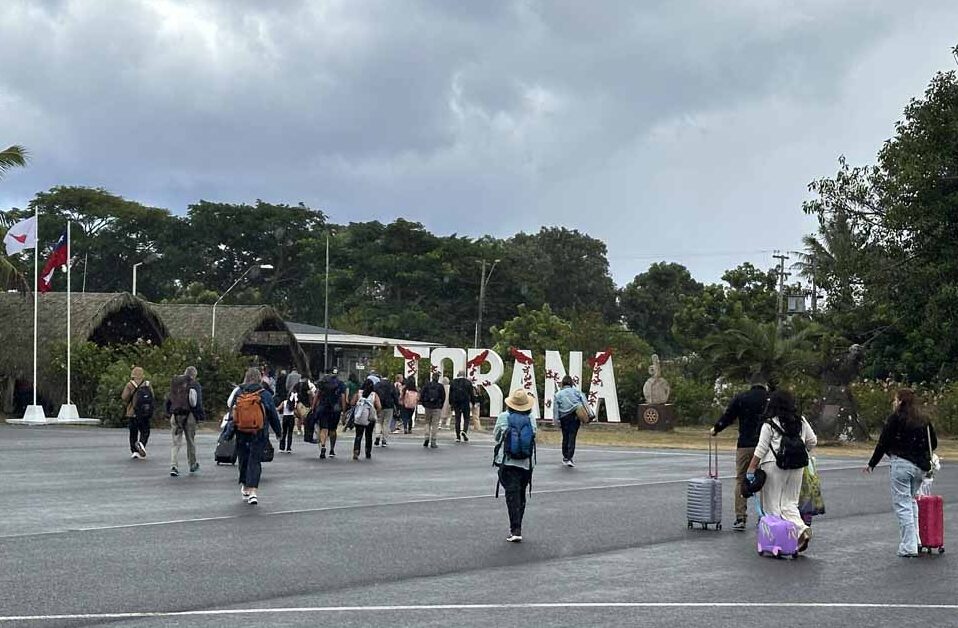
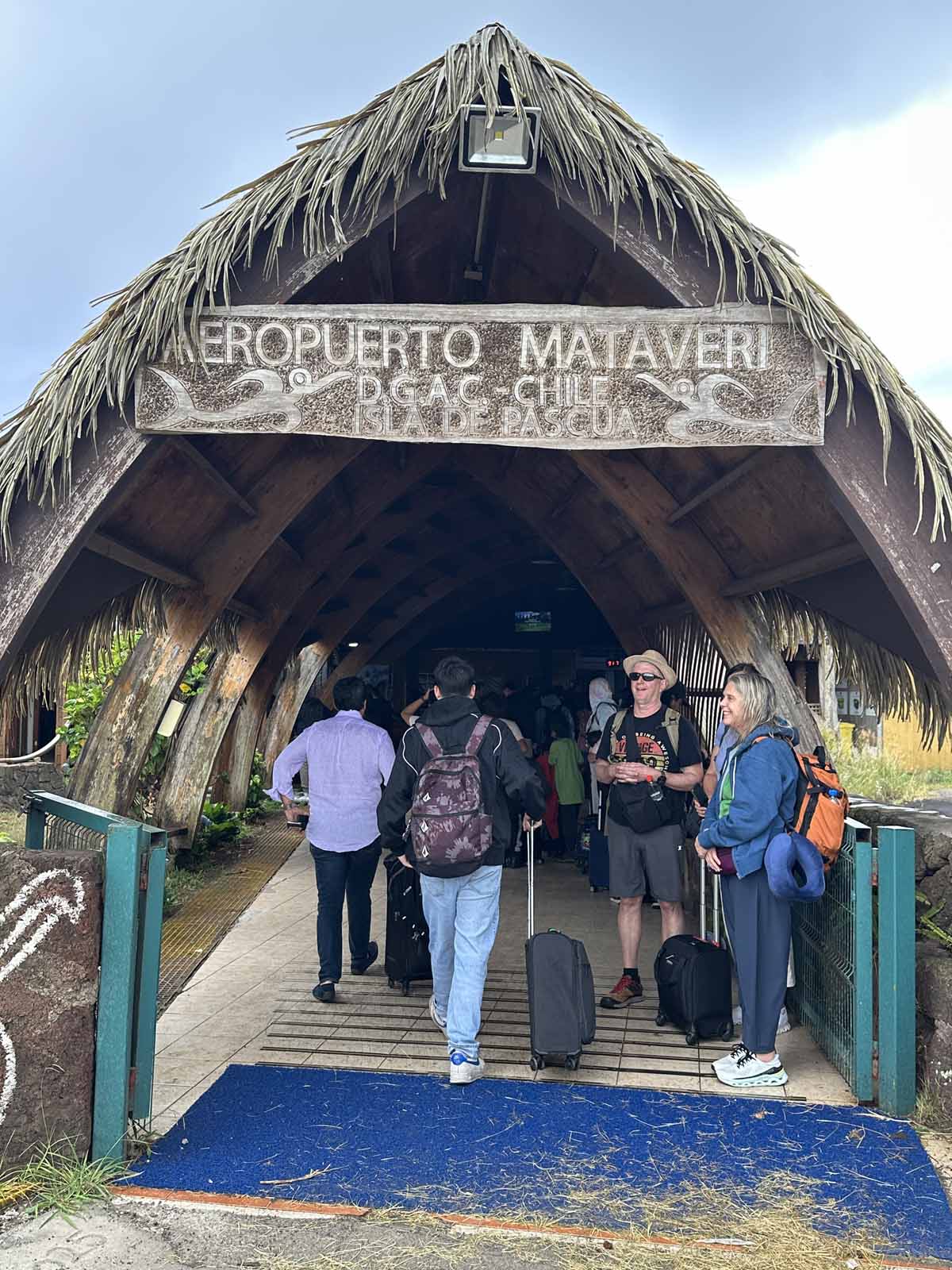
We arrived at the island’s small – but nice – airport around 12:30pm to light rainfall. It must have been Rapa Nui’s tropical welcome for us, and it soon stopped. After getting our bags, we were greeted with a fresh lei by Nico from Maururu Travel.
Nico would be our excellent local guide for the next 3 days (along with a driver), as we toured the island’s many sites. He was born in Rapa Nui, is age 37, still single, and has no desire to leave the island that he dearly loves. Plus, Nico told us he has around 54 first cousins & over 200 other cousins & relatives on the island!
-

- Arriving into Rapa Nui’s airport terminal
-
- Kim & Deb with our local guide Nico
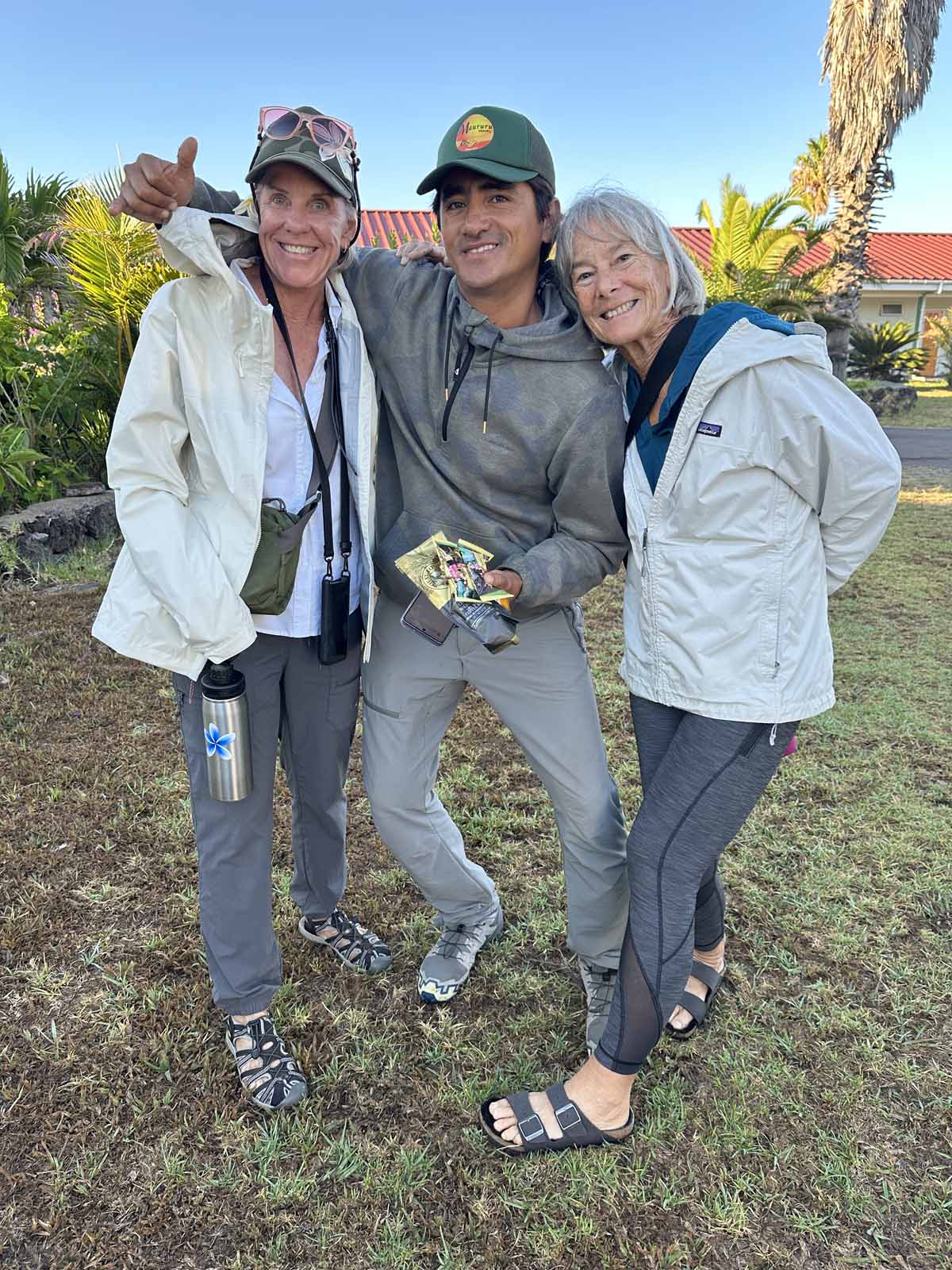
It was a short drive to our hotel, where we had time to unpack and relax a bit. At 3pm, we met up with Nico to start our island sightseeing with a visit to 3 different Rapa Nui sites that afternoon. Whoo Hoo – finally time to see our first moai!
5 KEY MOAI SITES WE VISITED
In this section, I will share 5 of the “key moai sites” we visited with Nico – so you can experience what made each site so different & special. Of course, I highly recommend all of them if & when you are able to make your own visit to Rapa Nui.
1) Ahu Akivi – The 7 “Navigators” Moai
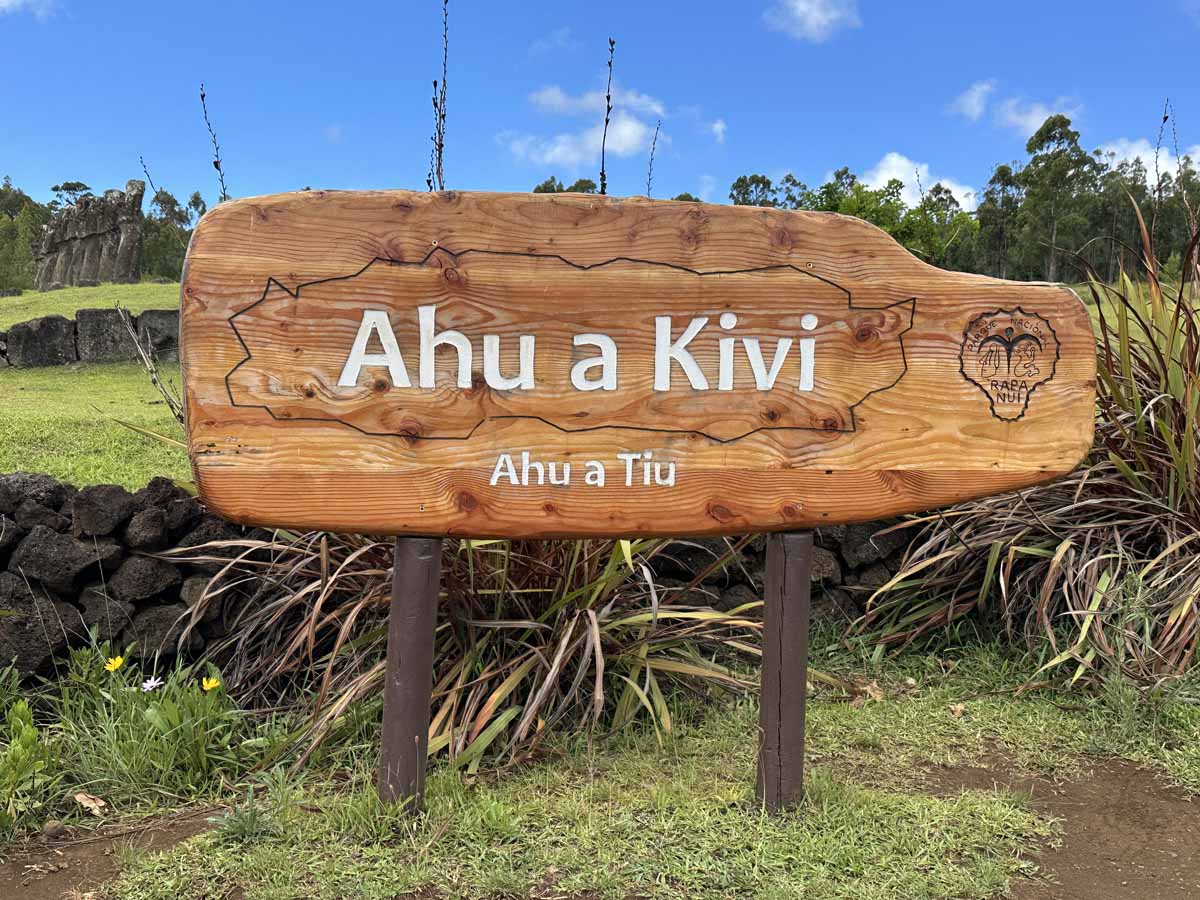
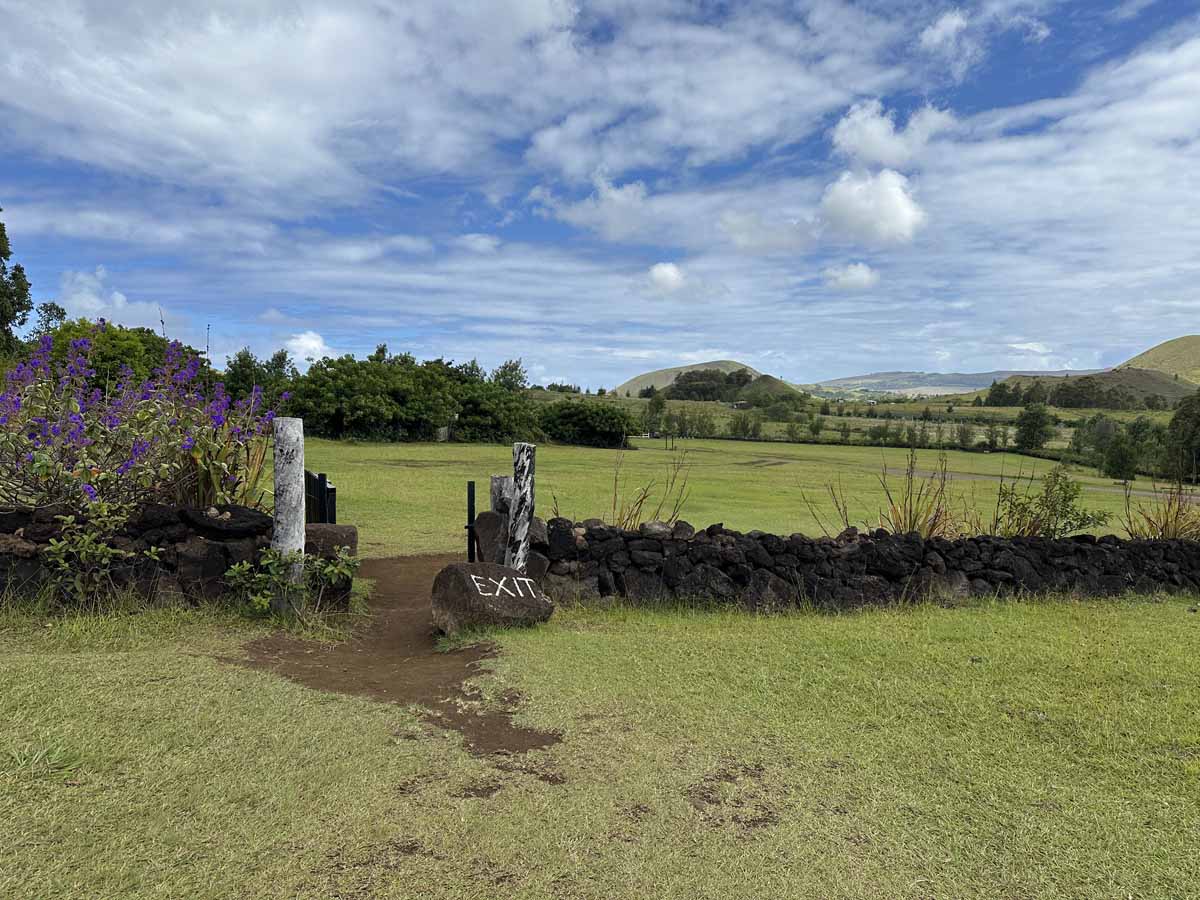
What a wonderful introduction to Rapa Nui’s mysterious moai. Located in a quiet, grassy field in the island’s interior, these 7 moai sit on a ceremonial platform (ahu). It was a lovely, peaceful setting, with just a few other visitors.
-

- The entrance to the Park site
-
- View of countryside around Ahu Akivi – click to enlarge
Unlike most moai groups, these seven statues are remarkably uniform – all nearly identical in style & height (at about 4–5 meters tall/13-16 ft.). In addition, they all face the sea, which is unusual. Most moai face the community they protect, with their backs to the sea.
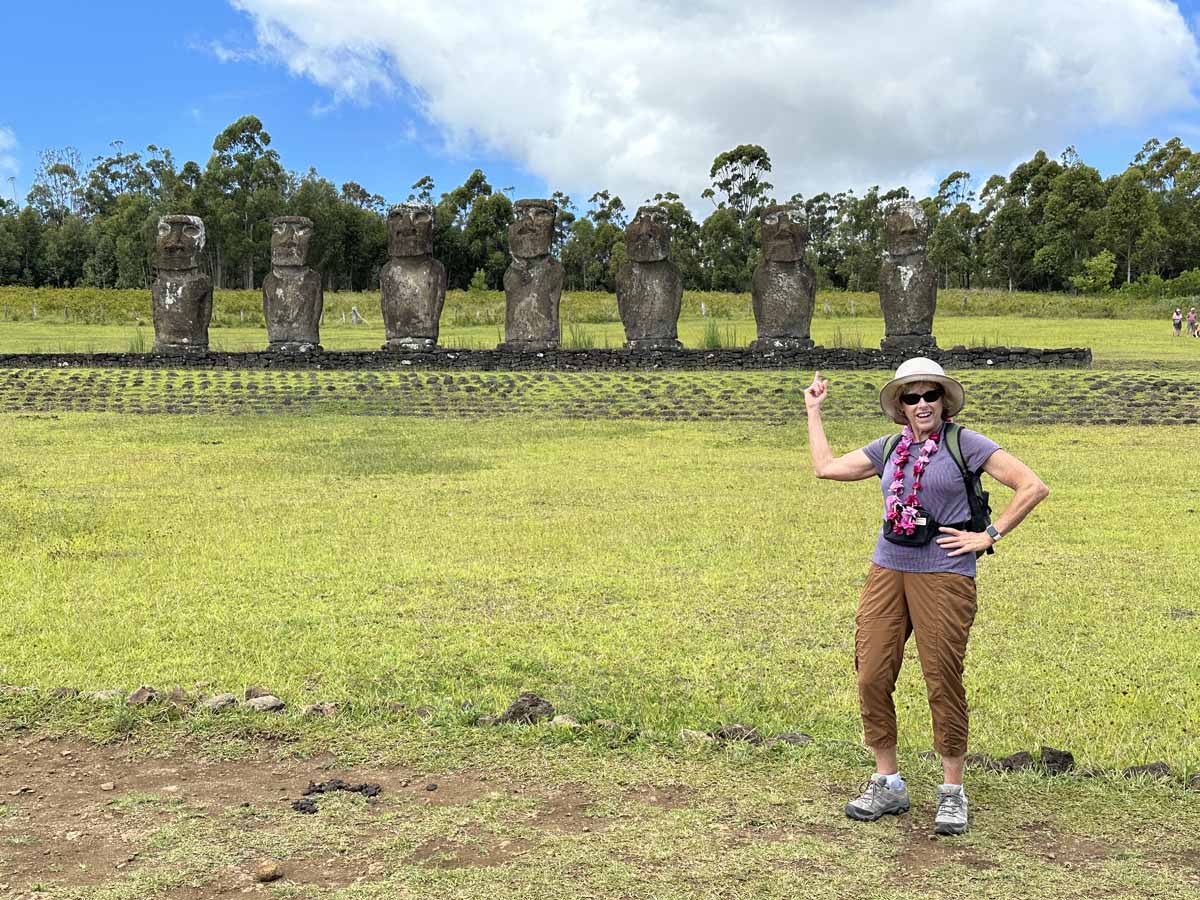
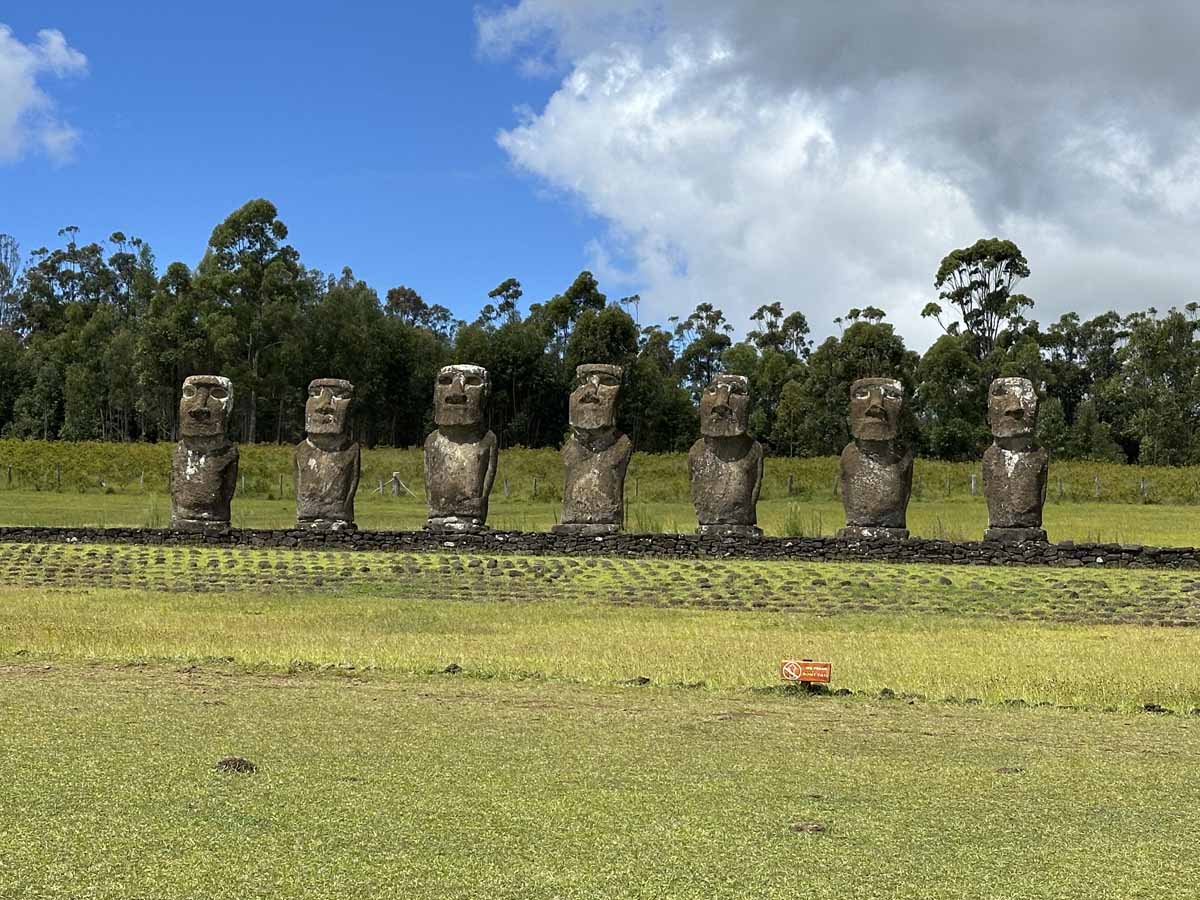
Rapa Nui oral tradition holds that these figures represent the seven scouts (the “navigators”) sent by the legendary king Hotu Matu’a to explore the island before his people migrated there. As mentioned, the moai face the ocean, watching for his arrival from their homeland known as Hiva (most likely the Marquesas Islands in French Polynesia).
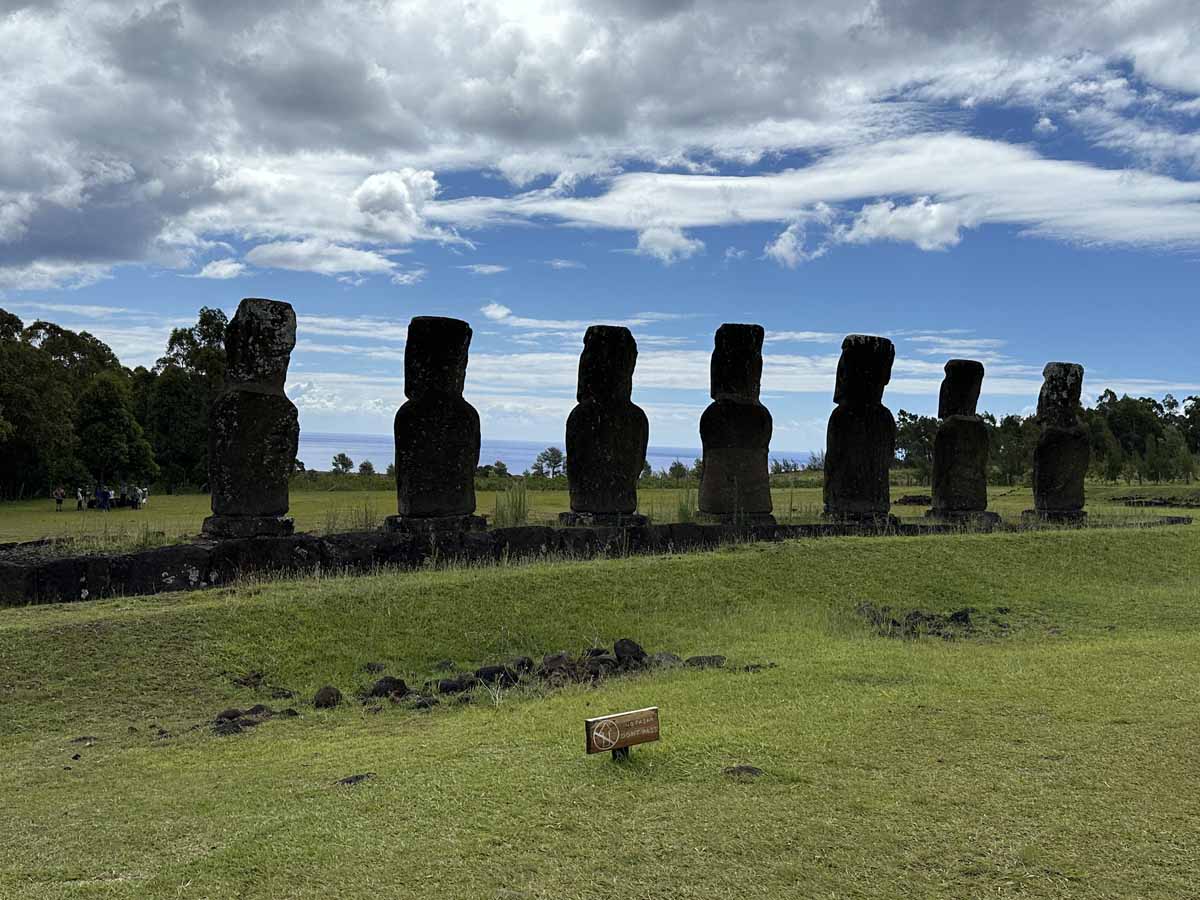
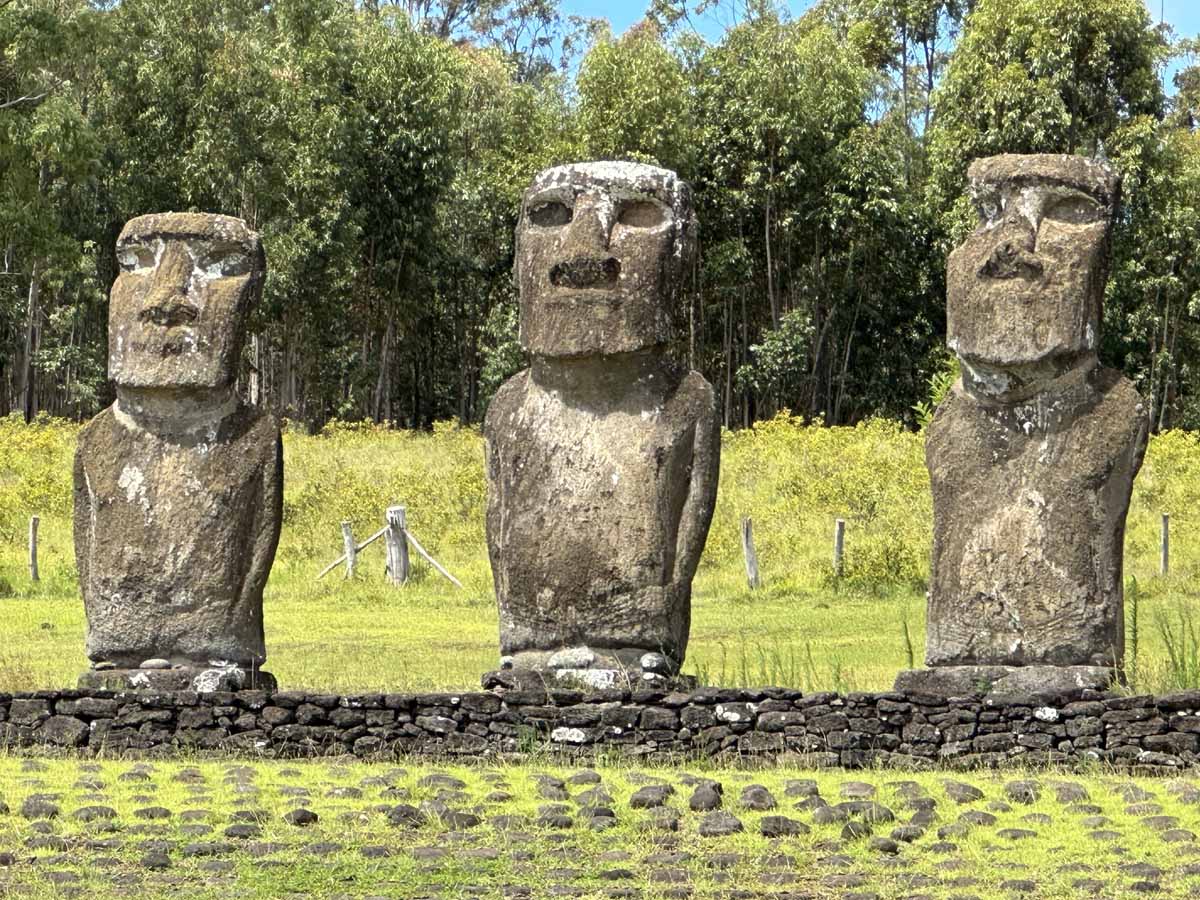
Ahu Akivi was one of the first moai sites on the island to be restored, excavated and re-erected in 1960 by American archaeologist William Mulloy and Chilean archaeologist Gonzalo Figueroa. Their work helped pioneer the methods later used to restore other sites across the island.
Quick Fact: William Mulloy (1917-1978) first came to Rapa Nui as part of Thor Heyerdahl’s 1955–56 Norwegian Archaeological Expedition. Mulloy became so captivated by the island that he dedicated the rest of his life to its study and restoration. In fact, he’s buried on the island (at Tahai) – and is deeply respected by the Rapa Nui people to this day.
2) Rano Raraku – “Factory of the Gods” Quarry
Rano Raraku is one of the most extraordinary archaeological sites anywhere on Earth. It easily wins the Rapa Nui grand prize for its drama & Wow Factor! Many of the photos we see of the island’s moai come from this amazing site.
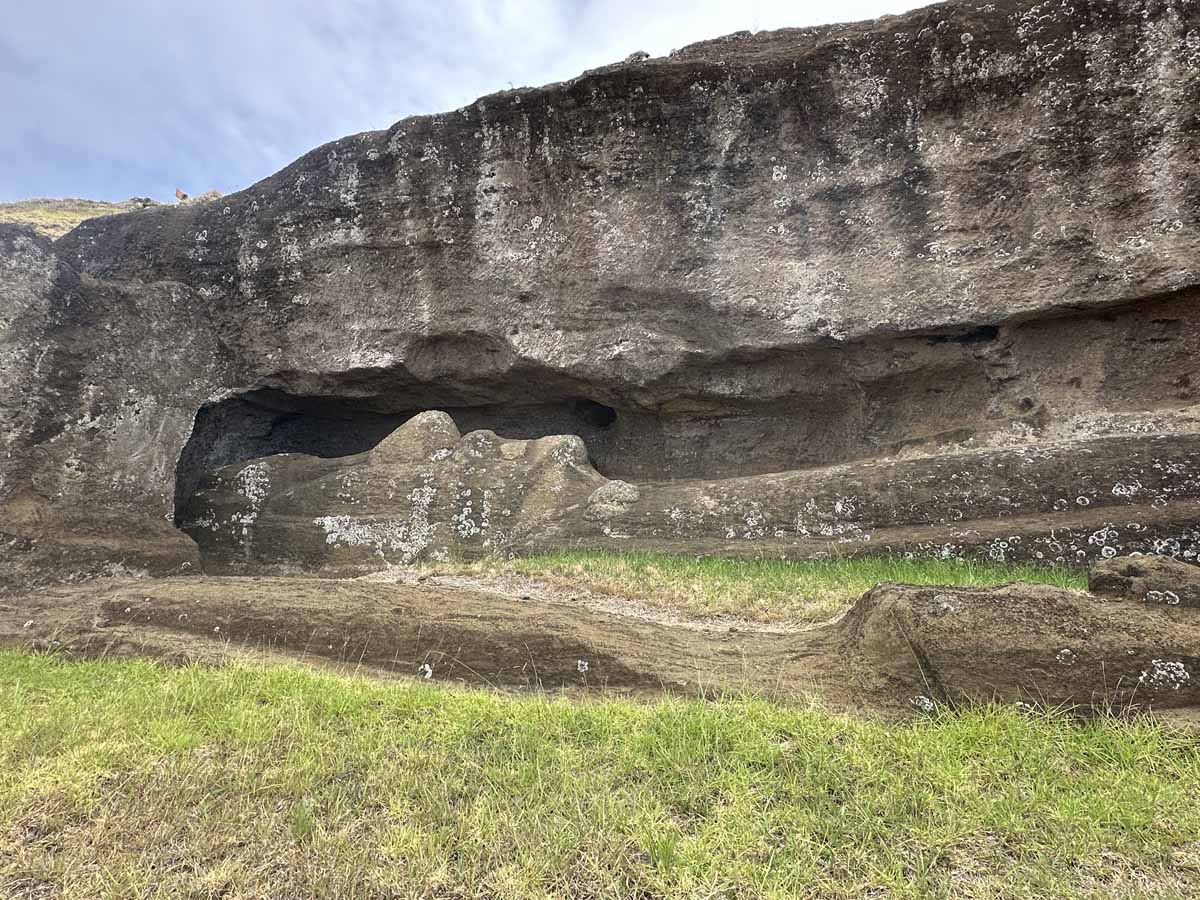
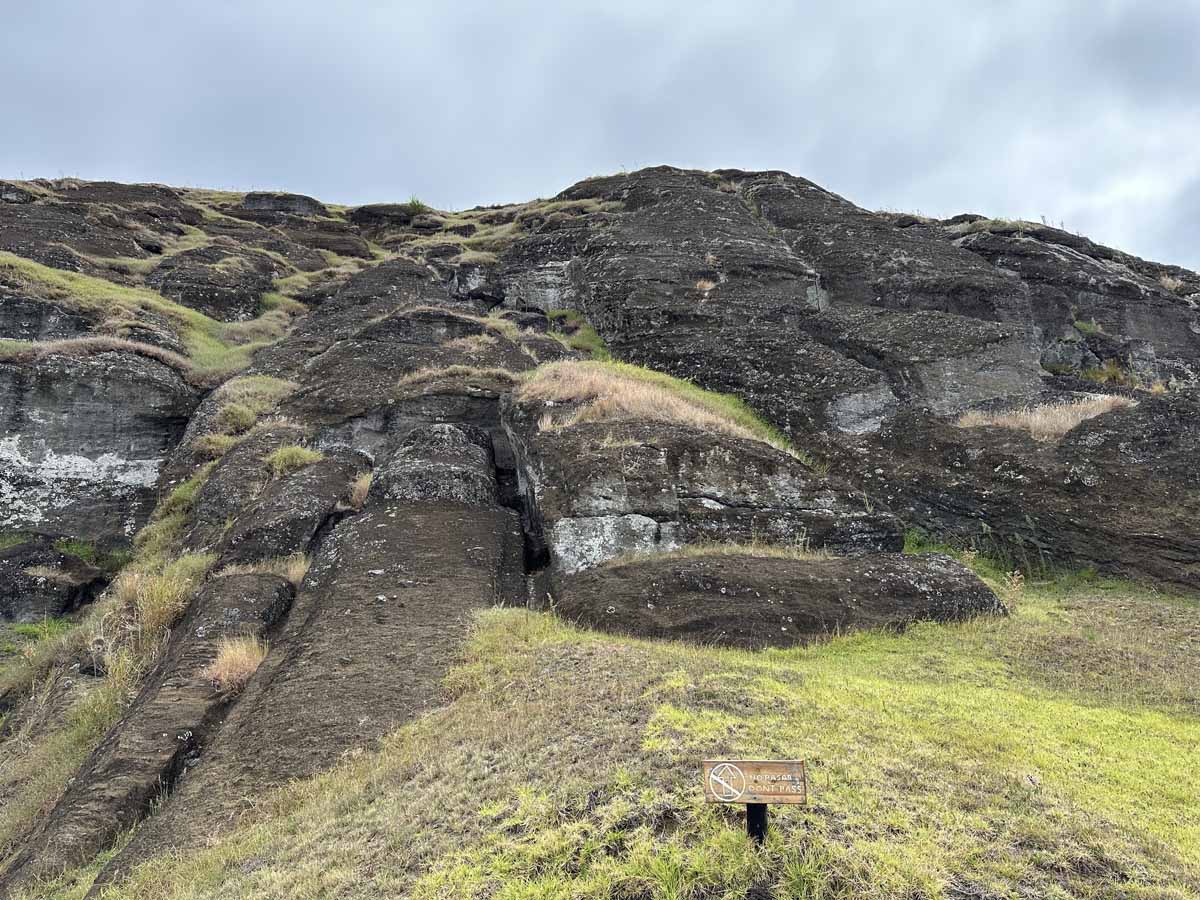
That’s because Rano Raraku served as the quarry & workshop for approximately 95% of Rapa Nui’s moai. On its slopes, you can find nearly 400 statues in various stages of completion – standing or lying, and others still in the process of being carved, not yet removed from the bedrock.
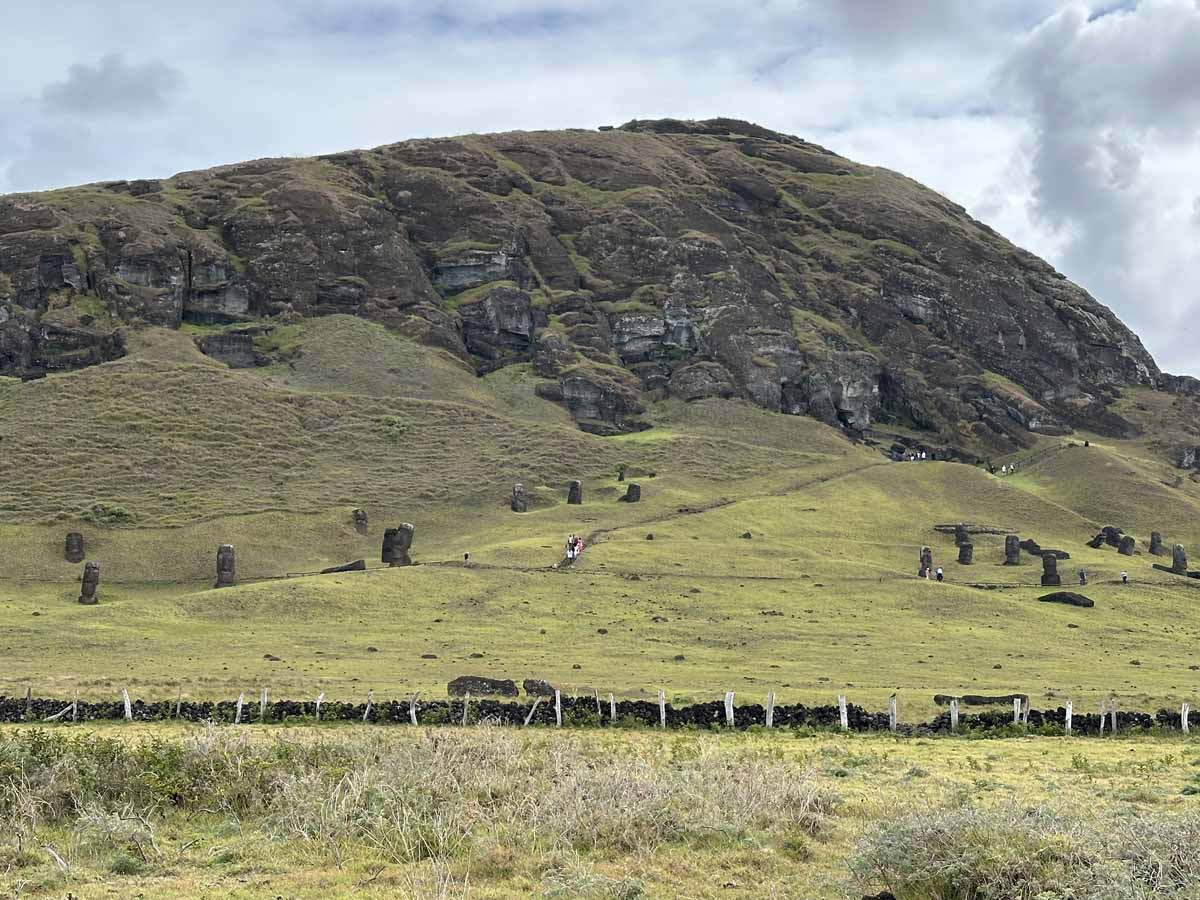
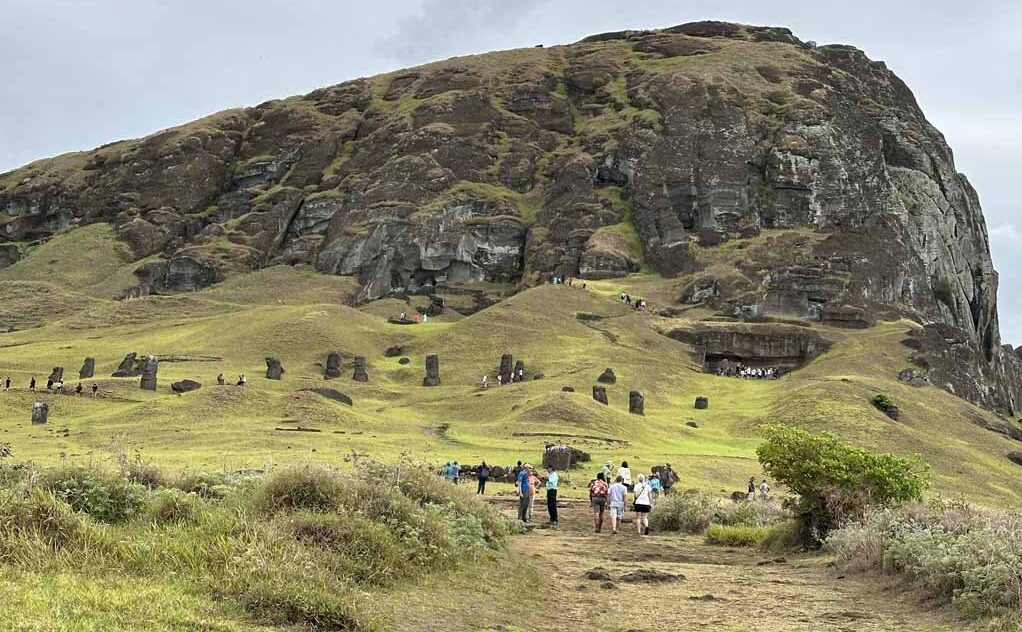
The extinct volcano of Rano Raraku was chosen as the island’s primary quarry because it consists largely of tuff – compressed volcanic ash that is easy to carve. The Rapa Nui people had no metal tools, only stone carving picks made from hard basalt.
When an important tribal member died, a statue was crafted at Rano Raraku before being transported to the burial platform in the village. A large moai could take a team of workers up to two years to carve. All details were completed at the quarry except for the eye sockets – which were done once the moai reached the platform.
As mentioned, Rano Raraku produced nearly a thousand moai before its work appears to have stopped abruptly. This is likely due to Rapa Nui’s social collapse because of the inter-clan warfare and resource depletion.
Visiting the Quarry
Today, many statues are buried halfway or more into the ground, which has led to incorrectly calling them “Easter Island Heads.” However, these moai all have bodies. They were just awaiting transport to their final destination. And exactly how these huge statues were moved remains a subject of much debate!
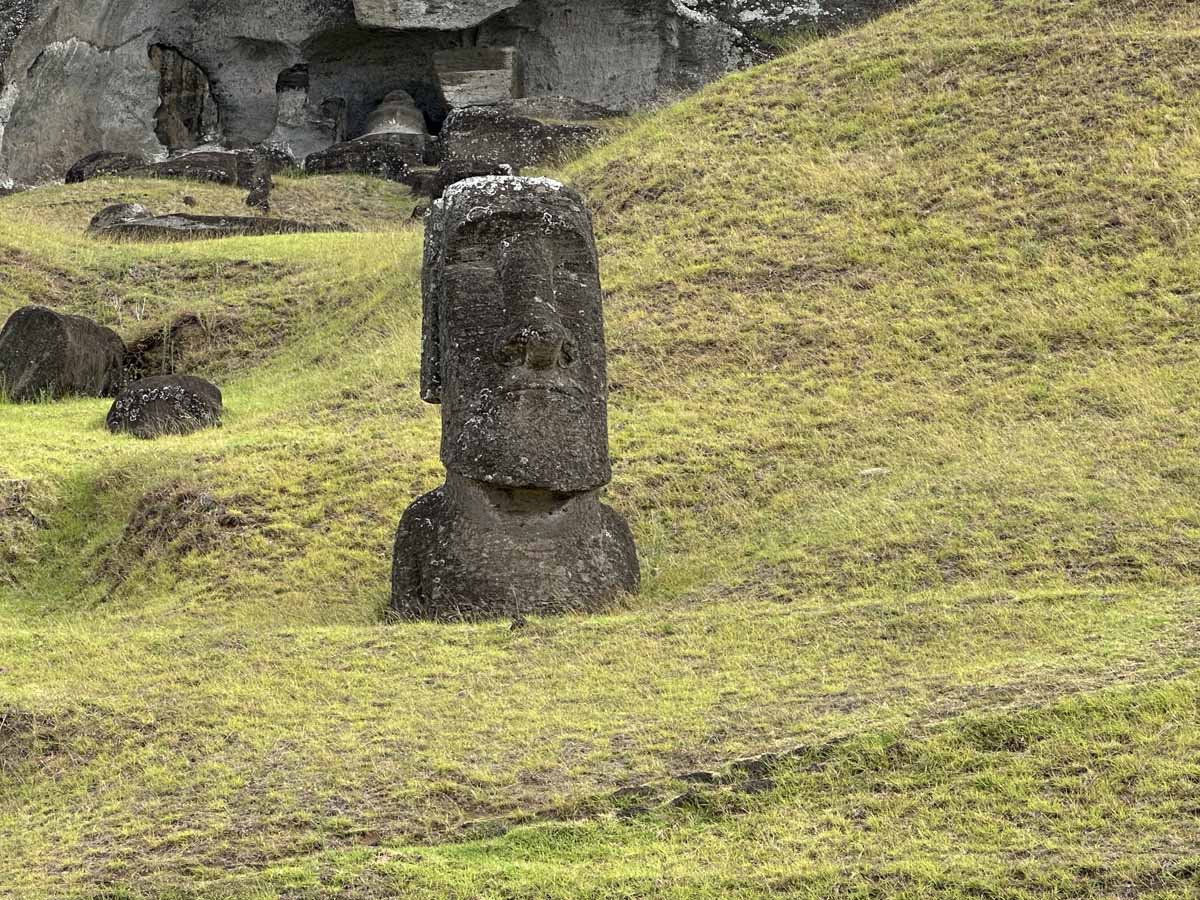
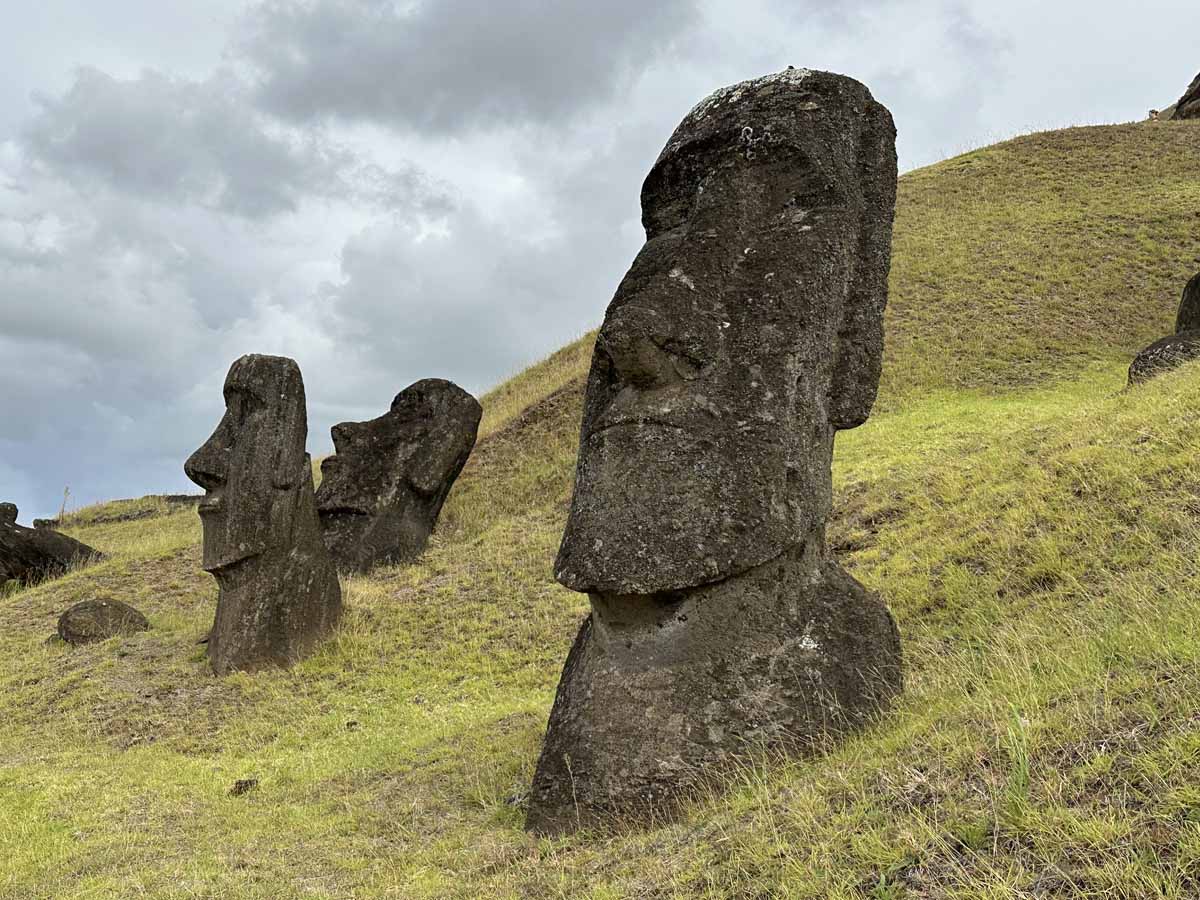
Visiting Rano Raraku has been described as “stumbling into a frozen construction site.” It’s a beautiful, peaceful, almost mystical scene. We spent 1.5 glorious hours there as Nico guided us along the various paths through the grassy hillside – allowing us amazing close-up views of the moai and their captivating & haunting faces.
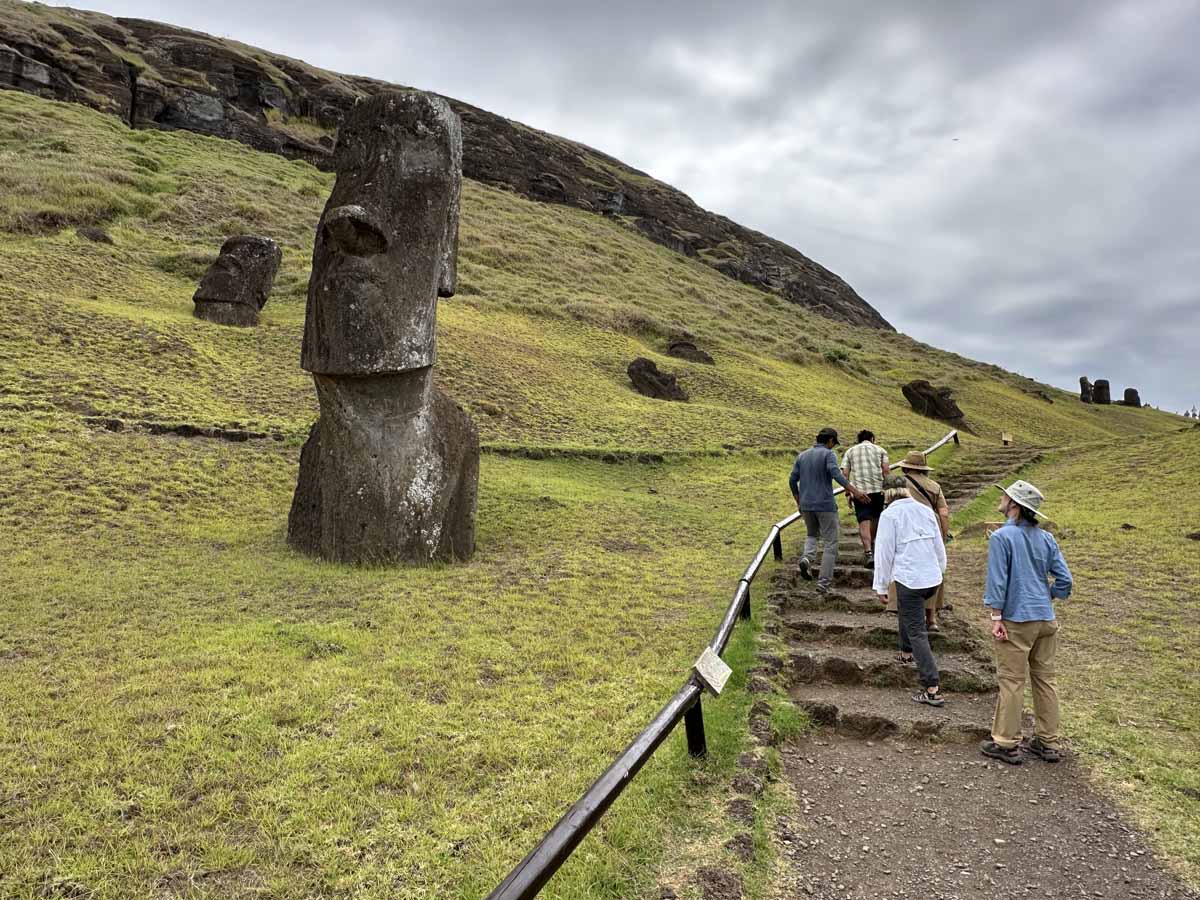
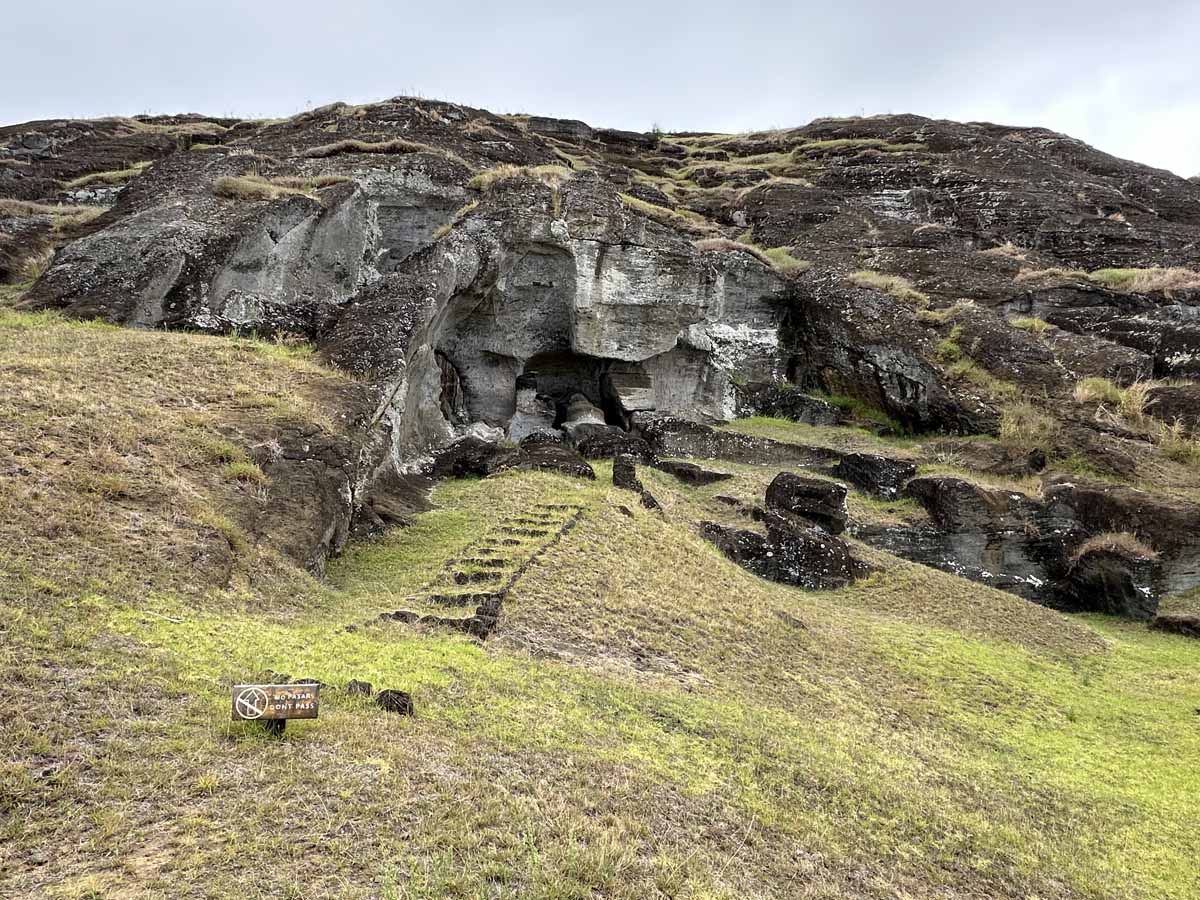
We finished our visit in the hill’s upper “rock quarry” area (above right) where the bulk of the carving took place, seeing around six partly done moai (photos below). We learned the Rapa Nui would first carve the front side and then start on the back. At a certain point, the carvers would roll (or slide) the moai part-way down the hill to a pit they had dug so they could tilt the moai upright to finish the carving.
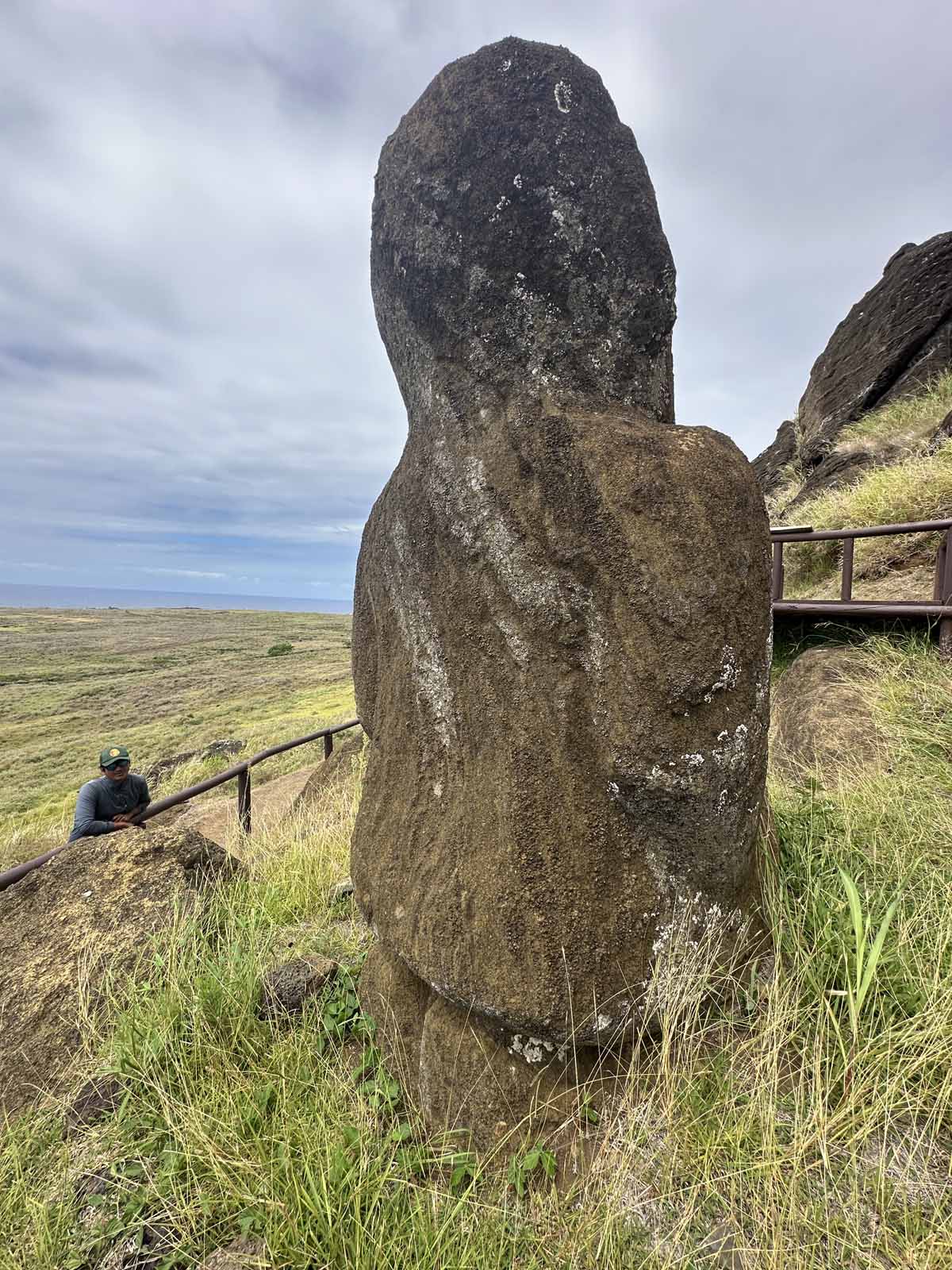
At the end of the visitor path at the top of the hill, there was a lone moai standing guard (below). This mysterious “Kneeling Moai” (named Tukuturi) is very different from all others on the island. From here, we enjoyed a panoramic view (looking east) of a beach – and the moai site of Ahu Tongariki – our next stop!
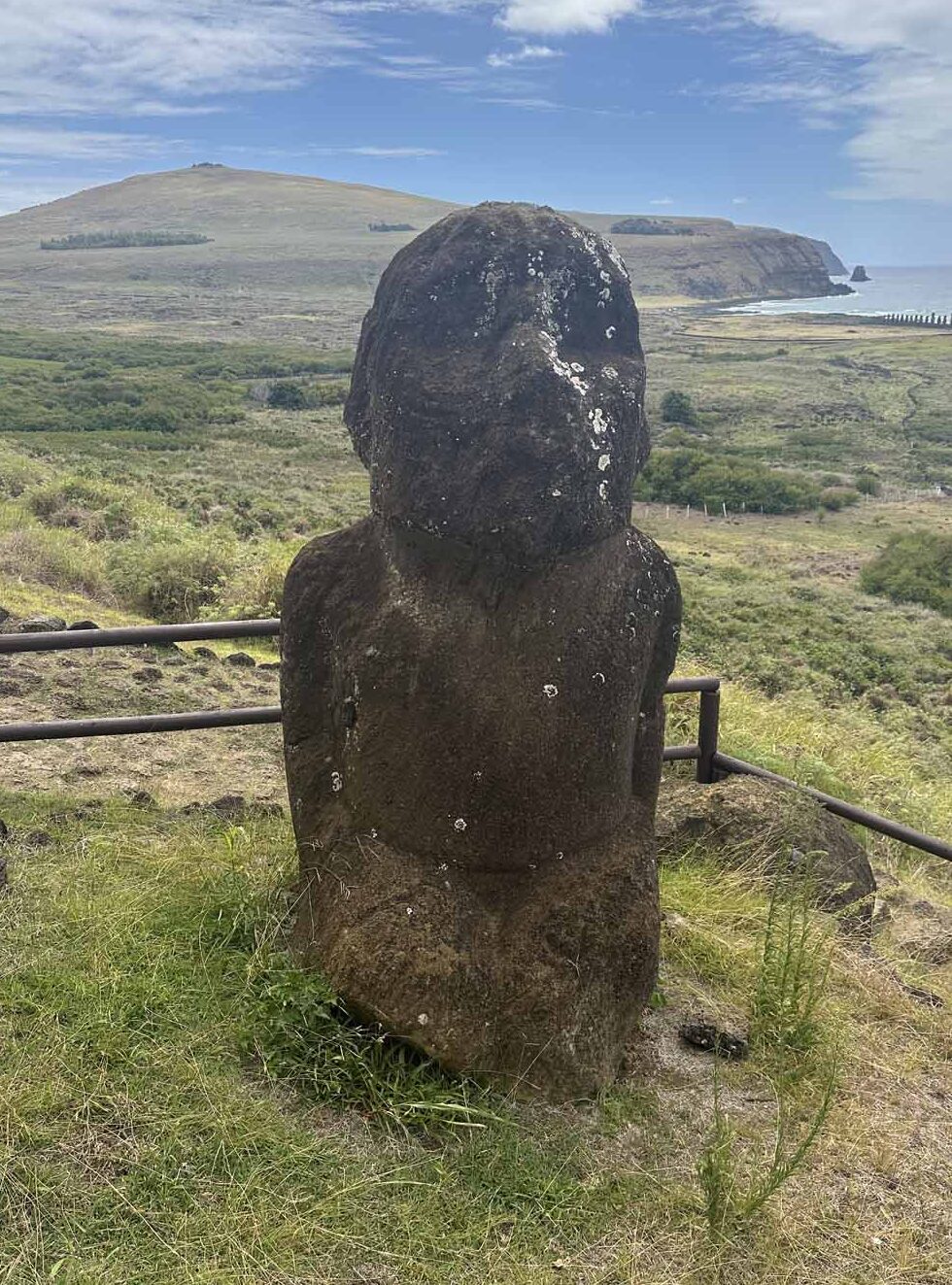
3) Ahu Tongariki – Iconic 15 Standing Moai
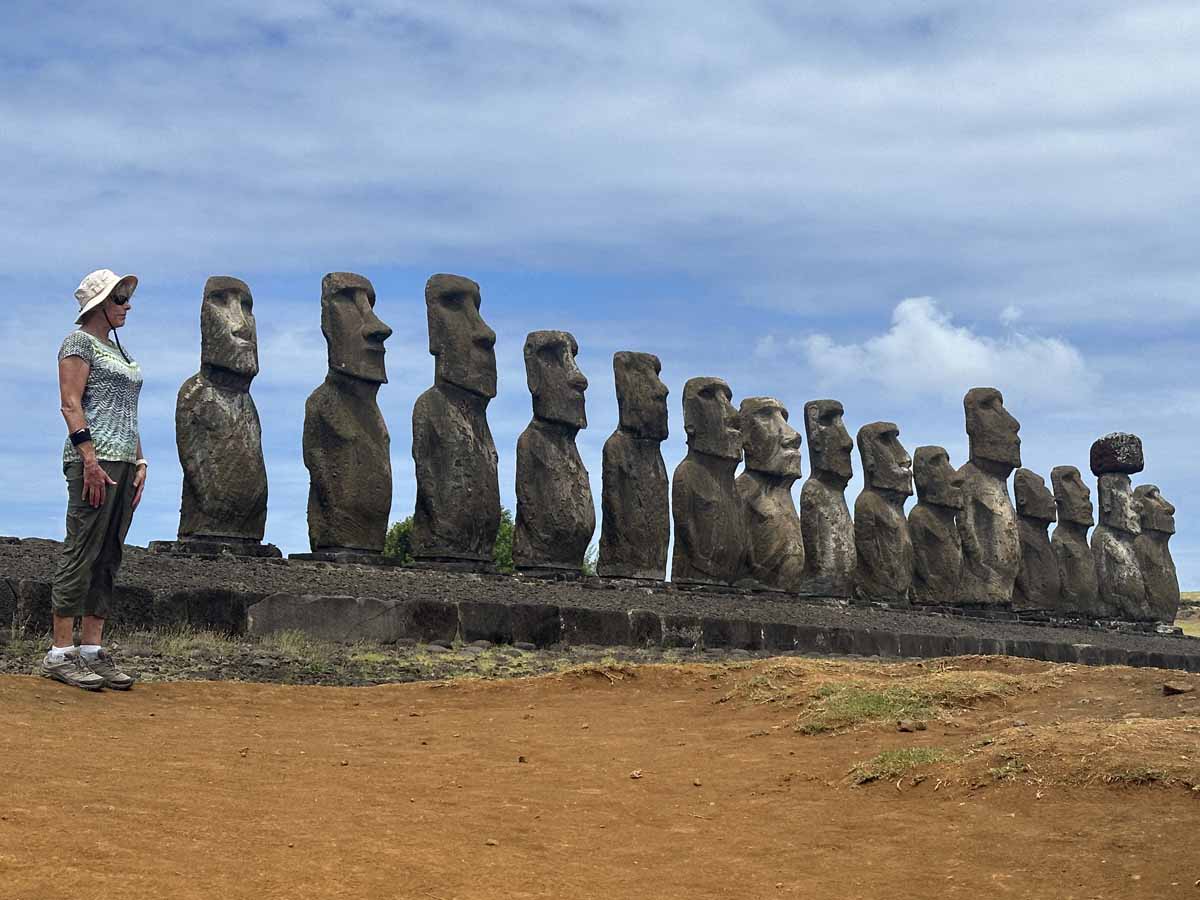
Without a doubt, Rapa Nui’s other crown jewel is Ahu Tongariki. Located on a beautiful & rugged shoreline, the ceremonial ahu platform features 15 large moai (each quite unique), standing shoulder to shoulder.
This is the largest stone ceremonial platform in all of Polynesia at approximately 200 meters (656 ft.) long. The largest moai here stands 9 meters (30 ft.) tall & weighs 86 tons! In fact, it’s the heaviest statue ever successfully transported and placed on an ahu. Luckily, its origin – the Rano Raraku quarry – was only 1 kilometer away.
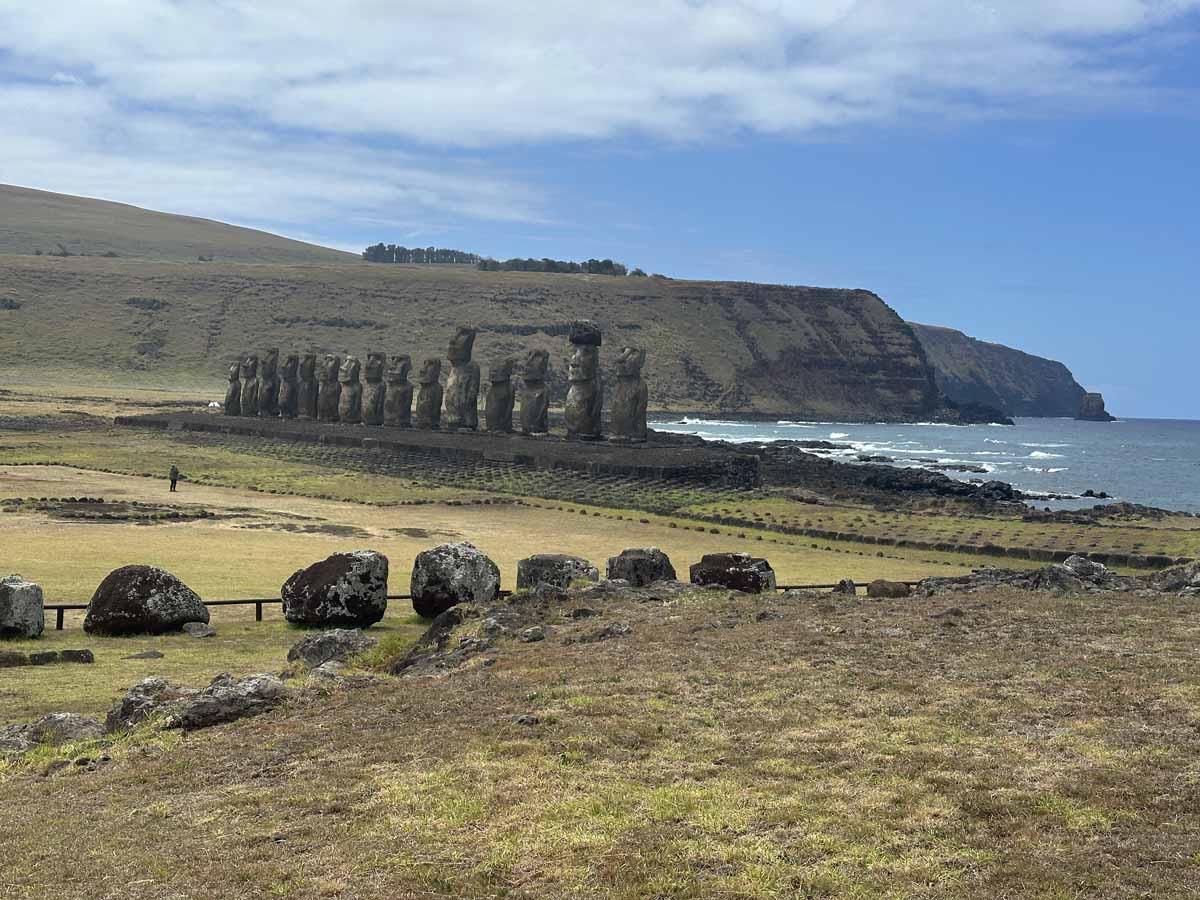
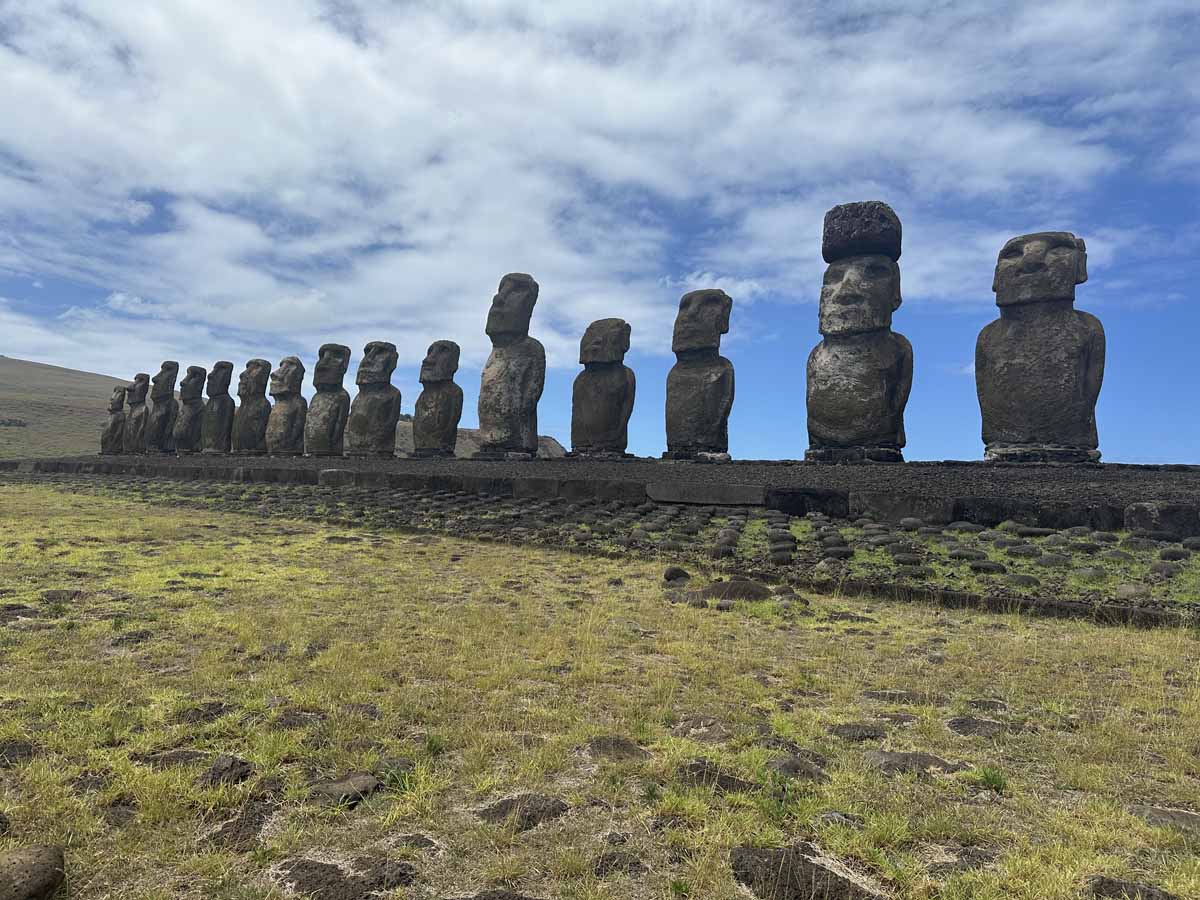
These 15 stone giants form a picturesque row on the central altar, with their backs to the sea. As with almost all moai, this was to project their mana or spiritual protection to the ancient village that existed here.
Turbulent History & Recent Redemption
The 15 moai were originally toppled in the 17th century during tribal war times. Disaster struck again in 1960 when a massive tsunami – caused by a huge earthquake in Chile (a 9.5!) – completely destroyed Tongariki. The water came 100 meters onto land, dragging the platform blocks and the already-fallen statues with it.
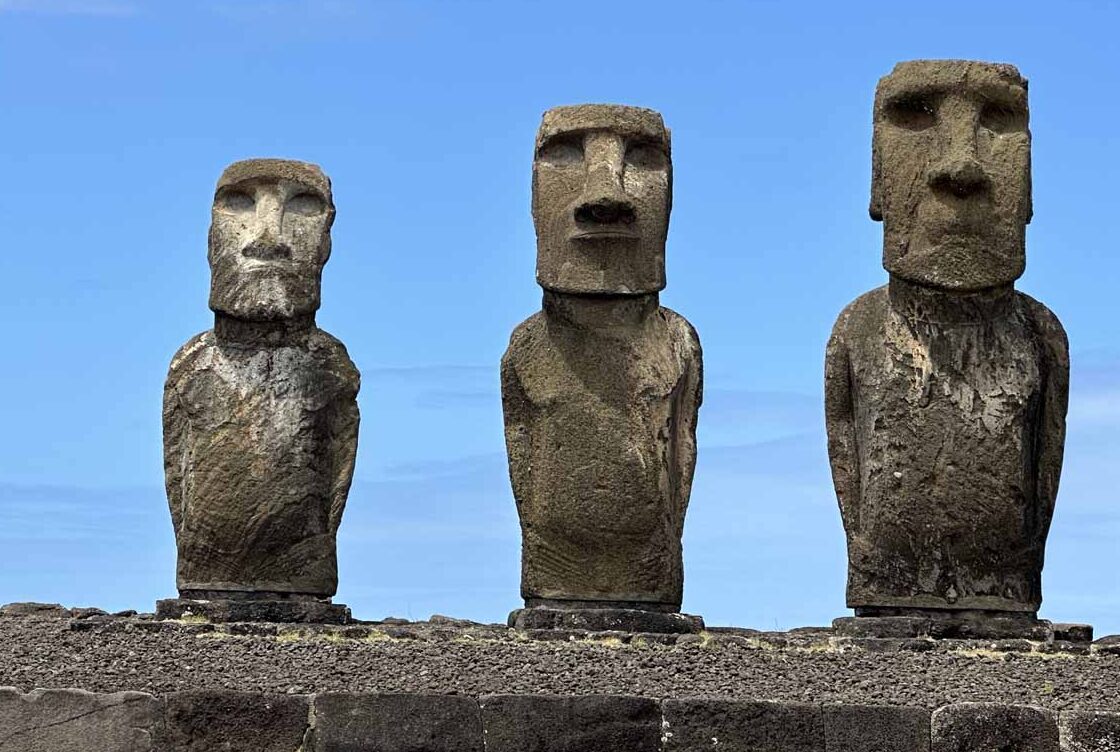
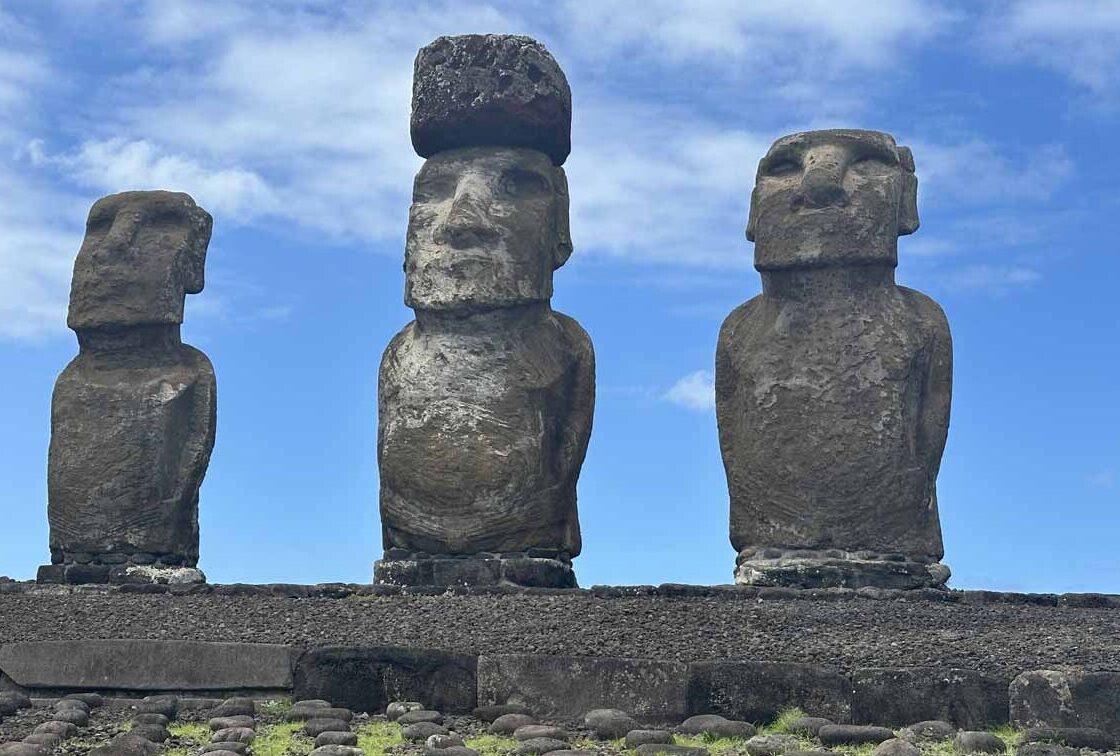
In 1992, a 4-year project began as a cooperation between Chilean & Japanese archeologists and other experts to restore this beautiful structure. In fact, Japan was the driving force and provided the bulk of the funding. It’s a remarkable story of international generosity!
Visiting the Site
We enjoyed exploring Tongariki, as we made a full circle around the ahu & moai – viewing them from both the front and back. Nico showed us the classic “optical illusion” photo tourists like to take. This involves standing off to the side of the 15 moai and ultimately looking like you’re standing in line with them as Moai #16. (my fun photo below left!)
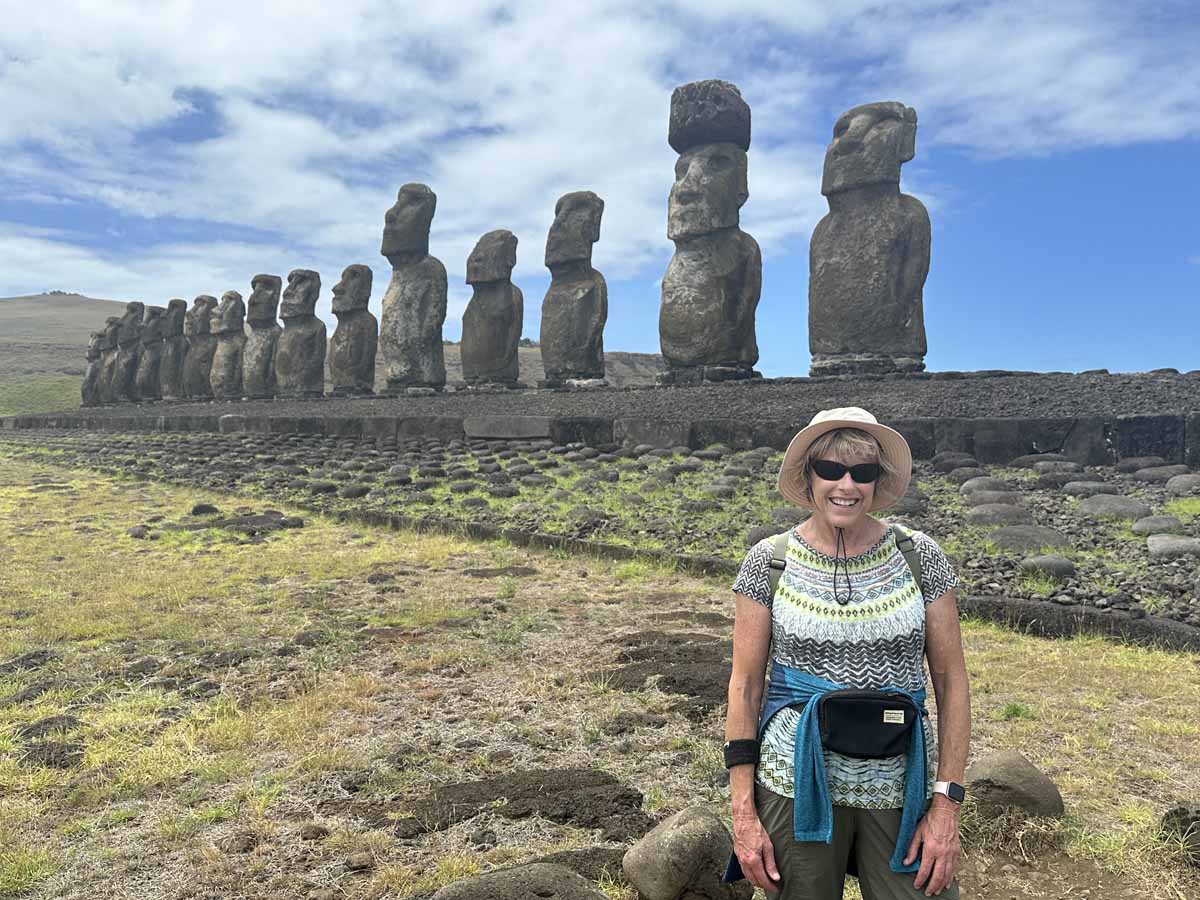
Archaeologists believe all 15 moai once had cylindrical “pukao” topknots on their heads, representing a hairstyle worn by high-status Rapa Nui males. The pukao is made from scoria, a porous red volcanic rock. However, during restoration only one topknot could be placed back in position. So, here it’s just one proud moai with its red scoria crown. (below left)
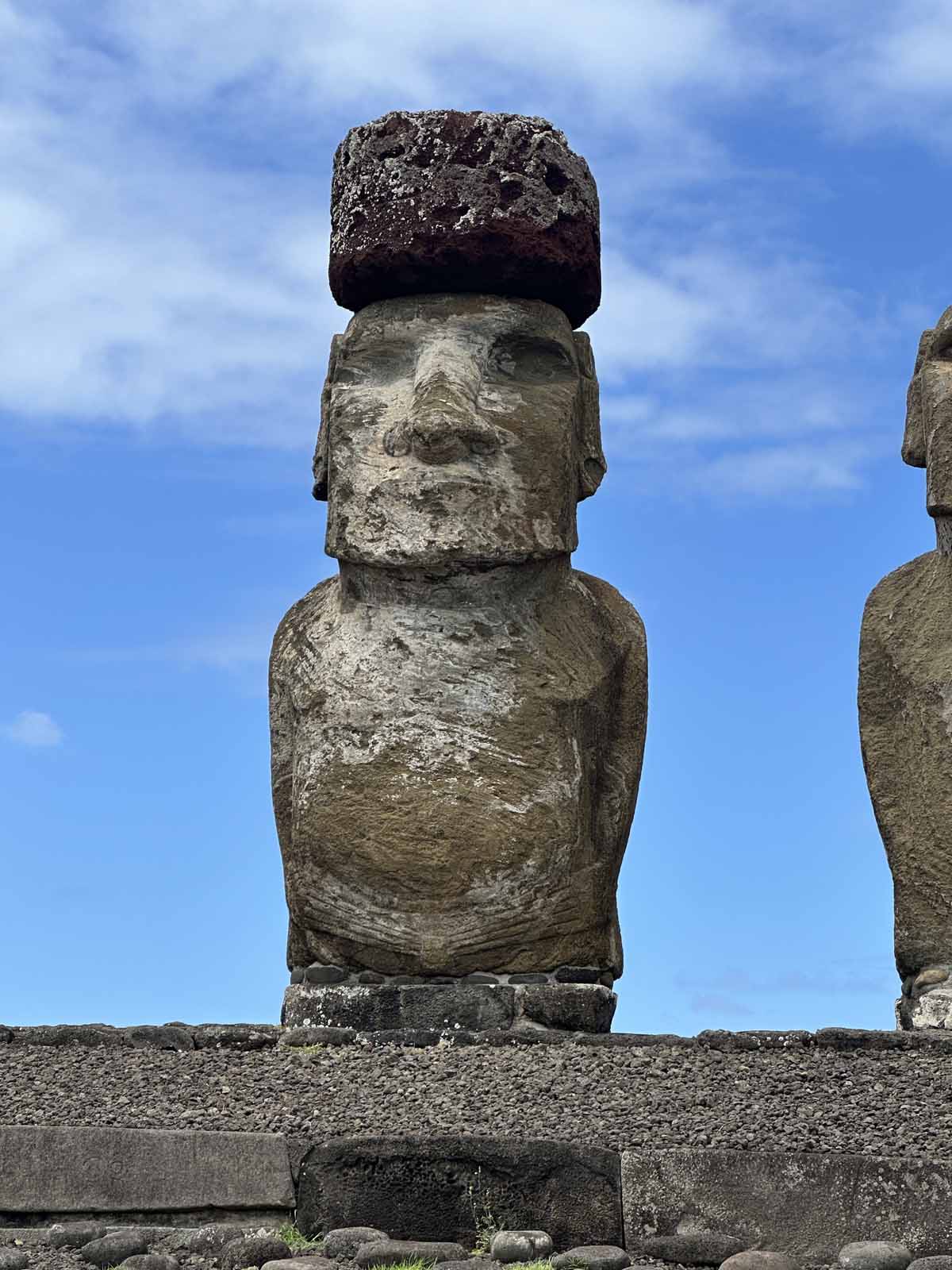
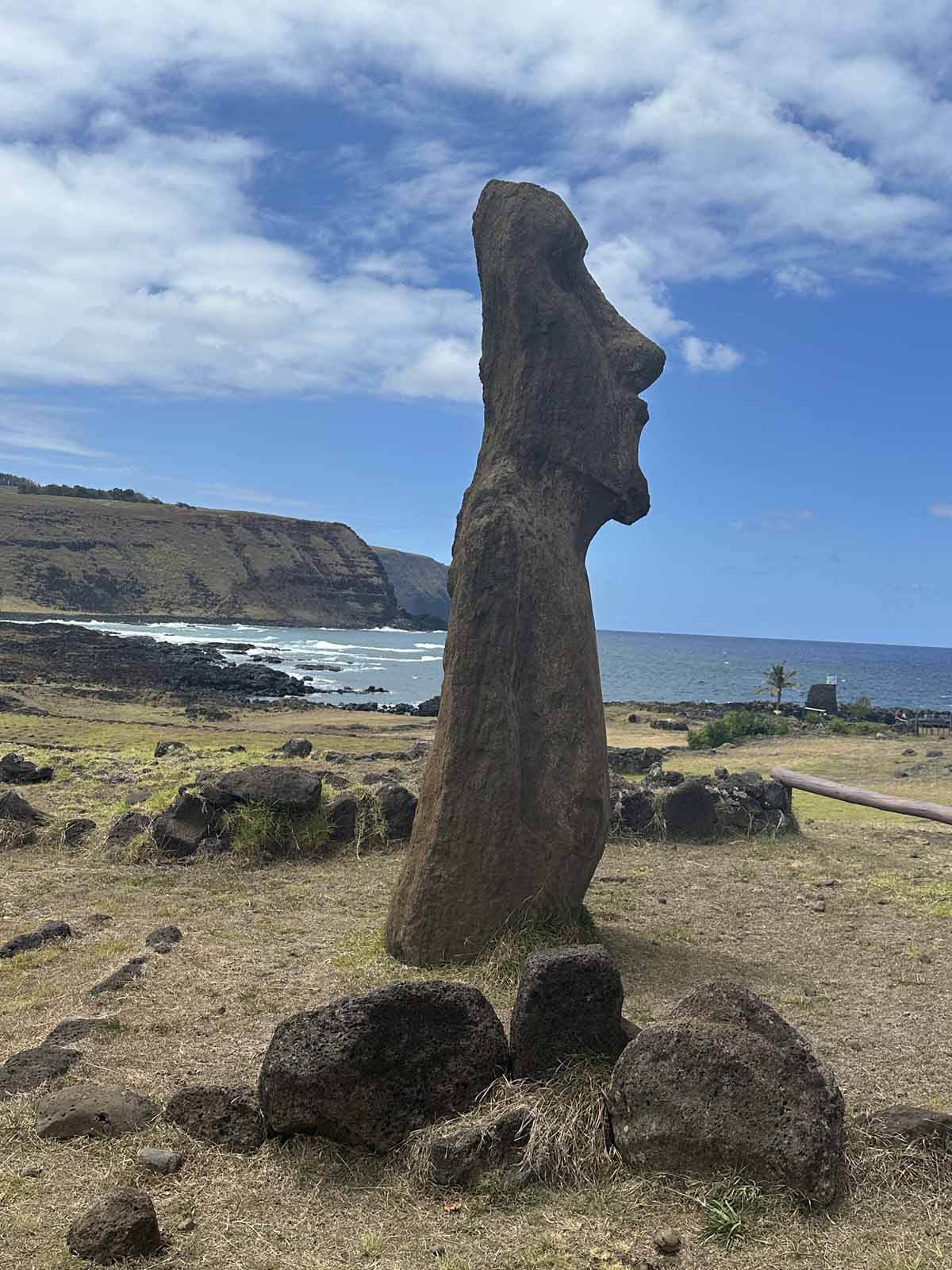
As we entered the archeological site, we were greeted by a lone moai which locals refer to as the “Traveling Moai”! (above right) That’s because it was loaned to the Japanese government in 1982 to be shown in exhibitions around the country, as a thank you for future support for the restoration project.
In addition, Ahu Tongariki is Rapa Nui’s famed location for watching the Sunrise framed by these magnificent moai. In fact, we returned here on our final morning to enjoy the magical sunrise experience – covered later in the blog post.
4) Hanga Te’e Vaihu – “Replica Village”
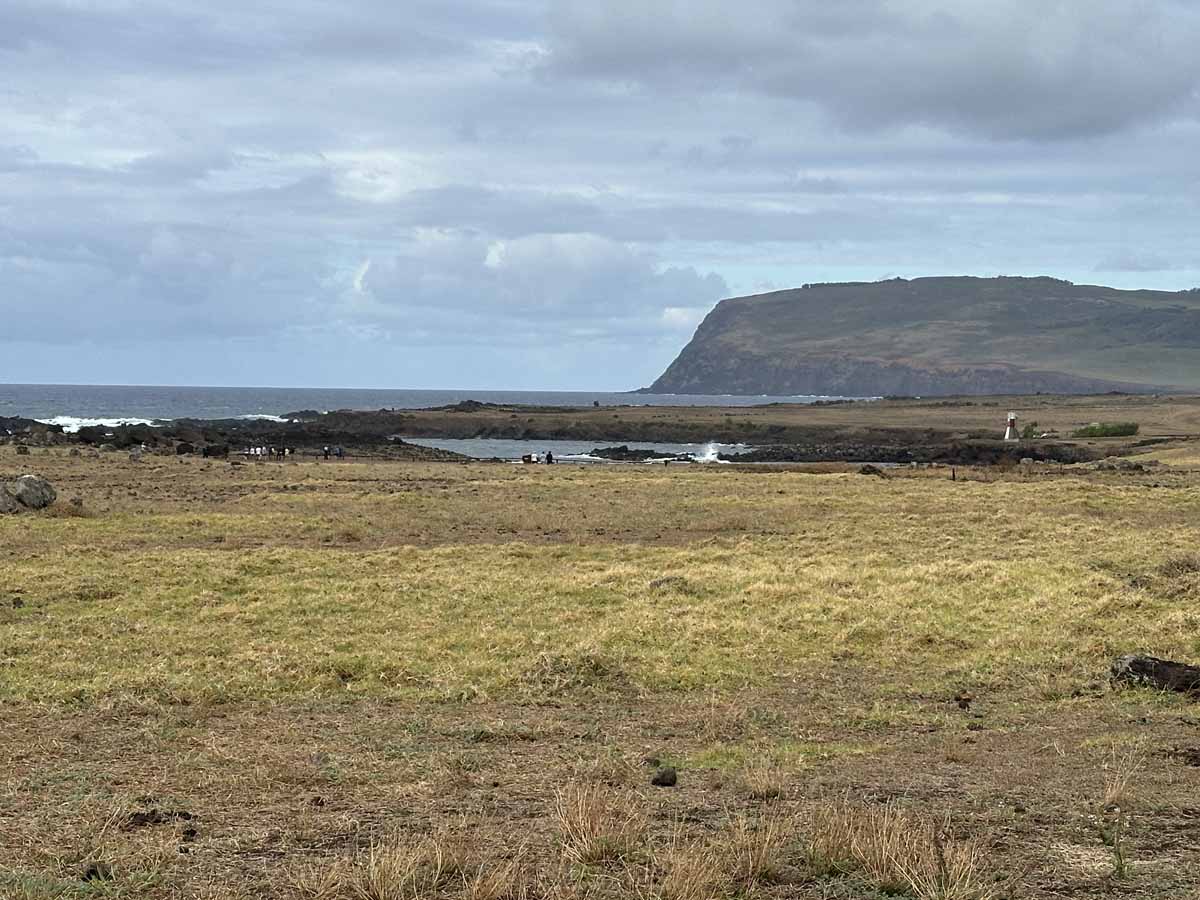
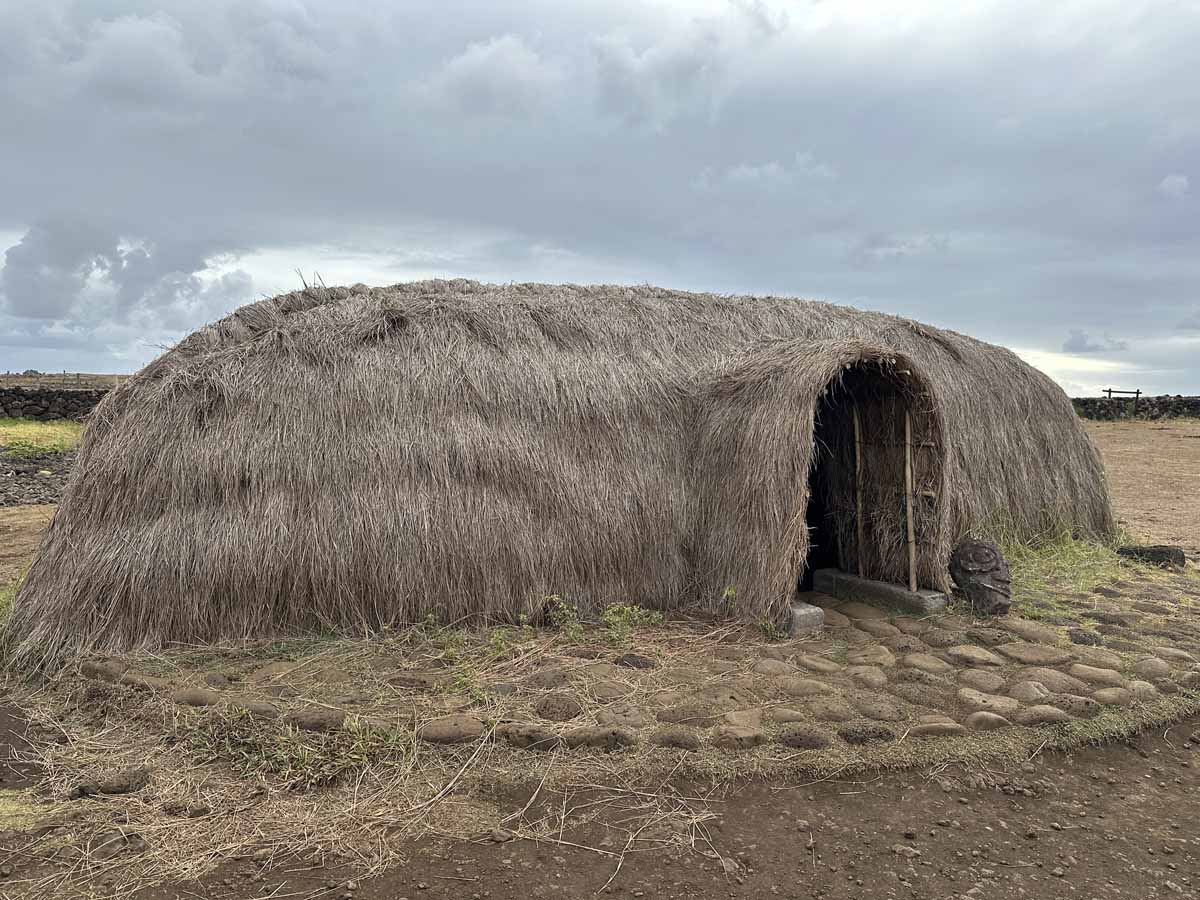
Another interesting visit was to Hanga Te’e Vaihu, on the island’s southern coast. This ancient village was reconstructed by archaeologists based on the original remains. It offered us a glimpse into how the Rapa Nui people lived many centuries ago.
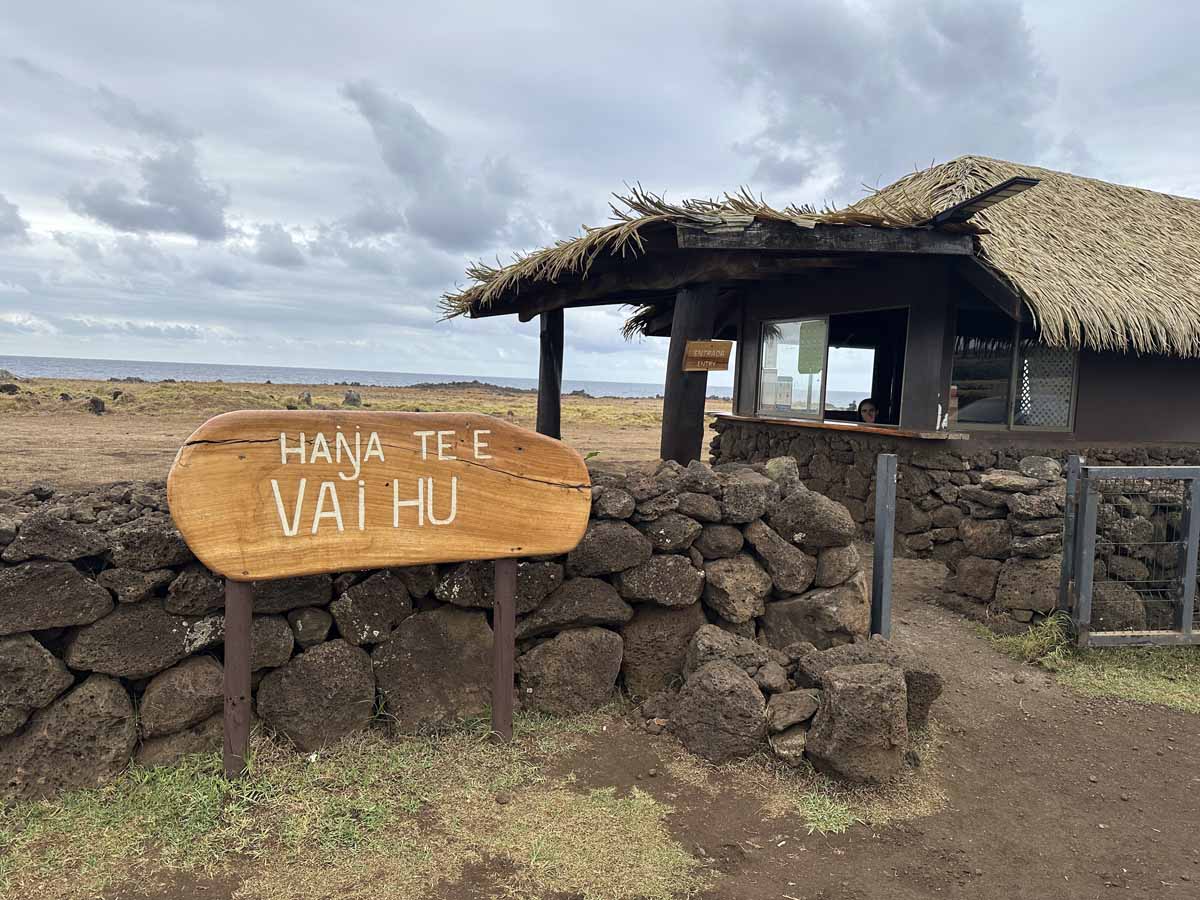
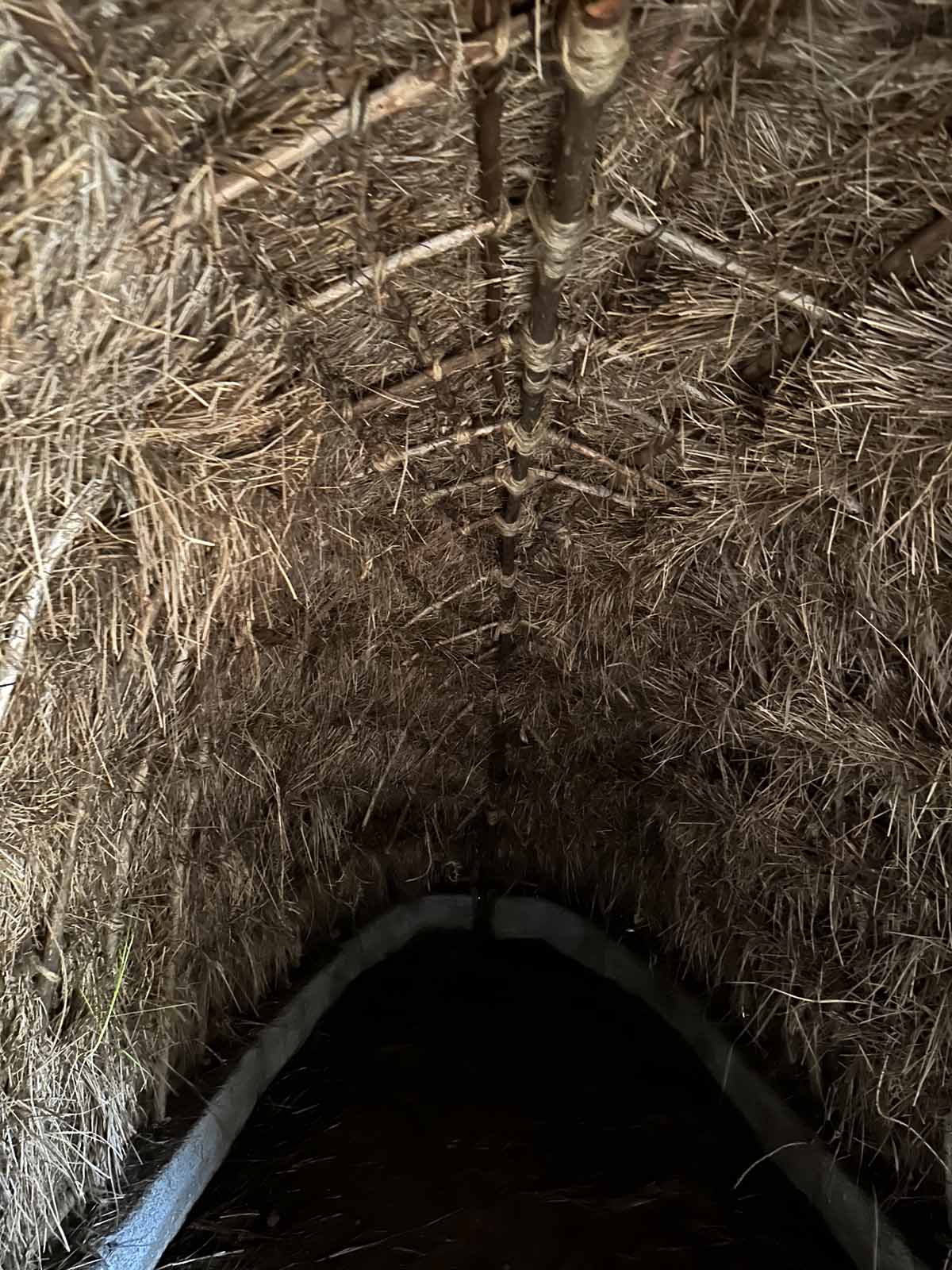
This village is a collection of restored traditional boat-shaped homes with a stone base & thatched roofs reaching the ground. We entered one of the “boat houses” to get a look inside (below, right). Nico told us the Rapa Nui people only used their homes to sleep, living outside the rest of the time.
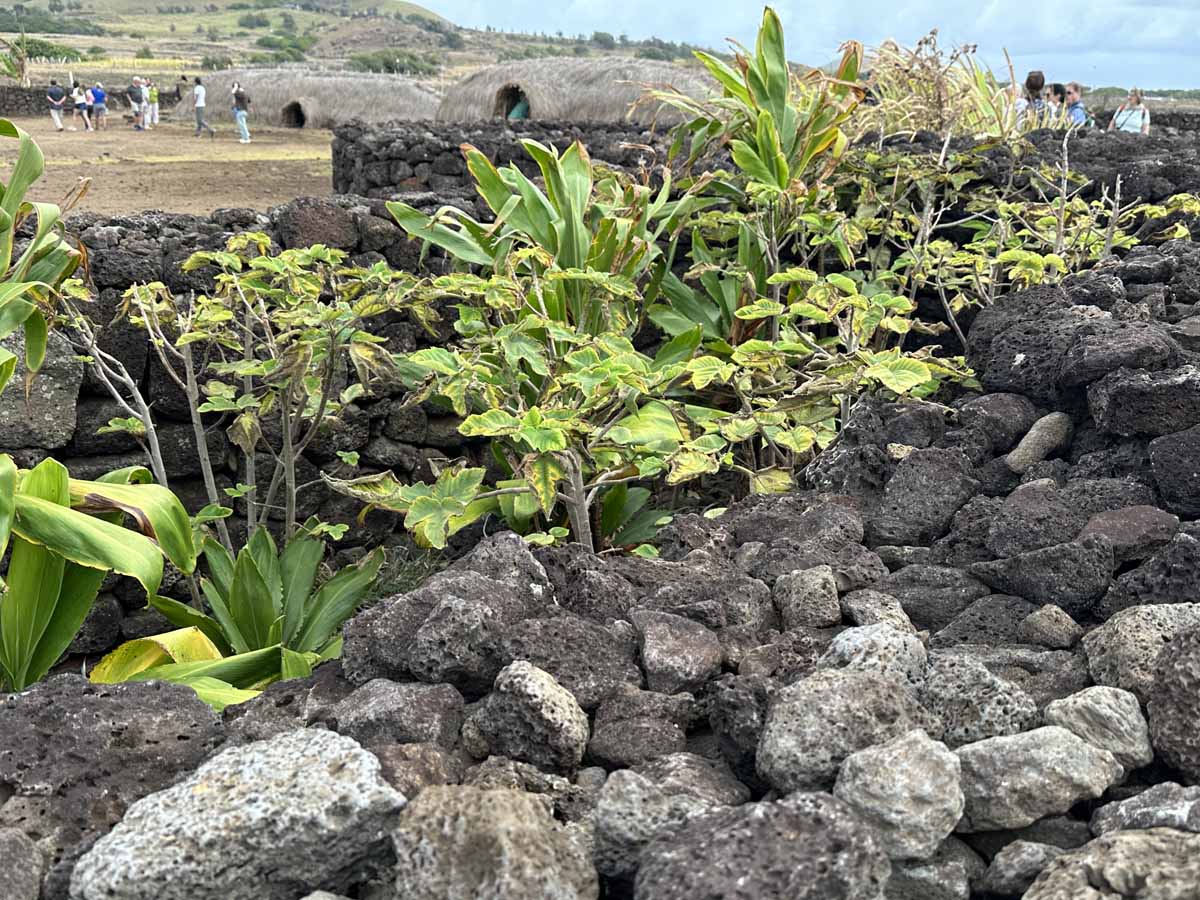
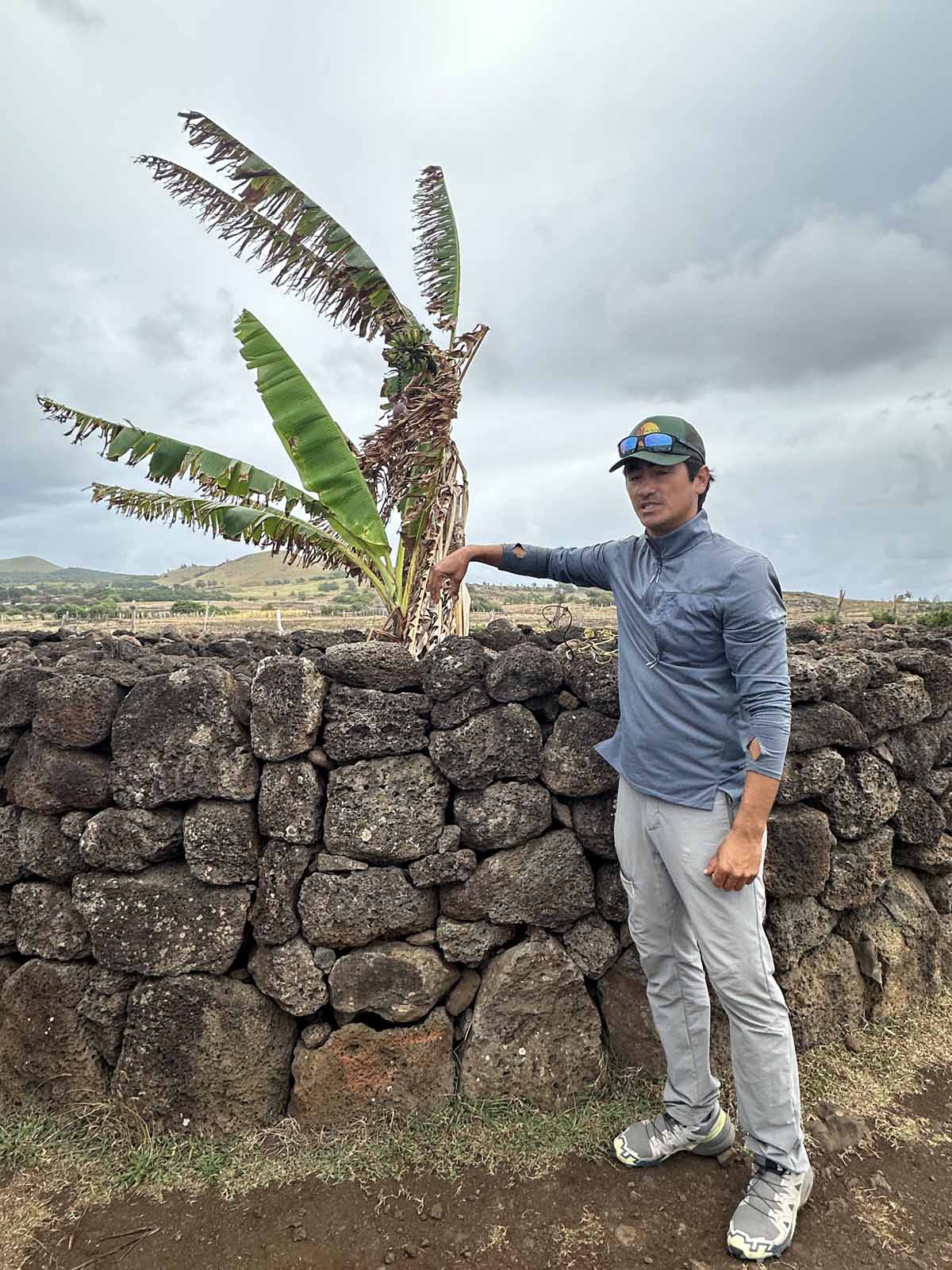
Turns out, wind is a defining feature of the island, with consistent strong winds throughout the year. As a result, the Rapa Nui built lava stone gardens (above & below, left), often quite high, in which to grow and protect their plants (including bananas & sweet potatoes) from the strong winds.
We also saw the village’s large rectangular stone chicken coops and an outside kitchen with a rock “oven” where they would cook in layers over a fire. Plus, there was one stone tower that marked the location of a good fishing area, since it was visible from the boats just offshore.
5) Ahu Akahanga – Burial village of the King / Still Toppled Moai
On the coast, just a short drive from Hanga Te’e Vaihu is Ahu Akahanga, an important ancient village. It is believed (but not proven!) to be the burial place of Hotu Matu’a, the legendary first settler & king of Rapa Nui.
Unlike most major sites on Rapa Nui, Akahanga has never been restored, so it remains untouched. It’s one of the few places where you can see the ruins of toppled moai – as the result of the tribal wars. (below, right)
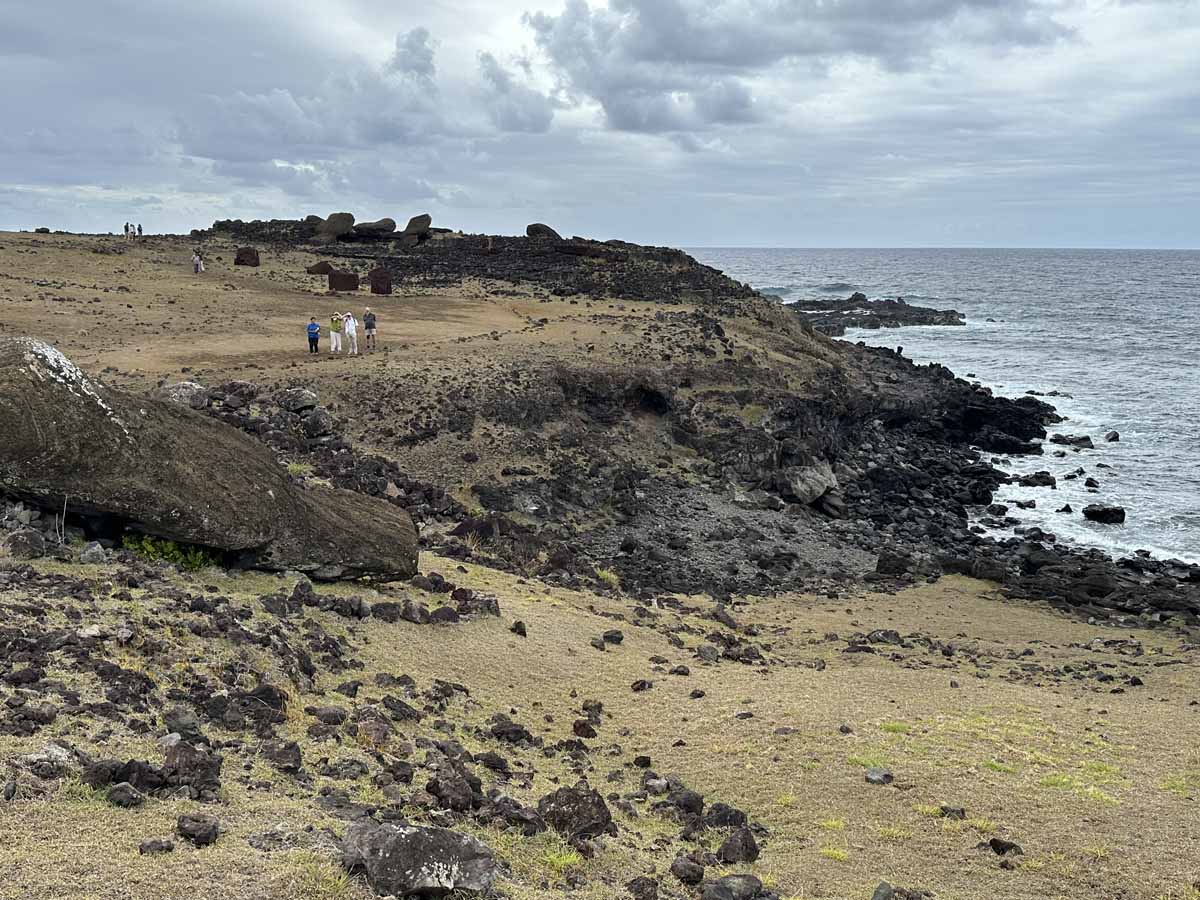
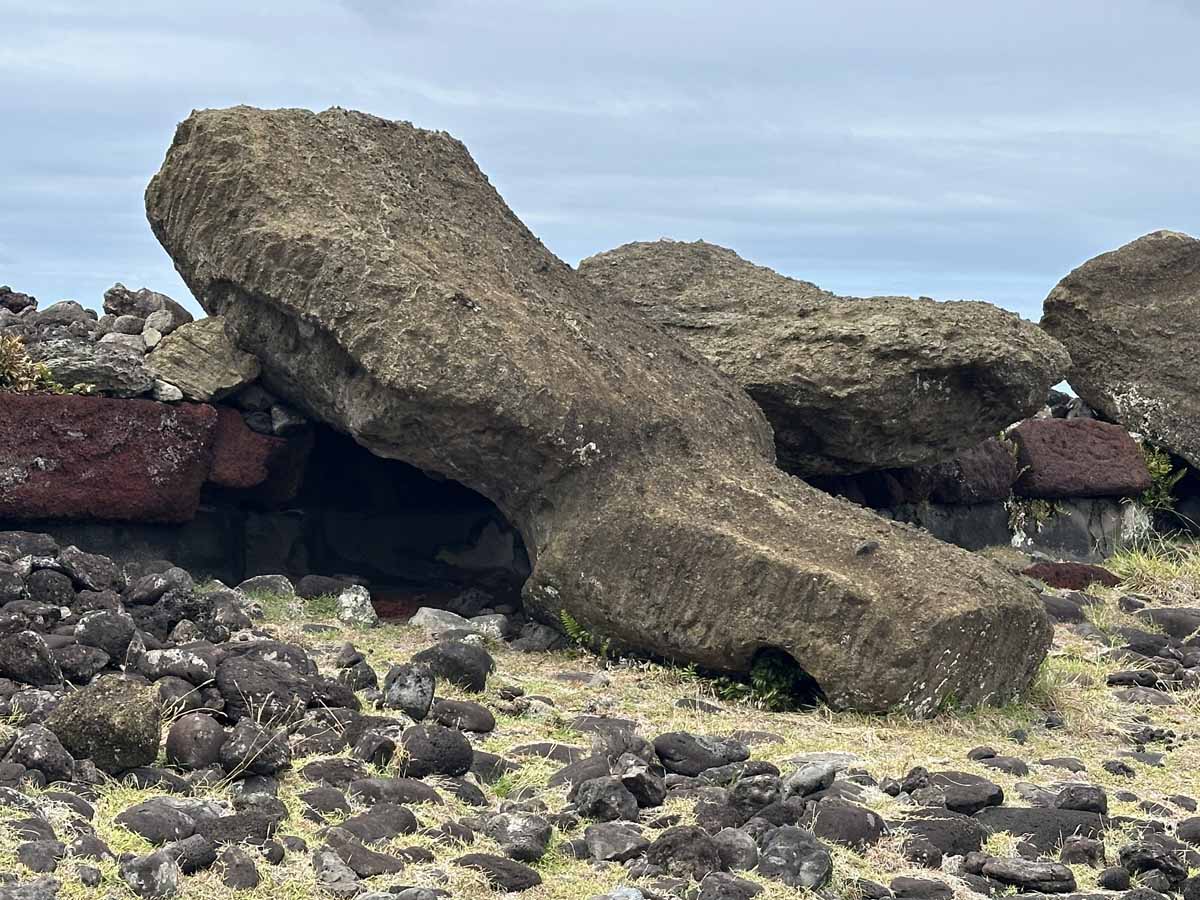
Ahu Akahanga has the remains of at least four platforms and many fallen moai. This suggests that it was once a large and important settlement, befitting a site associated with the island’s founding king.
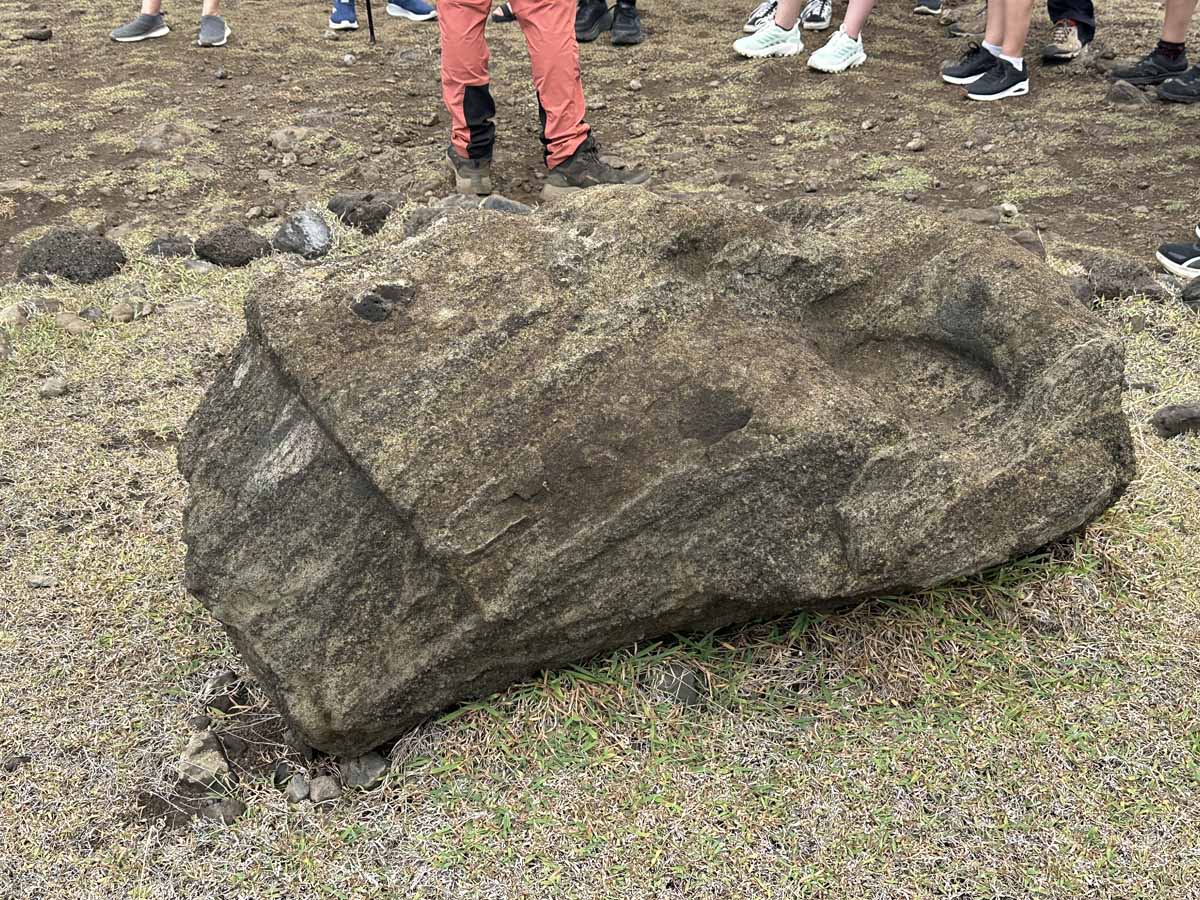
Ahu Akahanga’s main platform held 13 moai, which ranged between 5 and 7 meters tall. They were knocked down both face-up and face-down. In most cases, toppled moai lie face down with their features hidden.
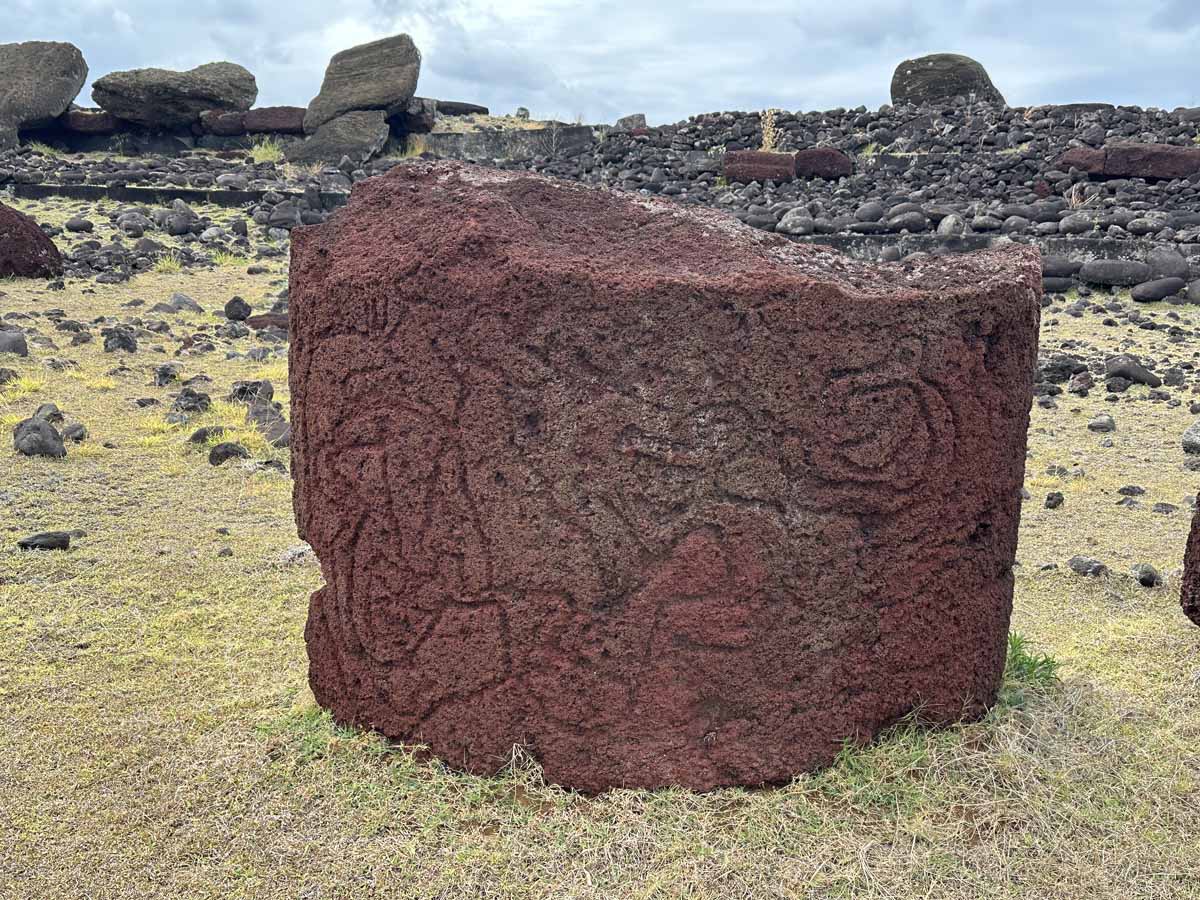
We got a good view (above left) of the large size of one of the fallen red “pukao” topknots. As mentioned, these pukao were made from a porous red volcanic rock called scoria. In fact, all pukaos were sourced & carved at a different quarry (Puna Pau) – not Rano Raraku.
VISITING HANGA ROA – RAPA NUI’S CHARMING TOWN
Touring Rapa Nui’s fascinating cultural sites with their evocative moai is the primary activity for most visitors. However, make sure to allow time to enjoy charming Hanga Roa, the island’s main – and ONLY – town.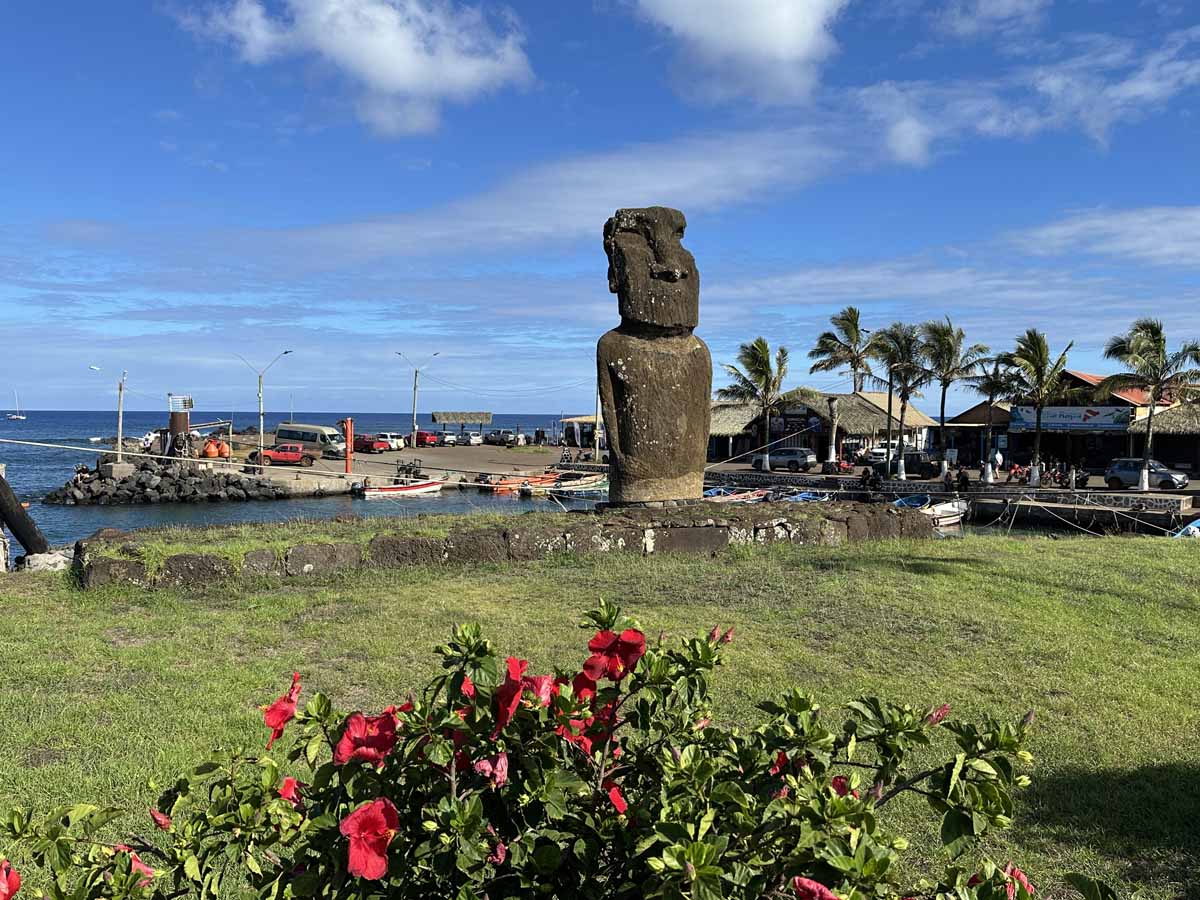
The island’s population (most everyone lives in town!) is somewhere between 9 to 10,000 people. Interestingly, less than half are of Rapa Nui origin. The rest come from the Chilean continent, plus a small group from other countries. As you can imagine, most locals are involved in tourism.
Hanga Roa is located on the island’s western coast, just north of the airport. I found this small seaside village/town to be peaceful & cute. You can walk its entire length comfortably in 20–30 minutes. Plus, it’s got everything a visitor to the island would need – like cafes, restaurants, shops, a tourist office, and lodging.
Our Walk Into Town
One morning, our group took a delightful walk from our hotel (located just south of the airport) into town so we could explore Hanga Roa for a few enjoyable hours.
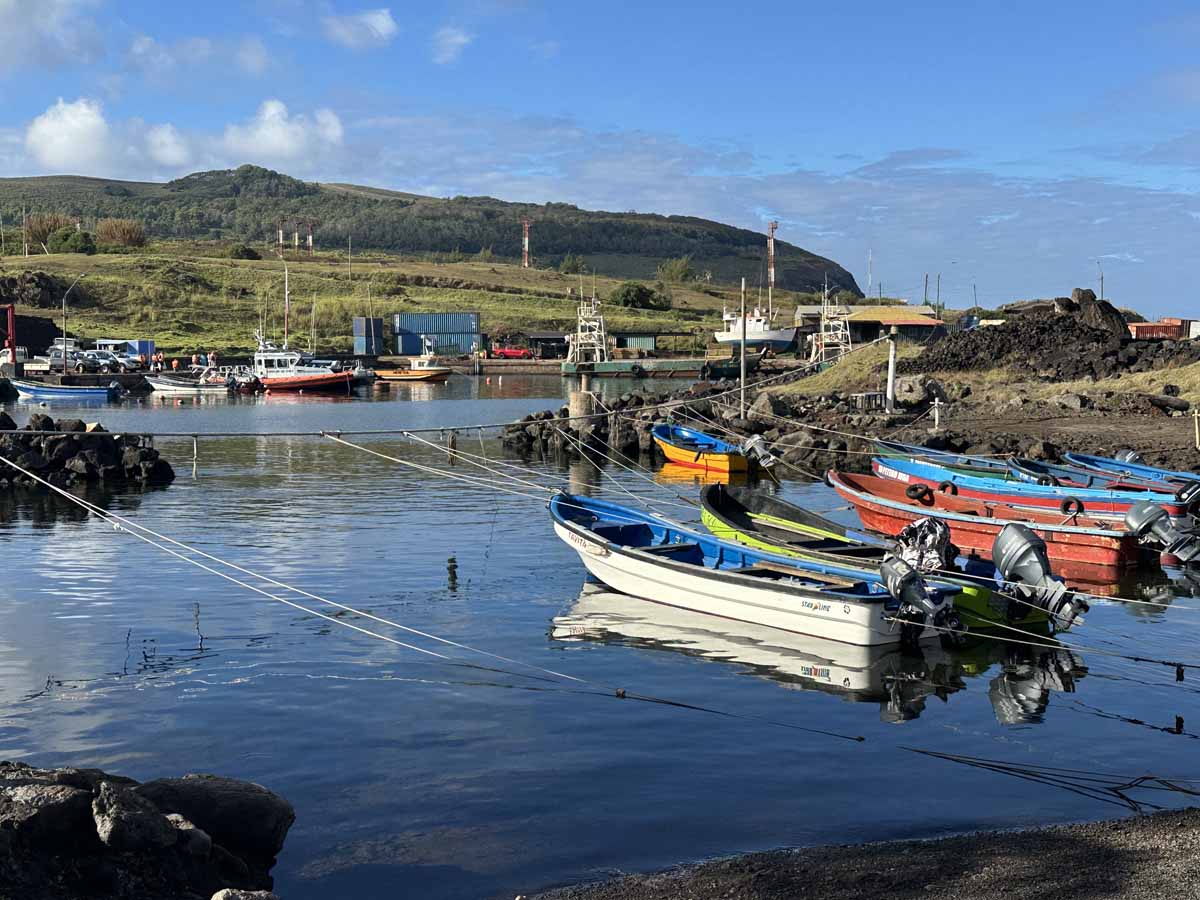
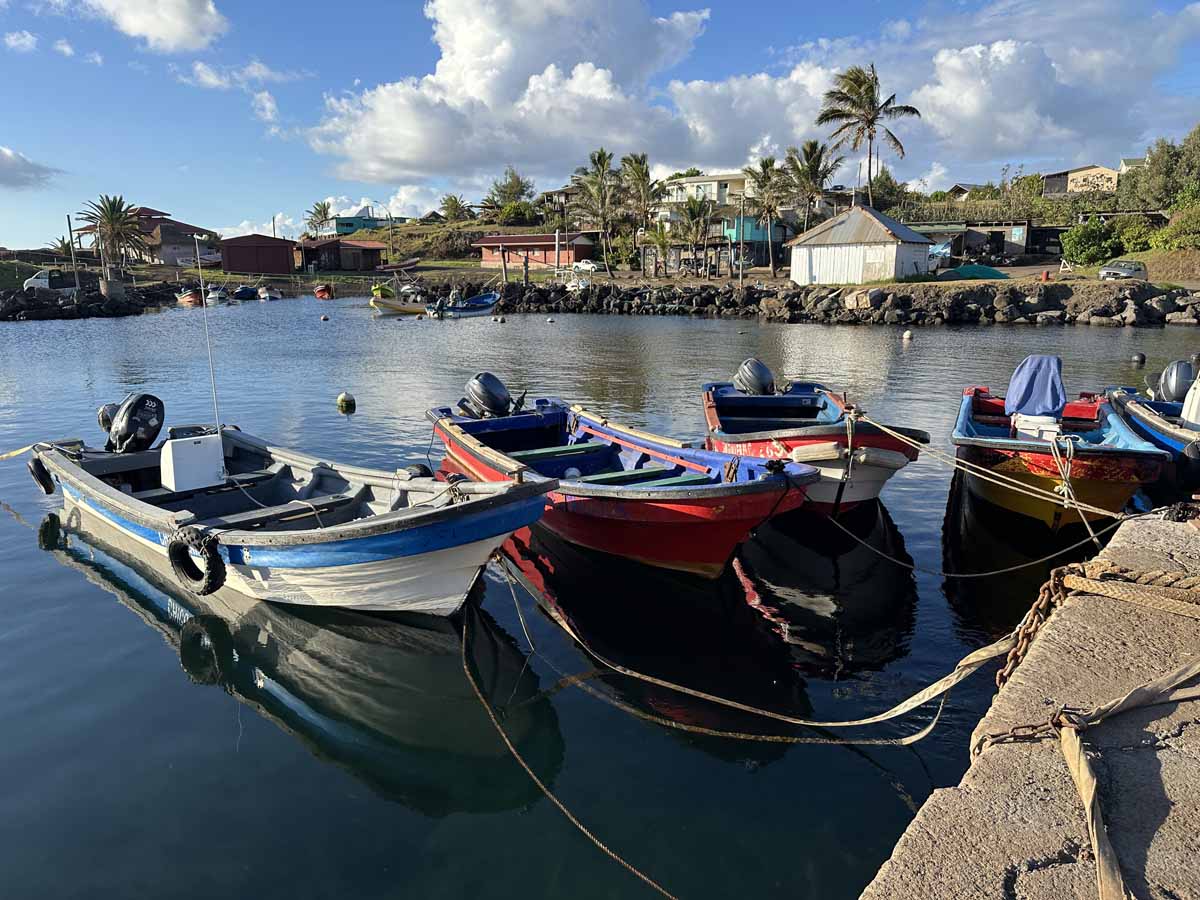
We first passed by a picturesque harbor in a small bay (caleta) filled with colorful fishing boats. After that, we walked on a statue-lined seaside promenade along the dramatic rocky volcanic coastline.
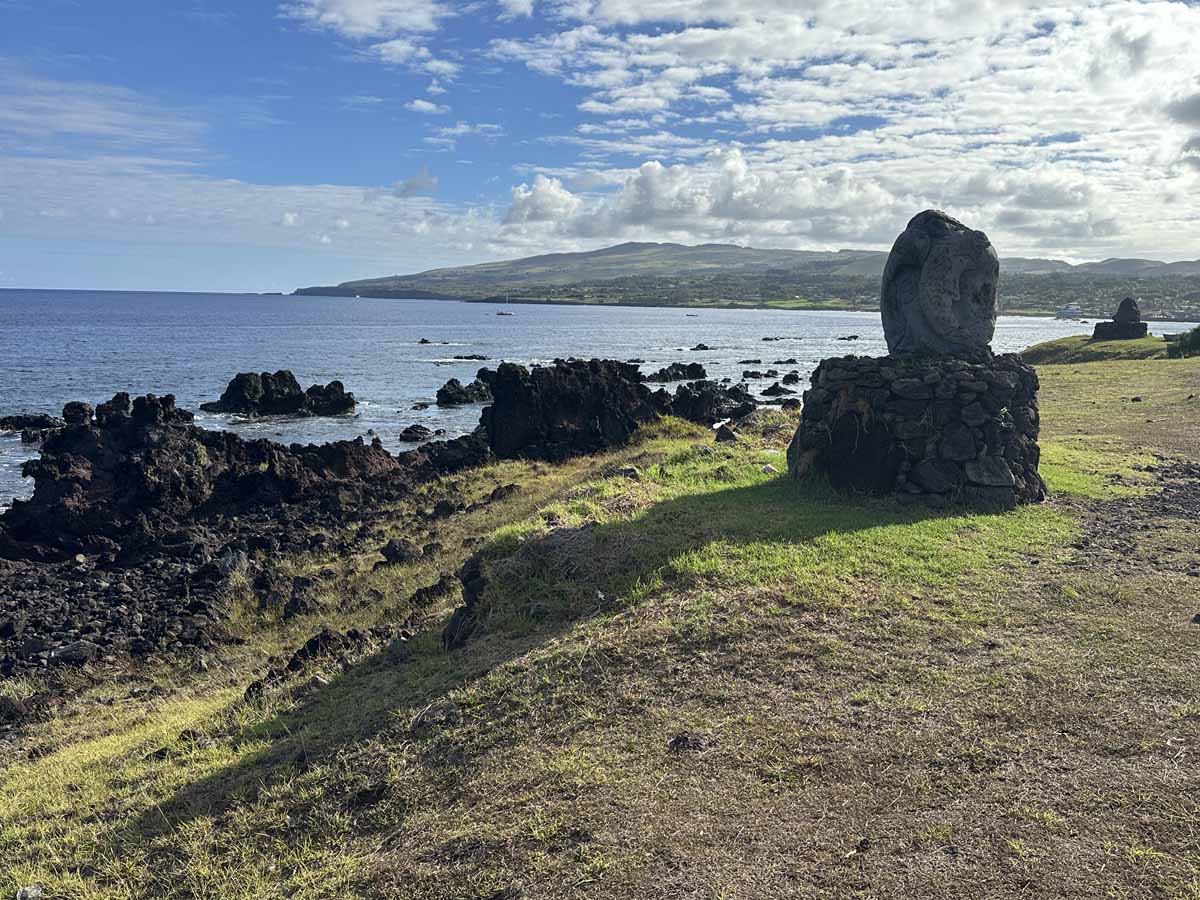
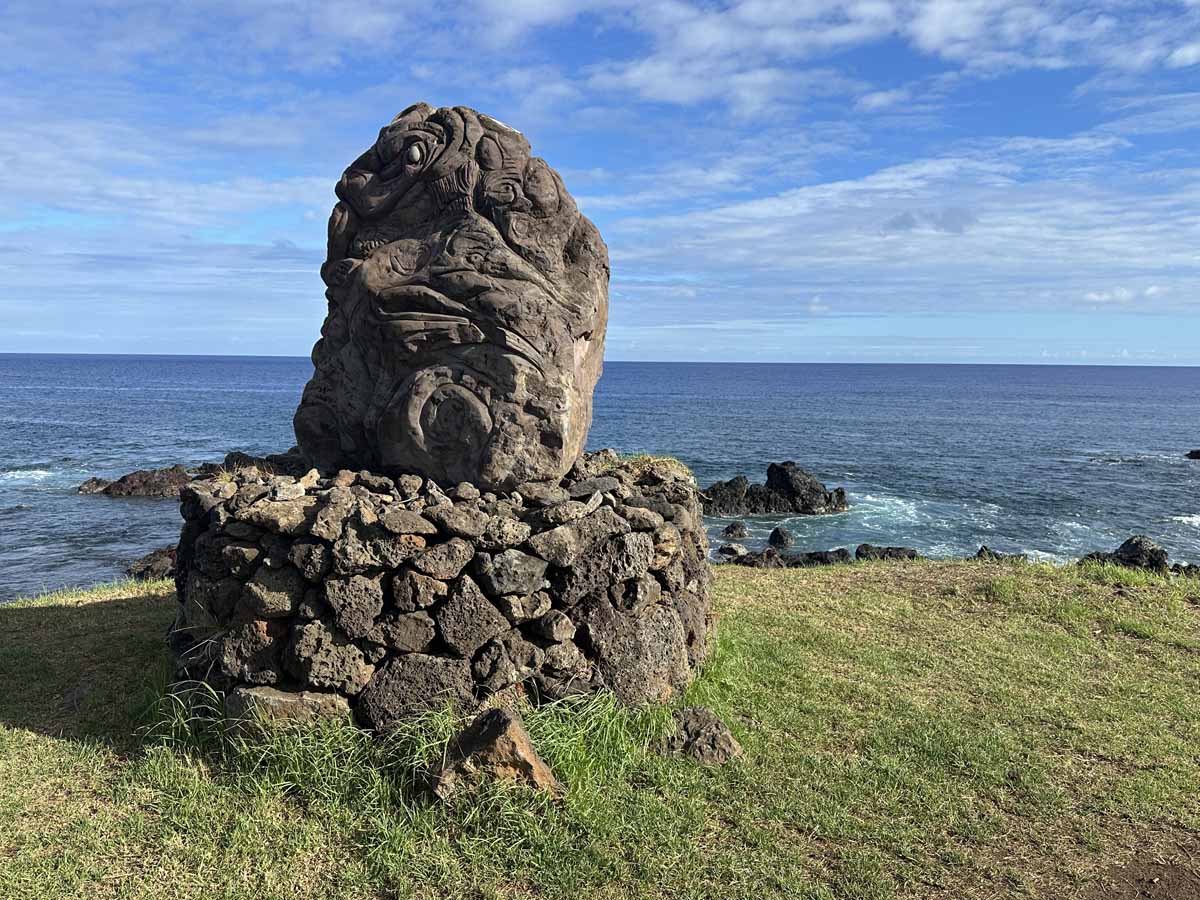
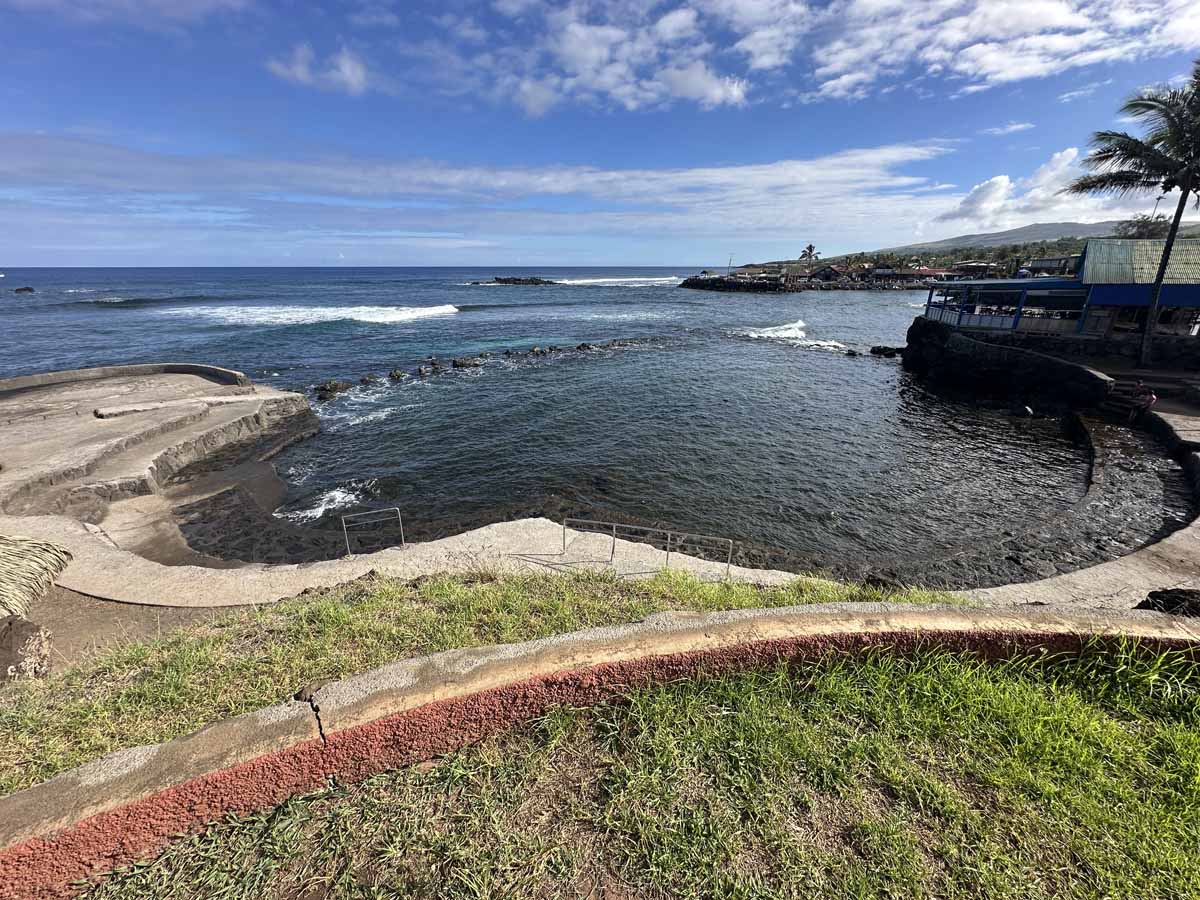
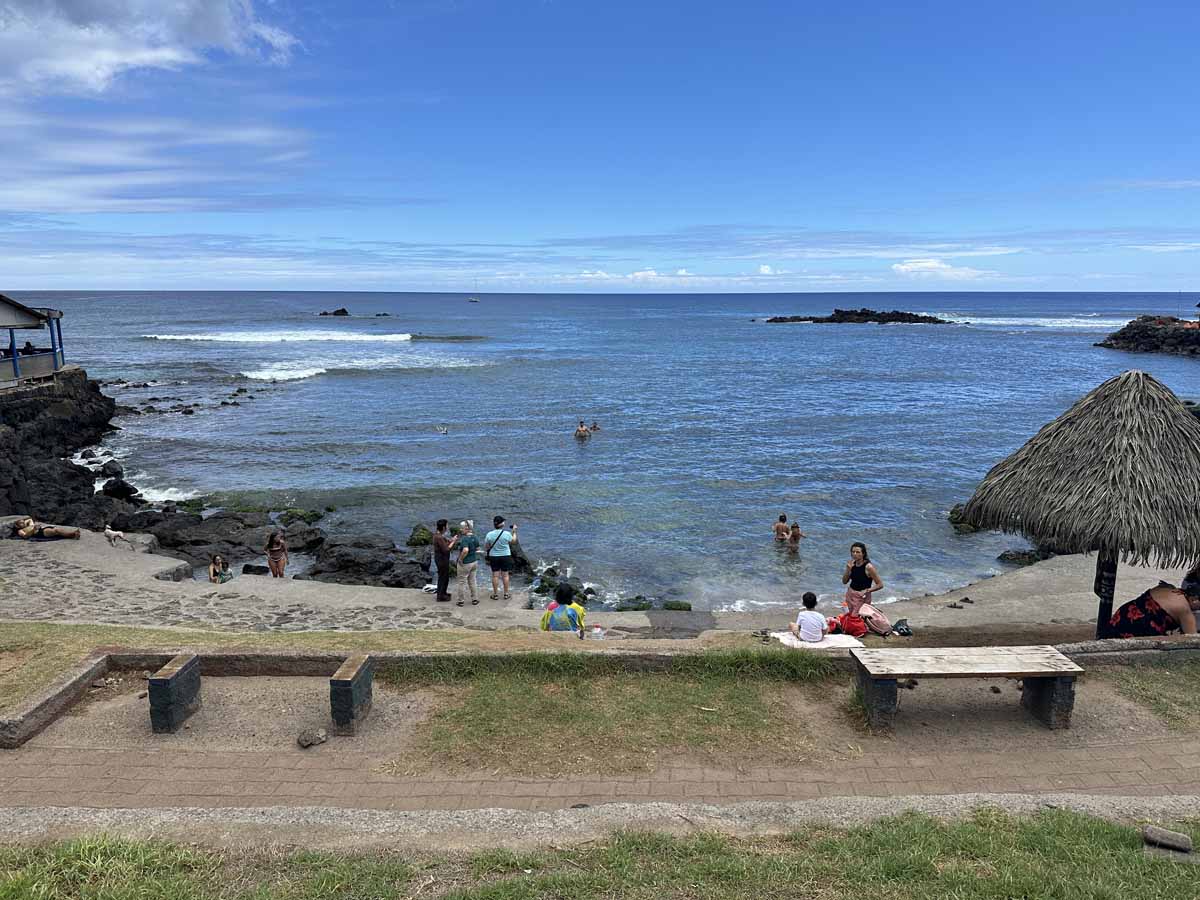
There are no sand beaches on this western coastline, but Hanga Roa has a couple “natural pool” swimming areas (below) within the large bay in the central part of town. Apparently, sea turtles like to hang out here close to shore, but we only saw the top of one turtle head before it submerged! Also, along the waterfront are two prominent moai standing on their platforms, safely behind barriers. (photo at top)
Shopping Handicraft Market & Lunch
Now it was time for some Rapa Nui souvenir shopping! Nico led us a few blocks along peaceful streets to the town’s main handicraft market – Feria Artesanal. My goal was to find a wooden moai statue, but it had to be small enough to fit in my suitcase (since I had 3+ more weeks of travel ahead of me).
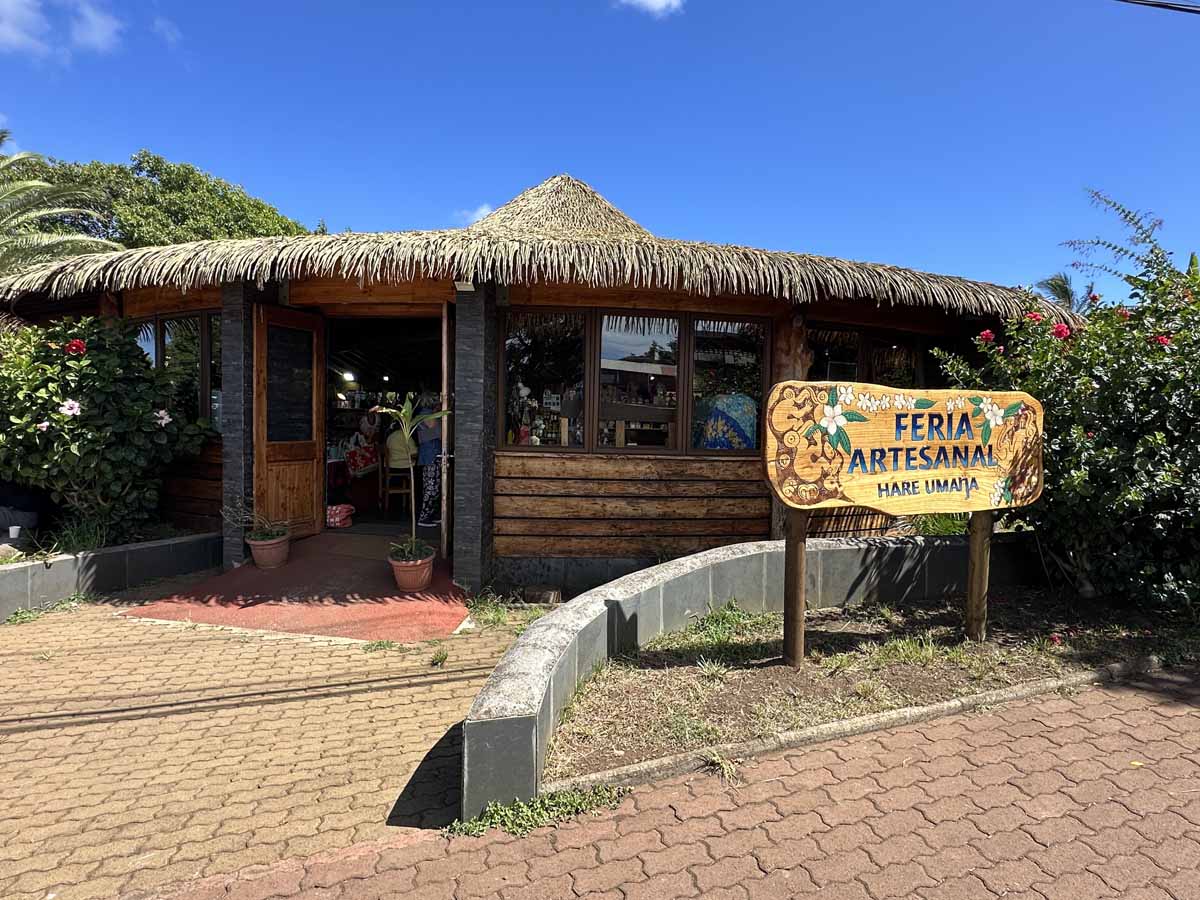
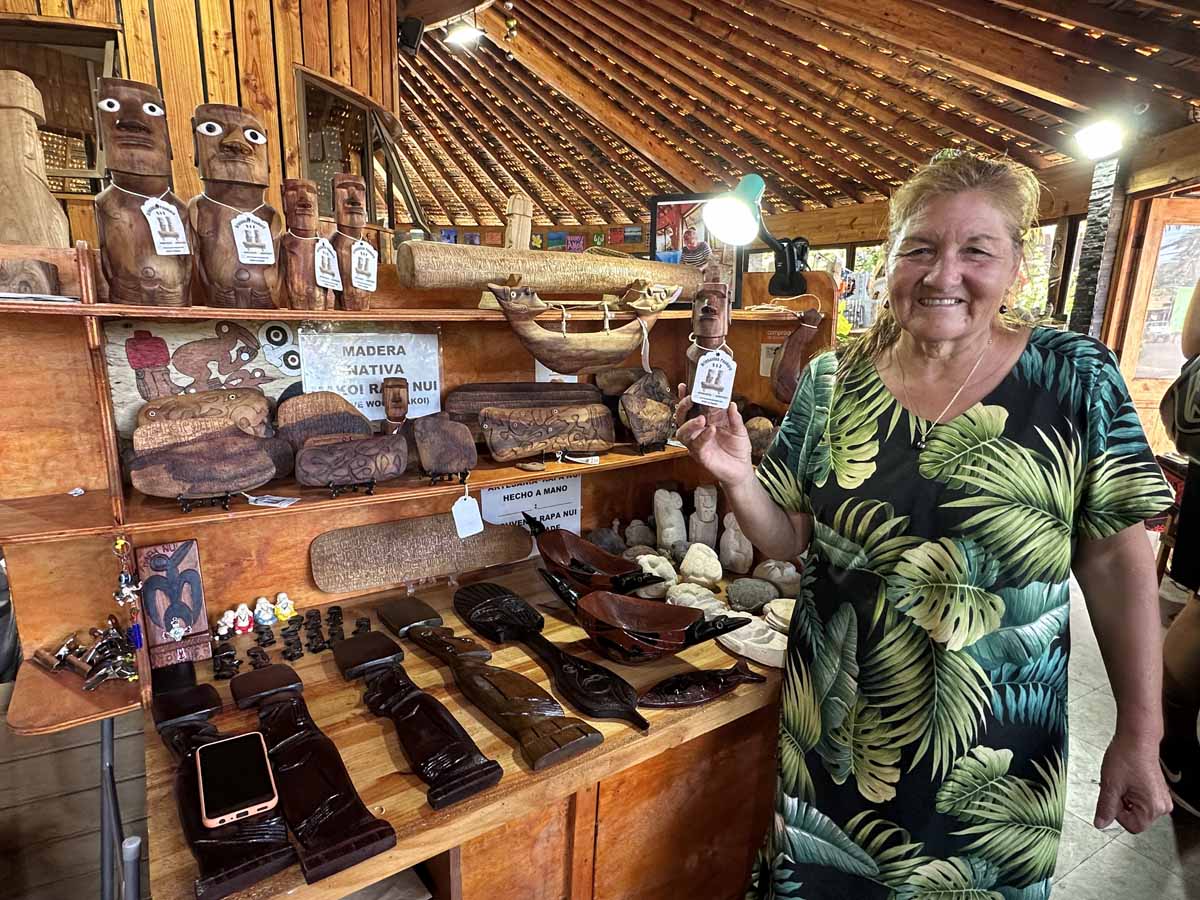
The market was filled with stalls with local artisans selling a wide variety of wood & stone carvings (in all sizes), jewelry, textiles & clothing, and other handicrafts. After surveying all the moai wood carvings a couple times, I finally found my winner! Plus, the woman vendor was lovely & happily posed with me.
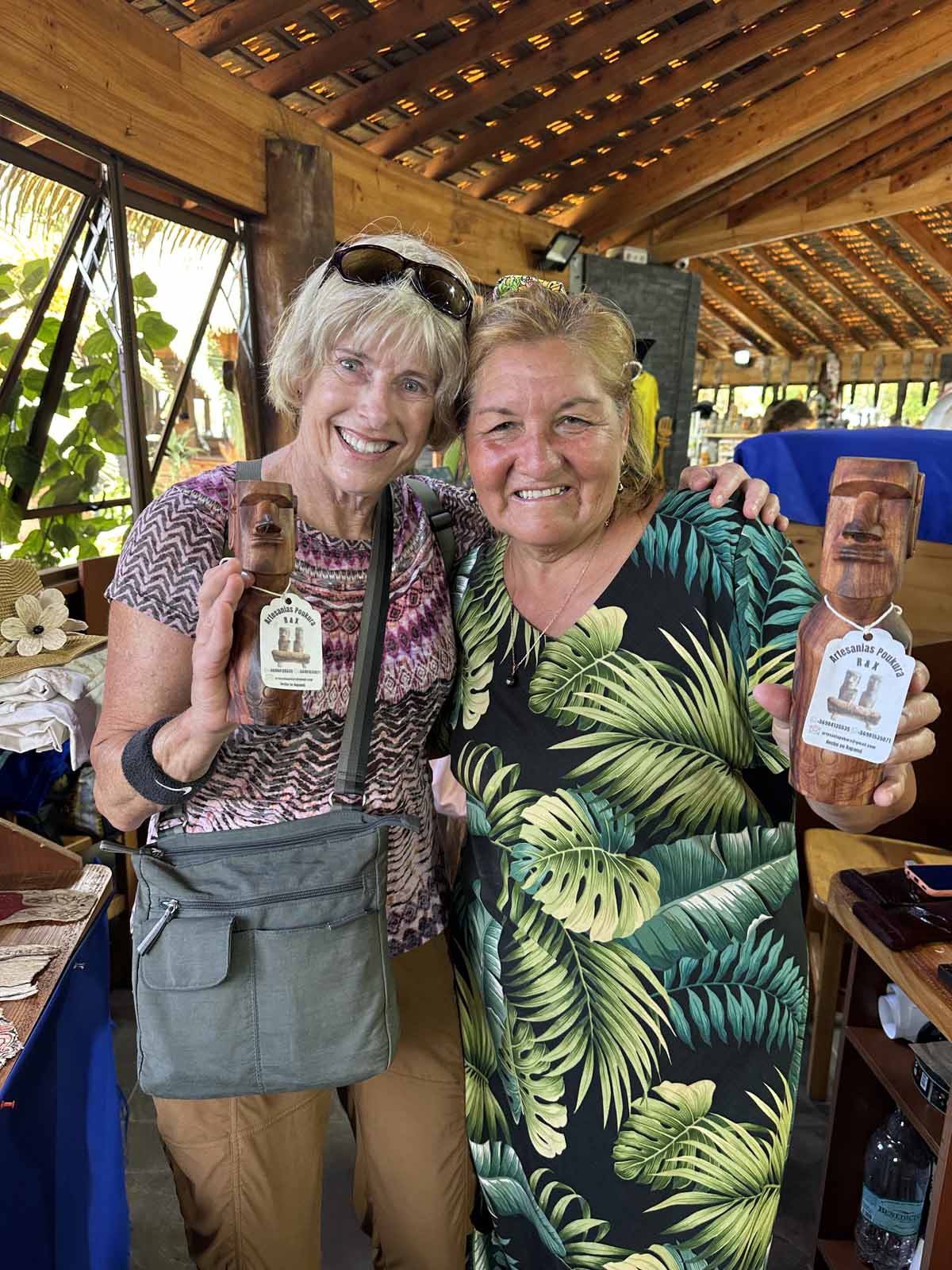
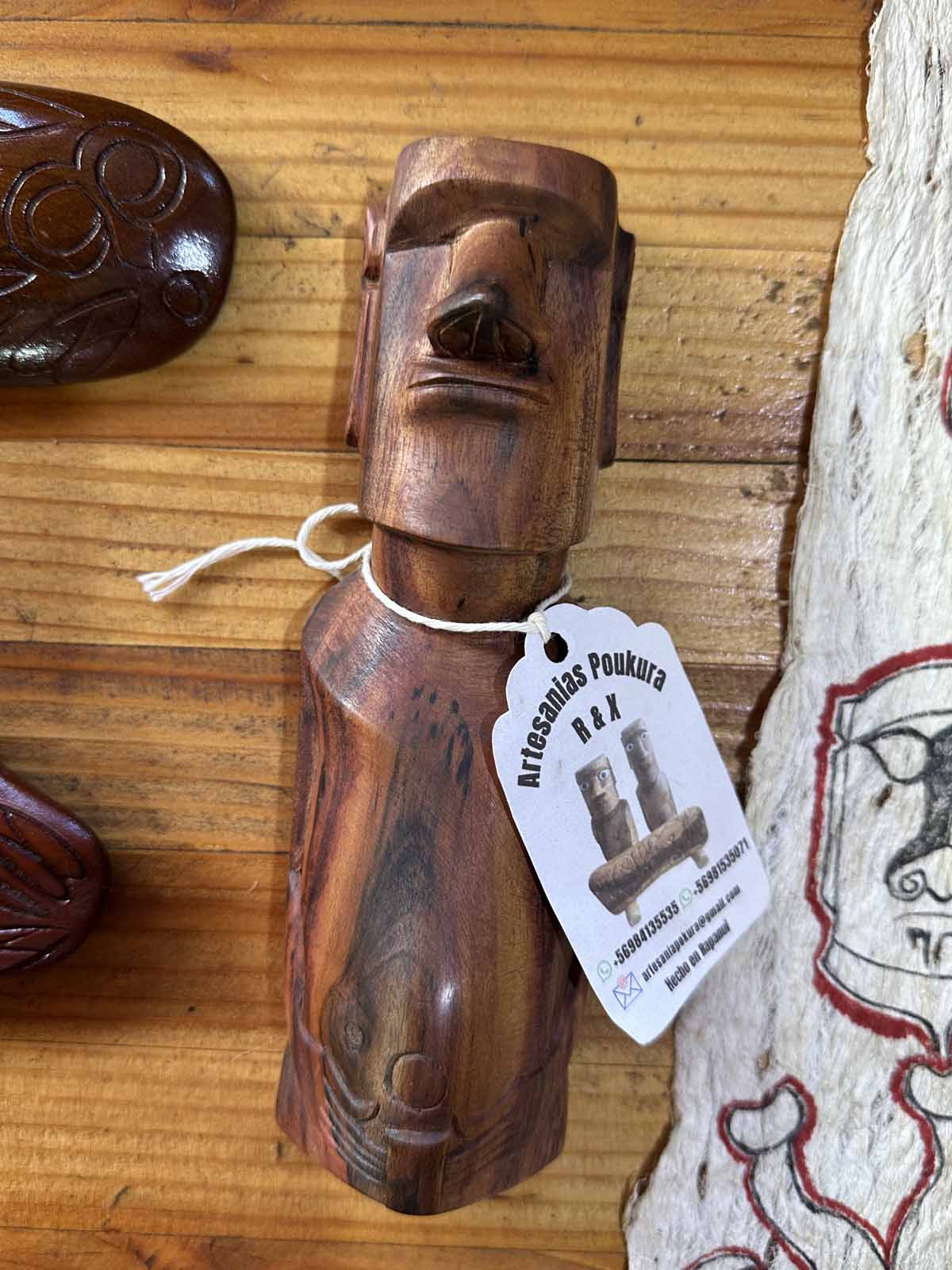
My beautiful wood carving was made of local mahogany (makoi), a higher quality wood. At just 8 inches tall, this moai was the perfect size. It cost me 210,000 Chilean pesos – which is around $235 USD. Definitely not cheap, but this was my entire trip’s big purchase. Happily, “my little moai” has found a place of honor at home in my living room!
Shopping complete, we returned to the waterfront for lunch at a cute beach-style restaurant named Oheho Surf Café. It was a great choice as my fresh seafood lunch was delicious!
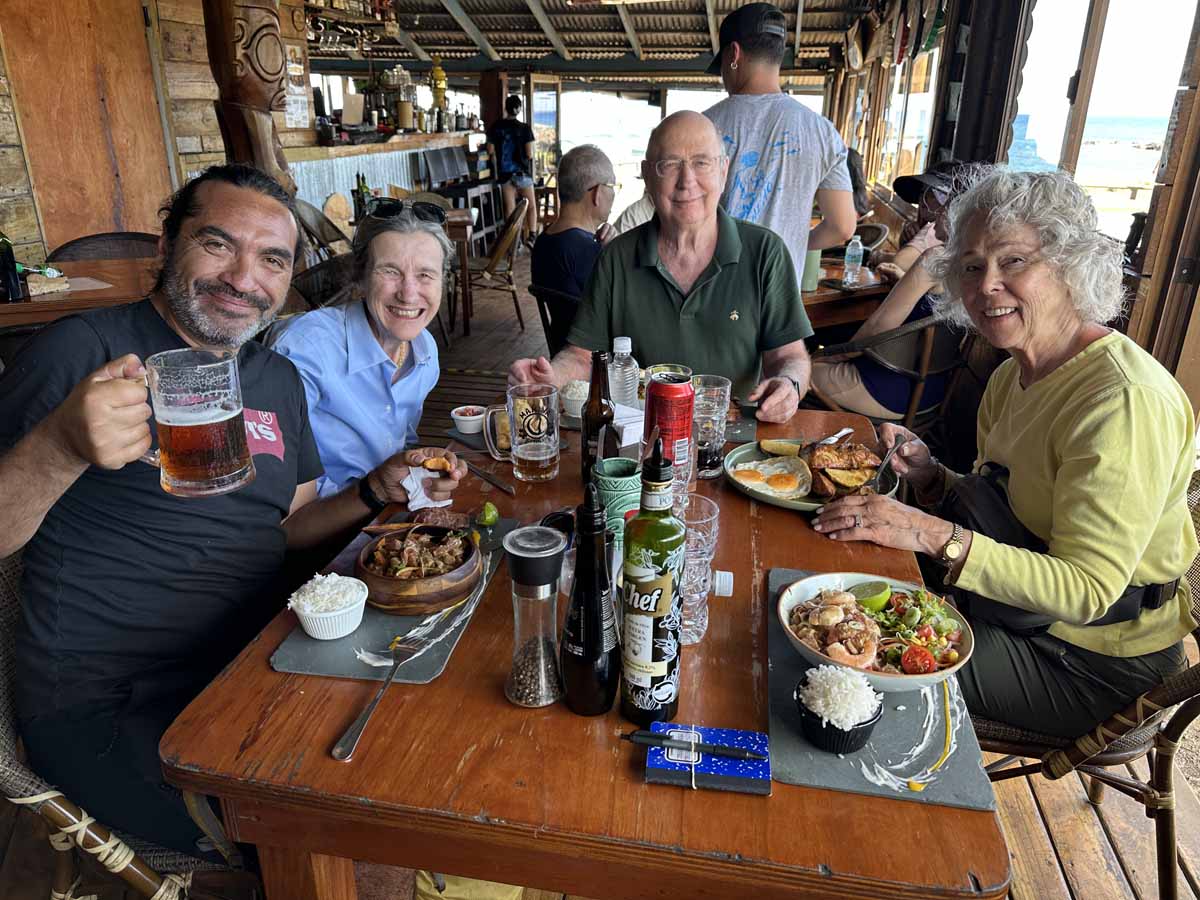
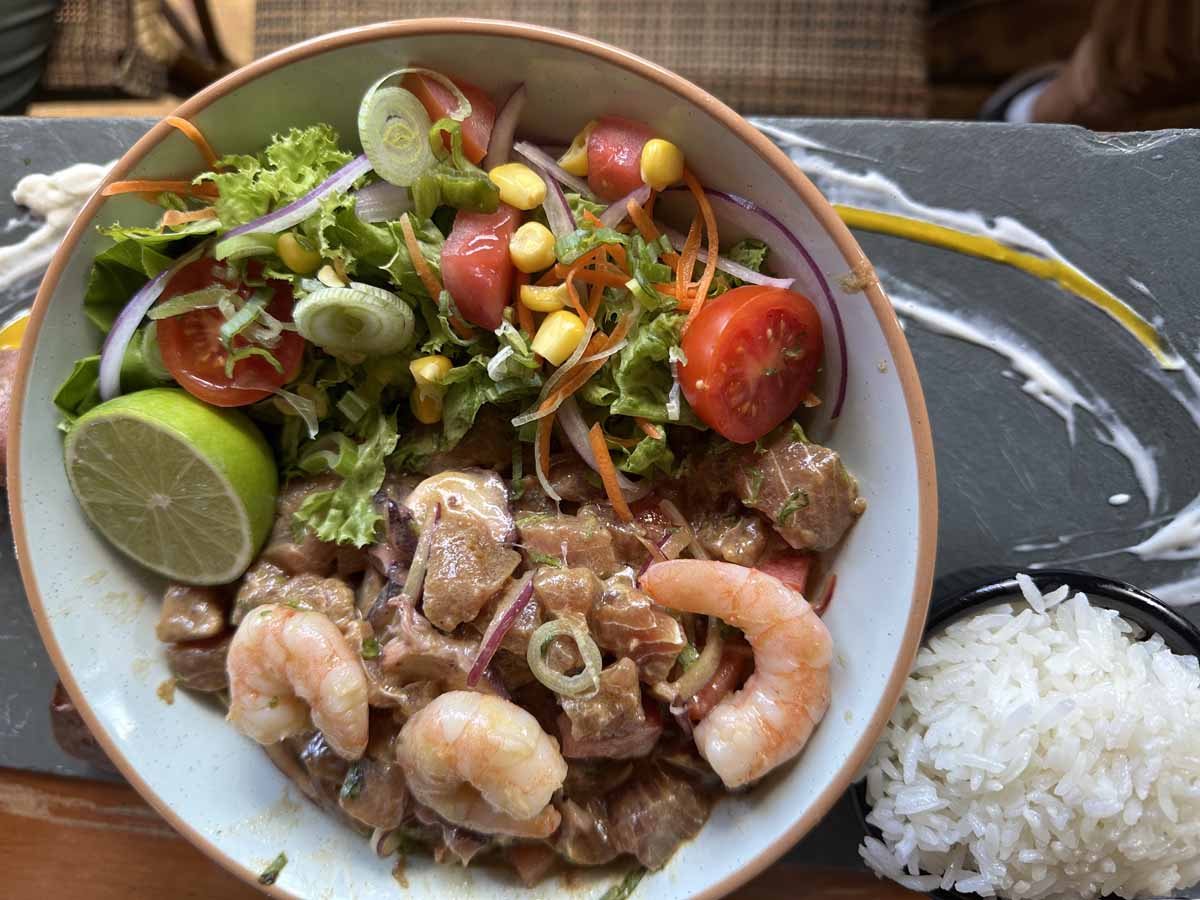
I ordered a ceviche salad with 3 types of sushi-style local fish – tuna, shrimp, and octopus. It also came with rice and a sweet potato. (above right) Others in my group got tasty empanadas – another hugely popular dish in both Chile & Rapa Nui!
FOUR OTHER SPECIAL RAPA NUI EXPERIENCES
Rapa Nui offered us more truly unique delights – including going to a white sand beach, learning about the island’s Birdman cult as we looked into a beautiful volcanic crater lake, and experiencing both a sunset & a sunrise among the majestic moai.
1) Anakena Beach (Hana Rau) & An Ocean Swim
As a Southern California girl & ocean swimmer (during the summers), I was beyond excited for the opportunity to swim in the exotic waters of Easter Island/Rapa Nui. What bragging rights for me & my 5 fellow American travelers!
In fact, Anakena is quite unique – located on the island’s north coast, it’s the only white coral sand beach on Rapa Nui with its mostly rocky shores! Also, this “Bay of the King” is historically significant because the first Rapa Nui king Hotu Matu’a disembarked here (with around 100 other settlers) when the island was first populated.
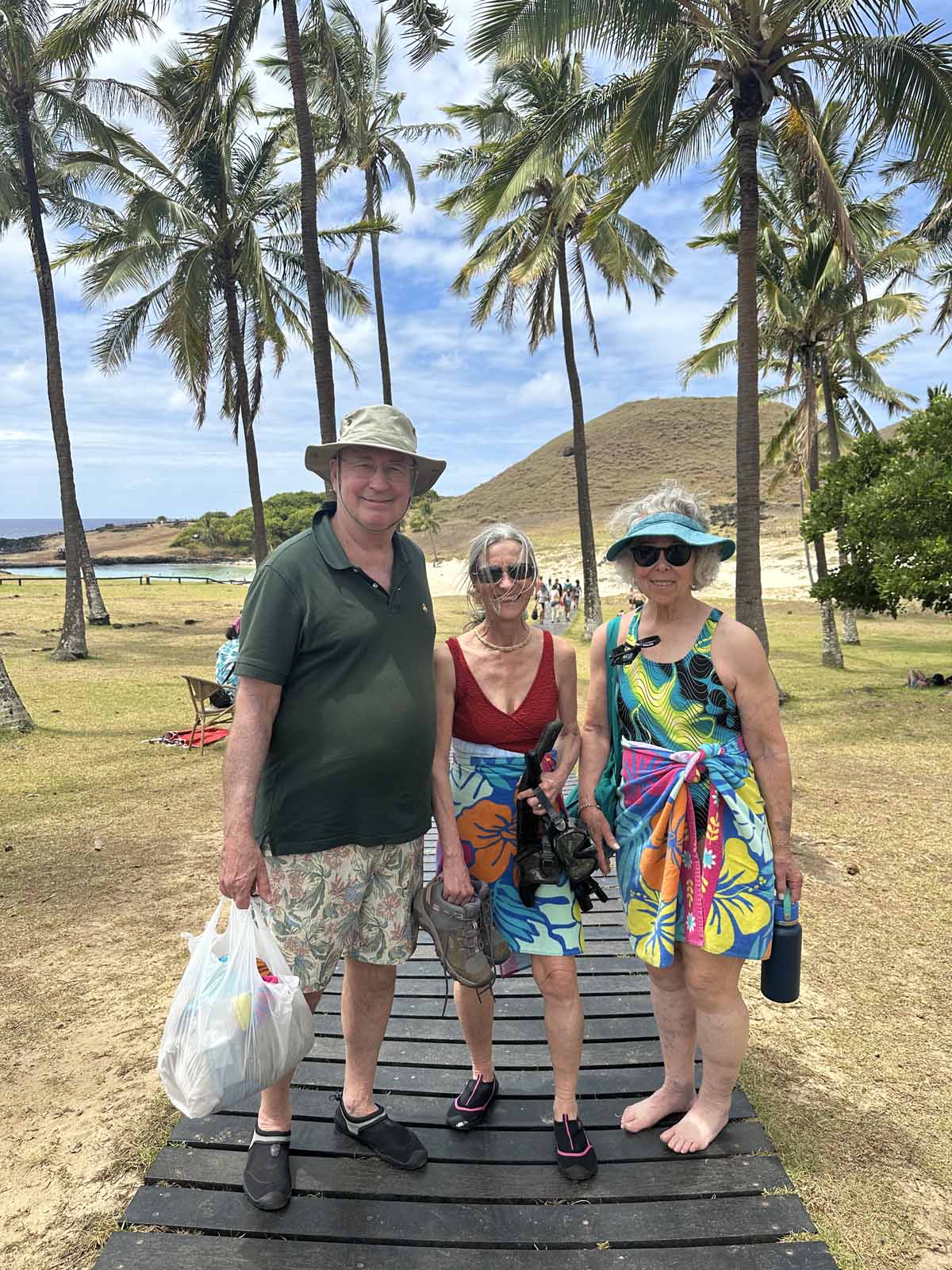
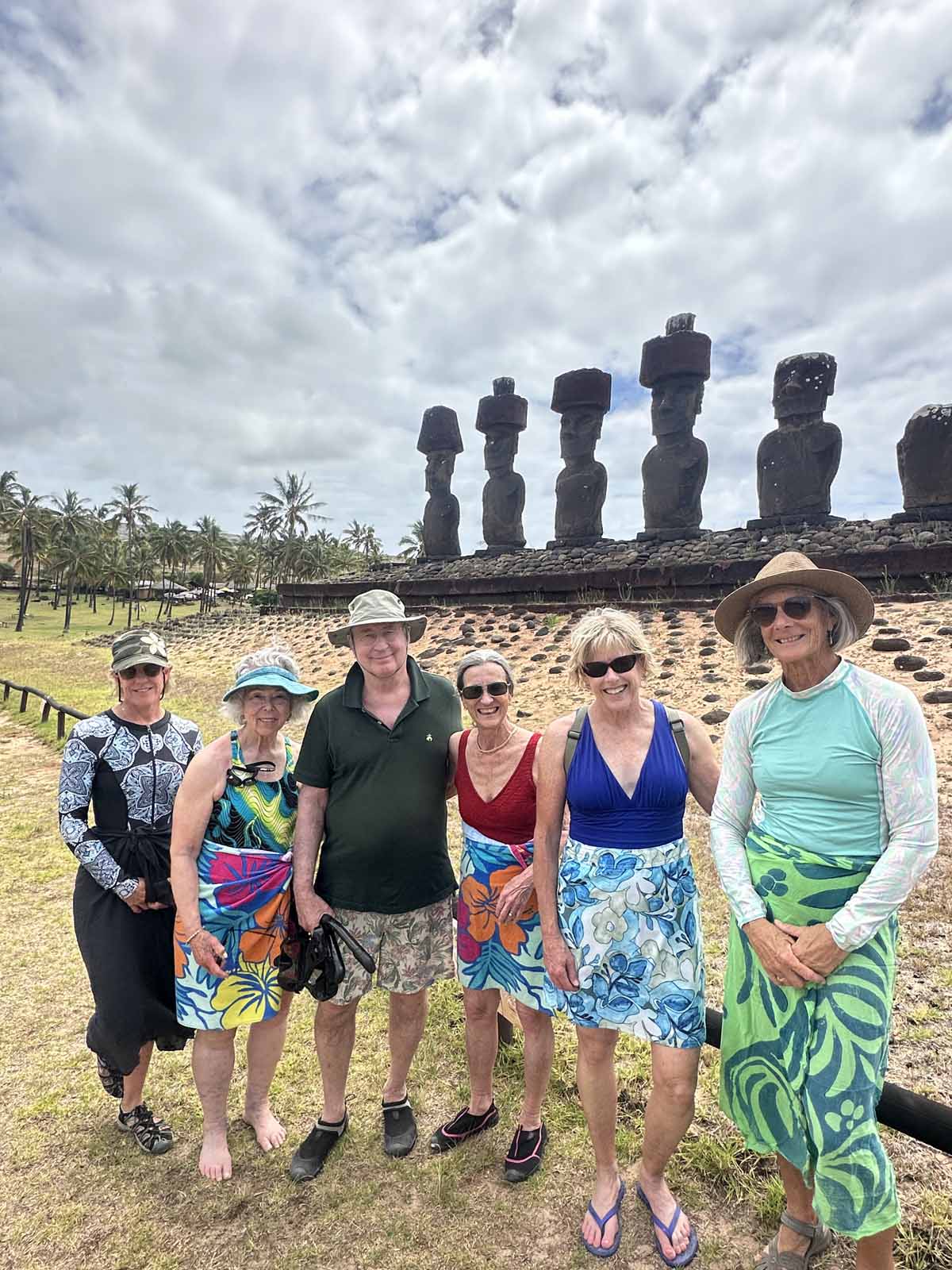
So, we drove to the beach one afternoon with Nico. Upon arrival at Anakena, we changed into our bathing suits and headed down the wooden walkway.
Moai Platform Overlooking the Beach
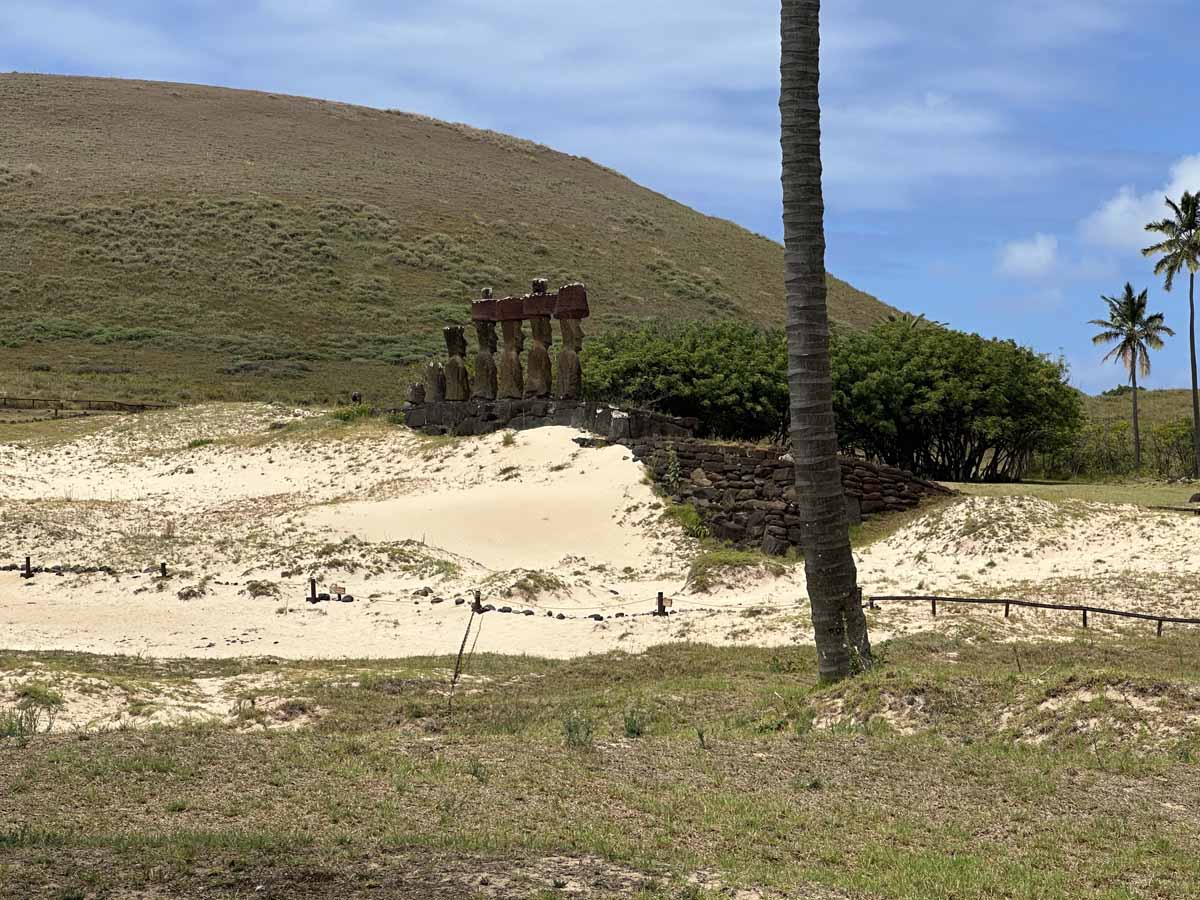
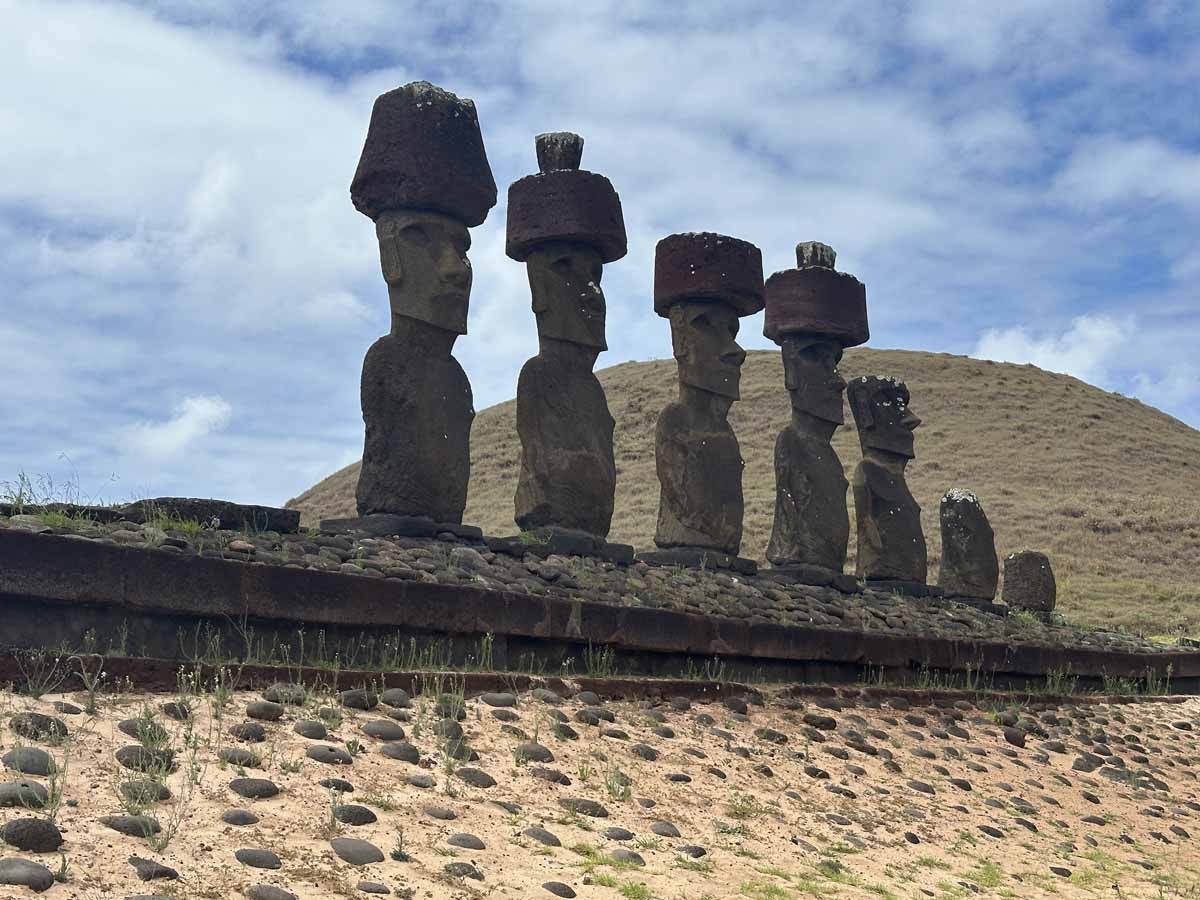
First, Nico led us up a nearby hill to see one of the two ahu platforms overlooking the beach – the impressive Ahu Nau Nau with its 7 moai. Four of the statues still wear their red pukao topknots – more than any other restored site on the island.
Then it was time to take our swim! The beach is situated on a small bay with a line running across to designate the swimming area. The water temperature was a delightful 78-80 degrees F. So, I spent a joyous half hour swimming laps in the warm, clear, calm waters – heaven! The bottom was mostly sand, so there were not many fish to see.
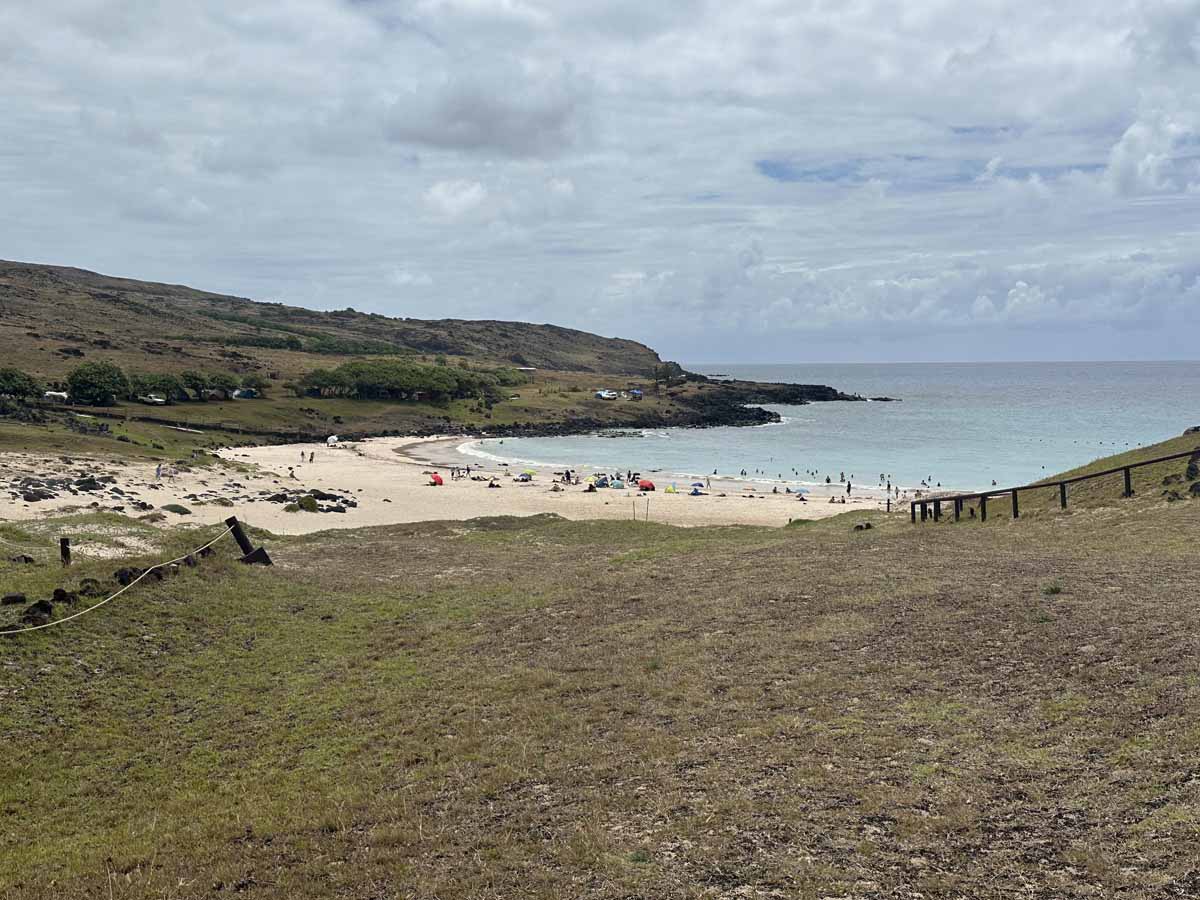
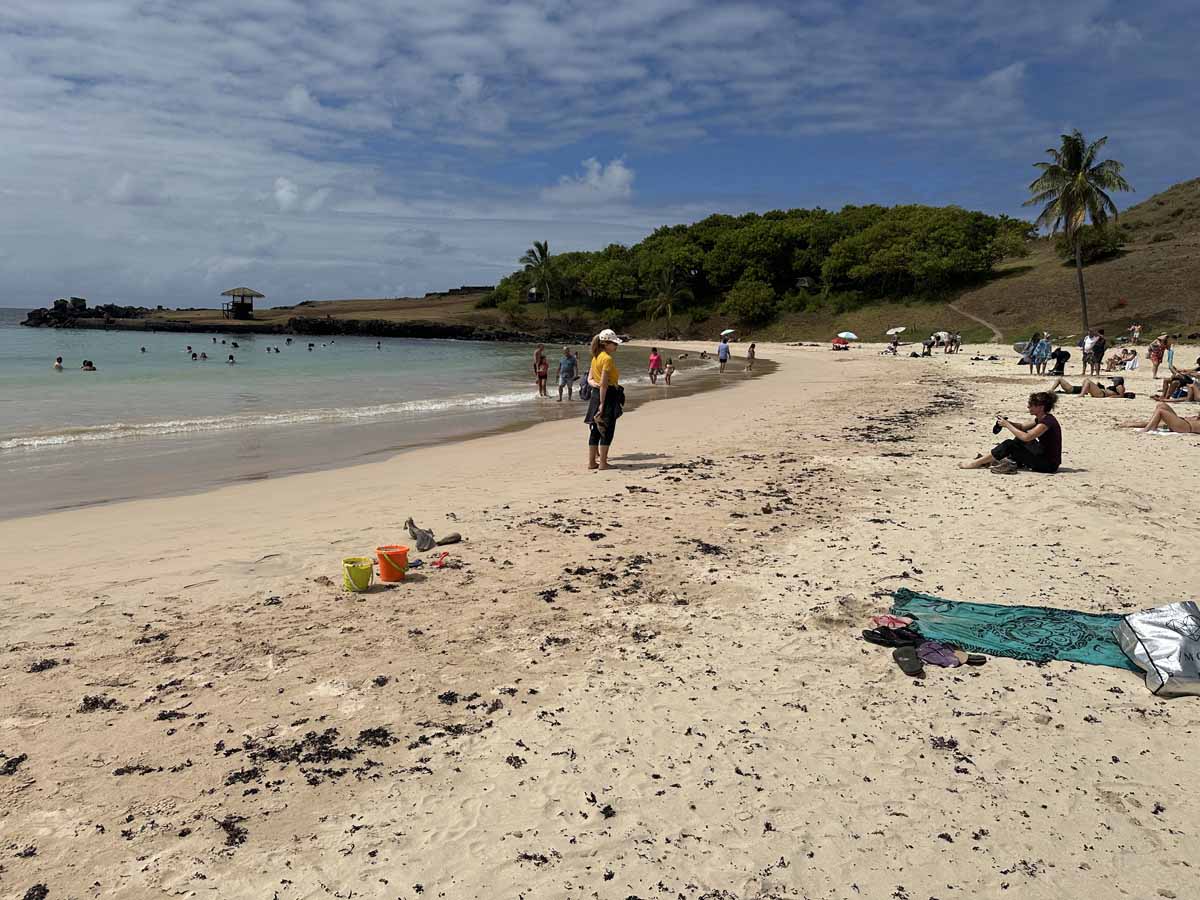
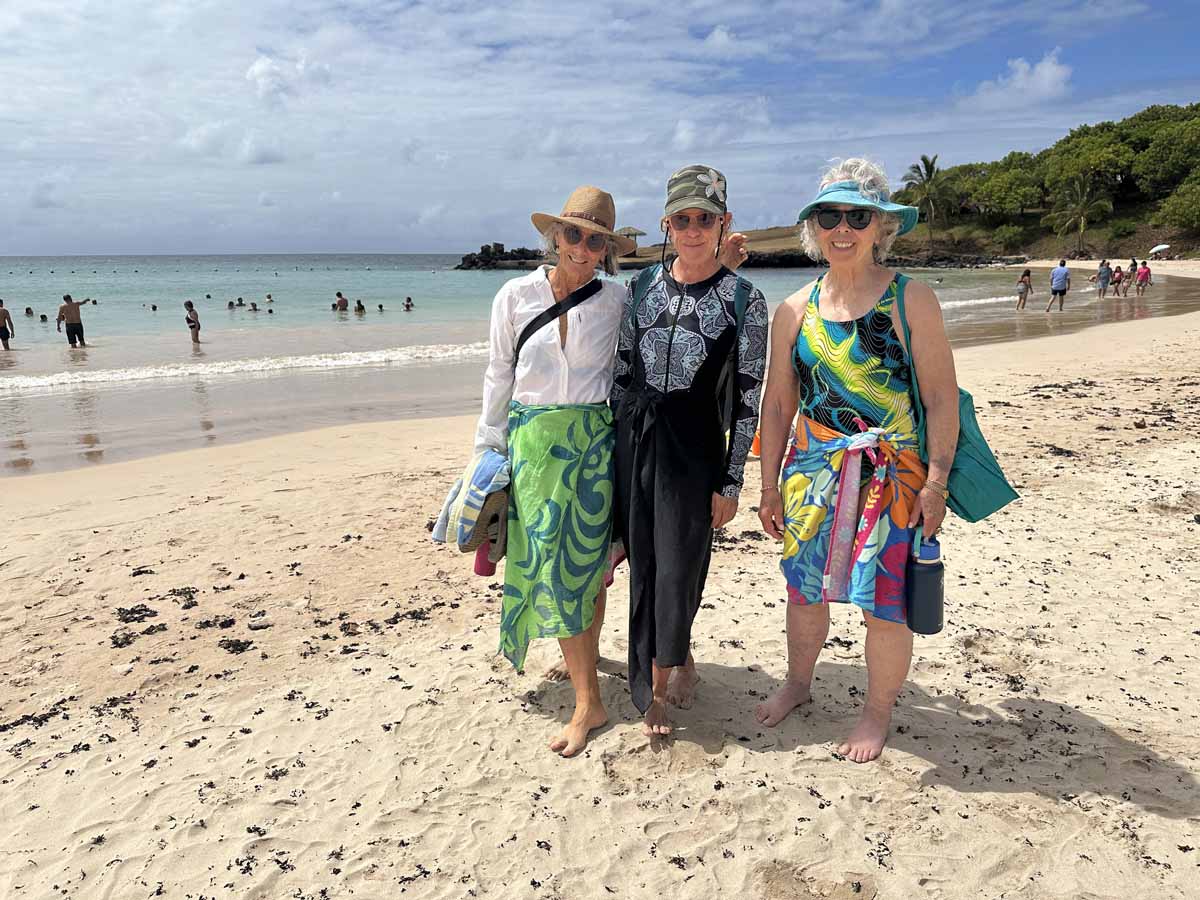
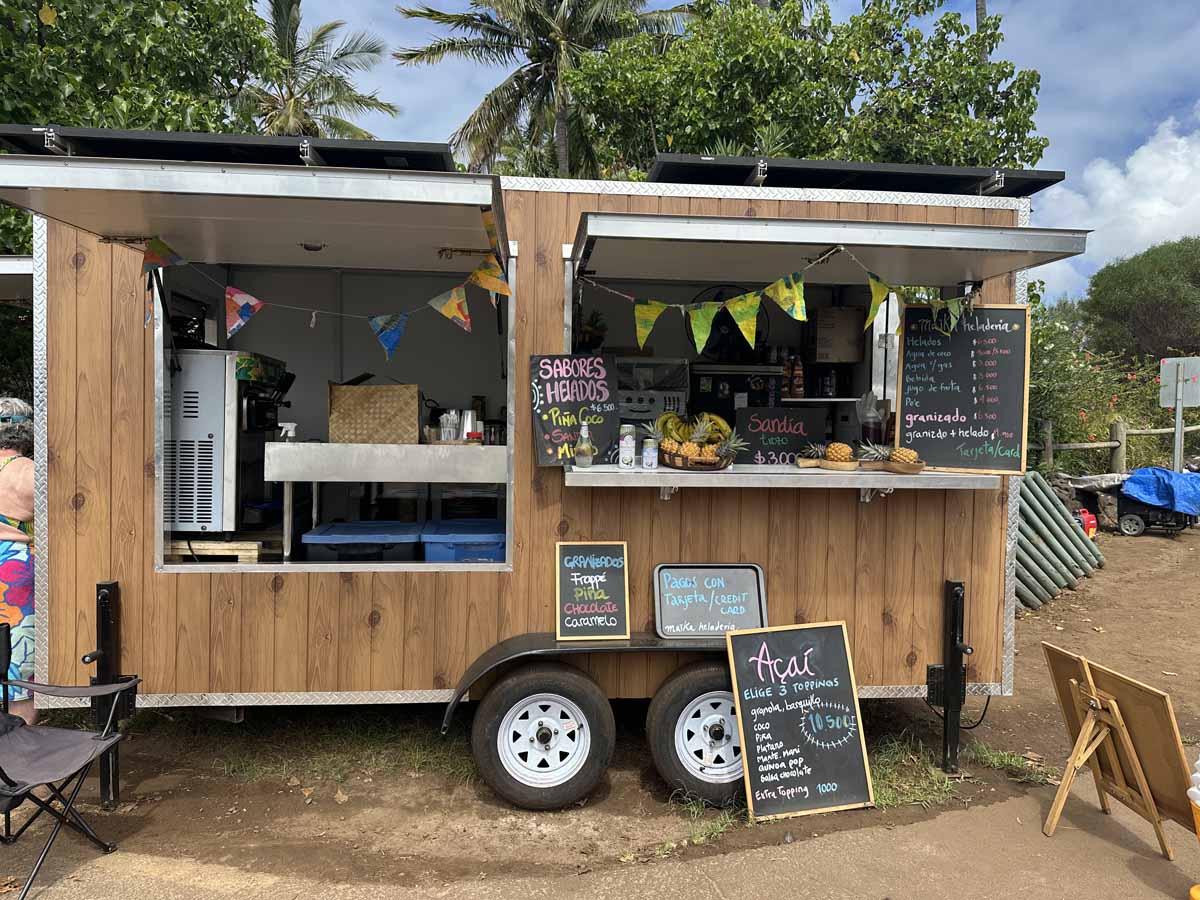
One other fun fact about this photogenic “island paradise” setting. The palm trees at Anakena were imported from Tahiti in the 1960s due to Rapa Nui’s deforestation over the centuries.
2) Orongo Cultural Center – Birdman Cult & Competition
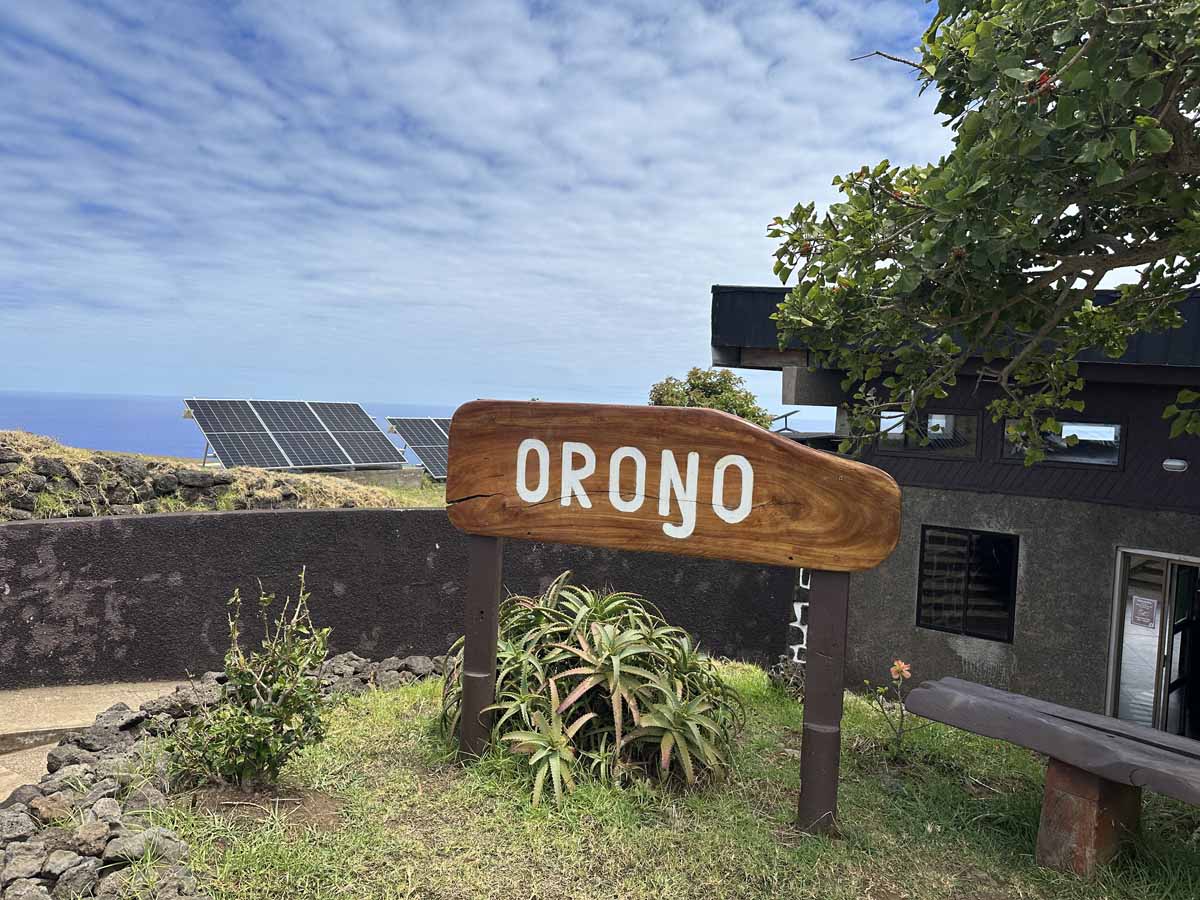 Visiting Orongo Cultural Center is the chance to delve into the island’s fascinating Birdman Cult, which emerged in the 1600’s and lasted until around 1866.
Rooted in the worship of Makemake (the god of fertility and creation), the cult centered around an annual competition to determine the next “Tangata Manu” or Birdman.
When the moai-building civilization on Rapa Nui collapsed due to inter-clan wars, a new system of determining the island’s leadership was needed – this time based on physical prowess and ritual. The winning Birdman’s clan held absolute power over island resources for an entire year, until next year’s competition.
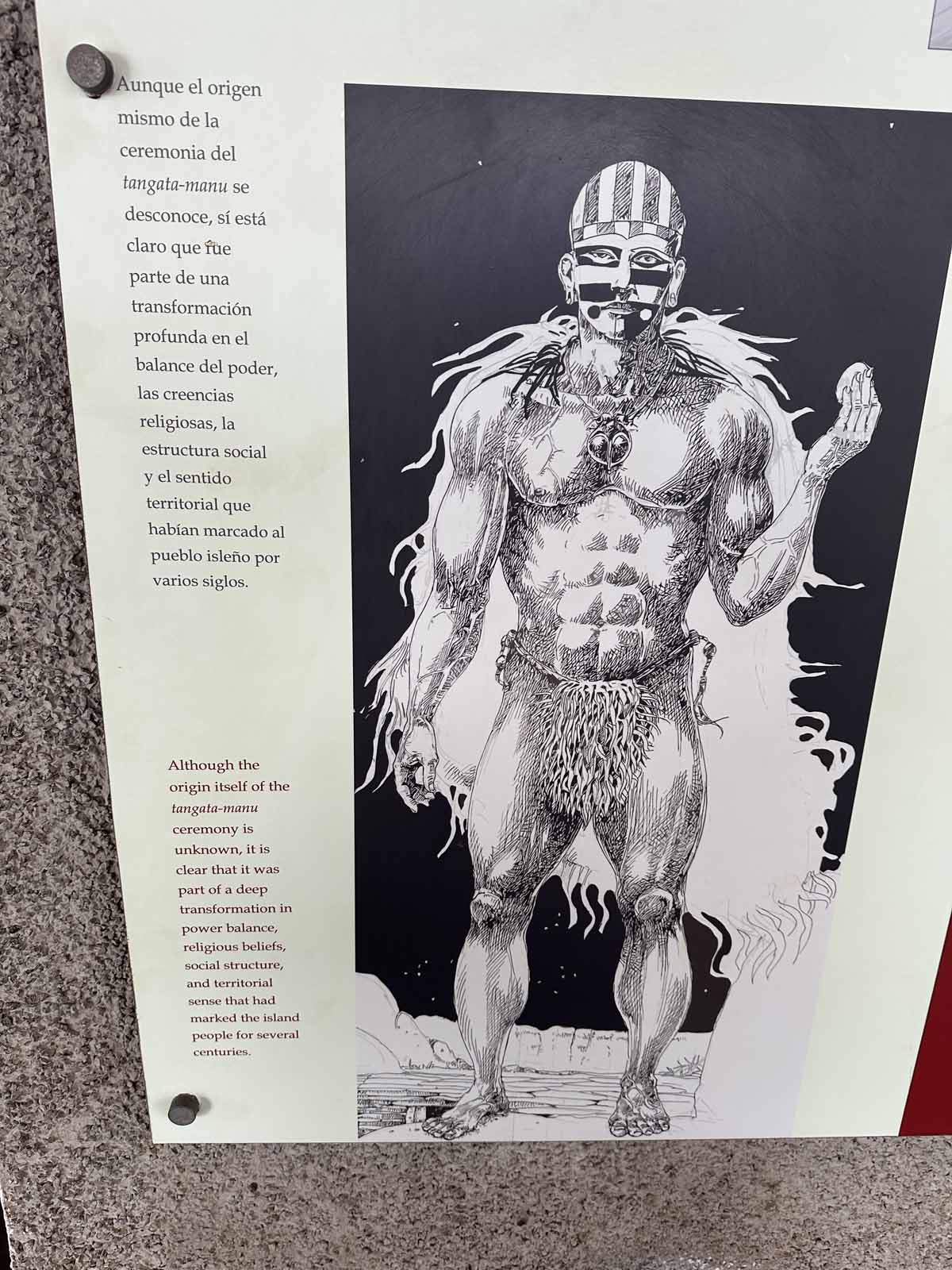
Click image to enlarge
Orongo was the site of the Birdman Ceremonial Village. Every year, each tribal chief would choose their strongest warrior – called a hopu manu – to represent him in the Birdman competition. These competitors stayed in Orongo’s stone houses for several days of ritual preparation and priestly blessings.
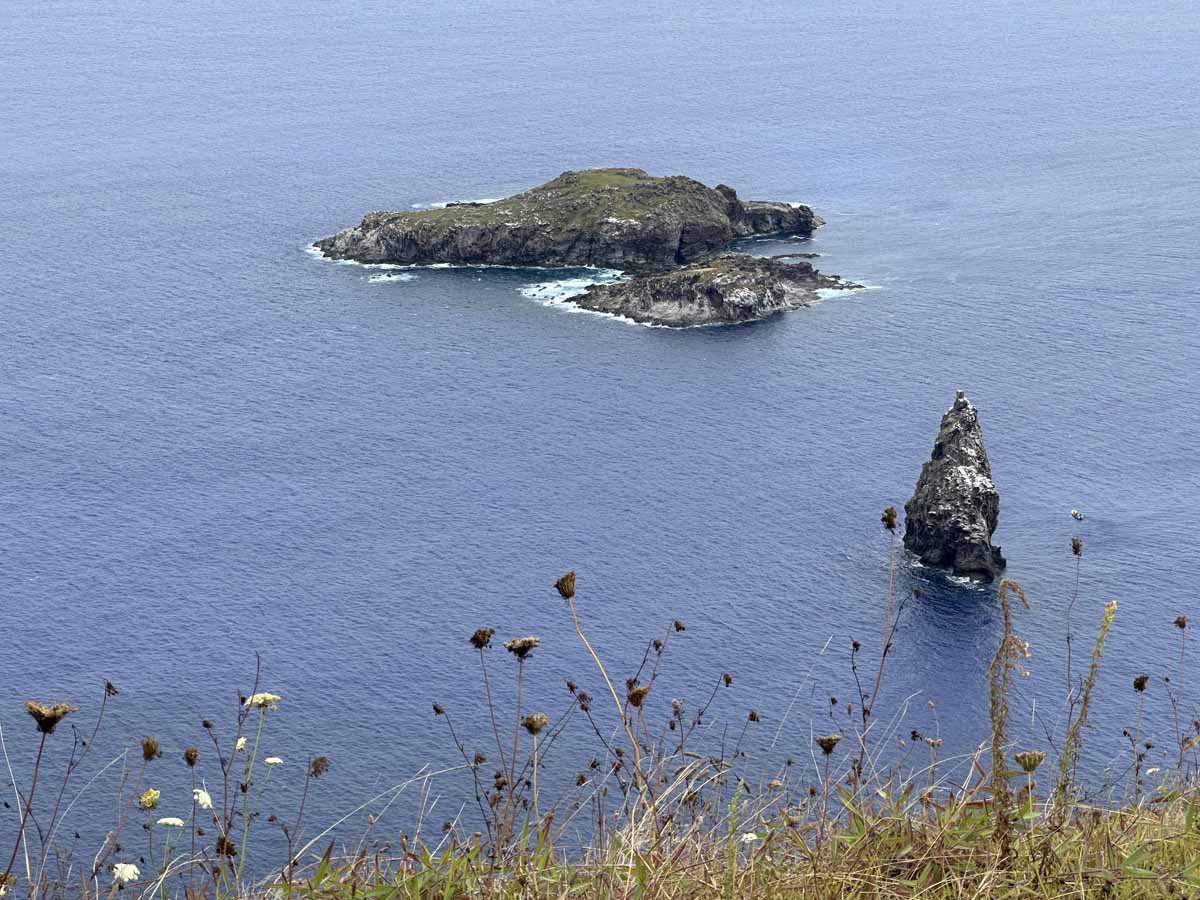
They were awaiting the arrival of the sooty tern bird – called manutara – to nest on Moto Nui, the largest of three nearby islets (photo, below right). When it was time (usually in September), these warriors would race down a steep 300-meter cliff face & swim around a mile across the ocean channel – filled with strong currents and sharks! – to reach the island.
The competitors then lived (for days or weeks!) in the island’s caves waiting to retrieve the first egg laid by the sooty tern. The winner was whomever returned first to Orongo village with an unbroken egg strapped to their forehead. The winning tribe’s chief was then named Birdman – not the warrior competitor who risked his life!
Our Walk Around the Orongo Site / Ceremonial Village
We started our Orongo Cultural Center visit in its excellent interpretative center, learning about this interesting Birdman competition. We then headed outside to walk along the different paths of the dramatic peninsula perched high above the sea on one side and the rim of the Rano Kau volcano on the other.
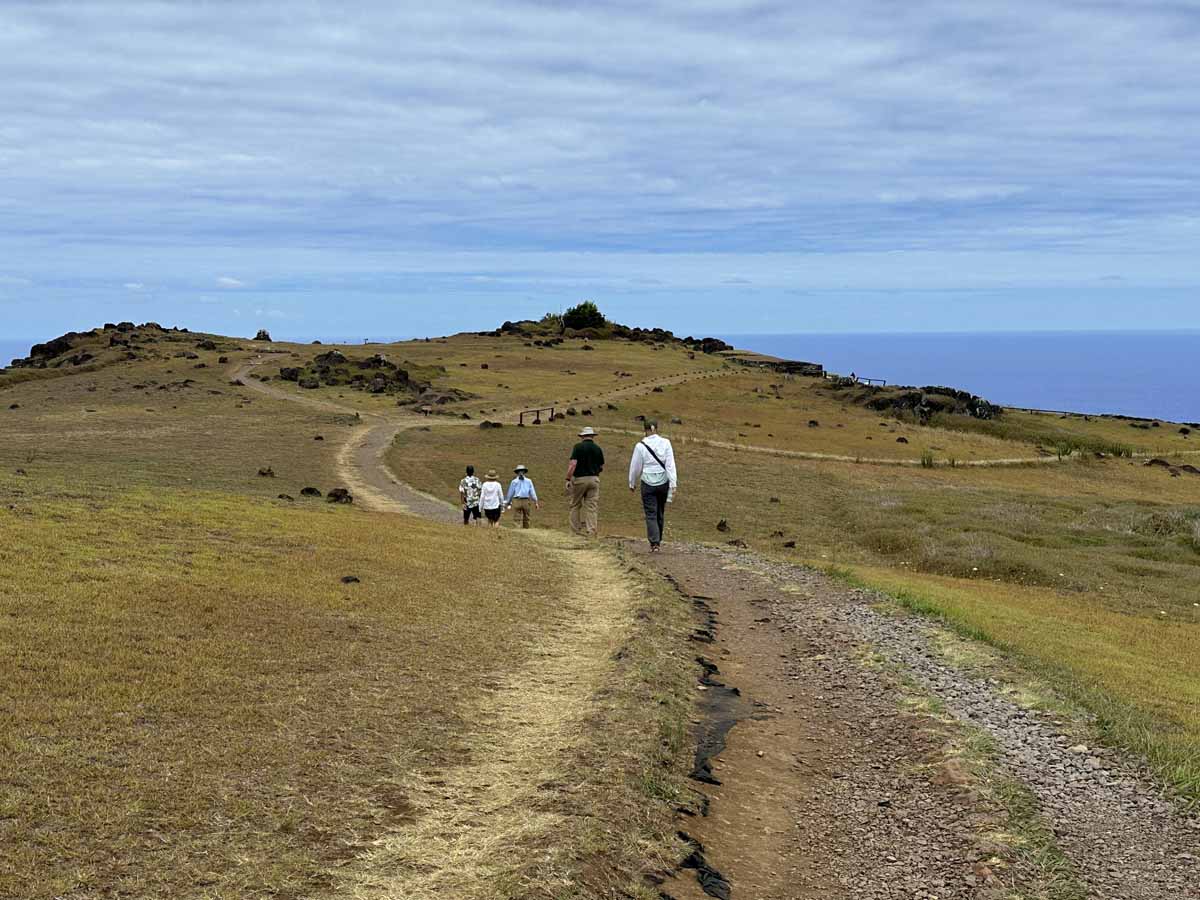
We walked by the Orongo Ceremonial Village – a collection of 53 restored, low-stone houses with no windows & tiny doors facing the ocean and nearby islands. This is where chiefs and contestants lived during the Birdman ritual. It certainly didn’t look very comfortable to me!
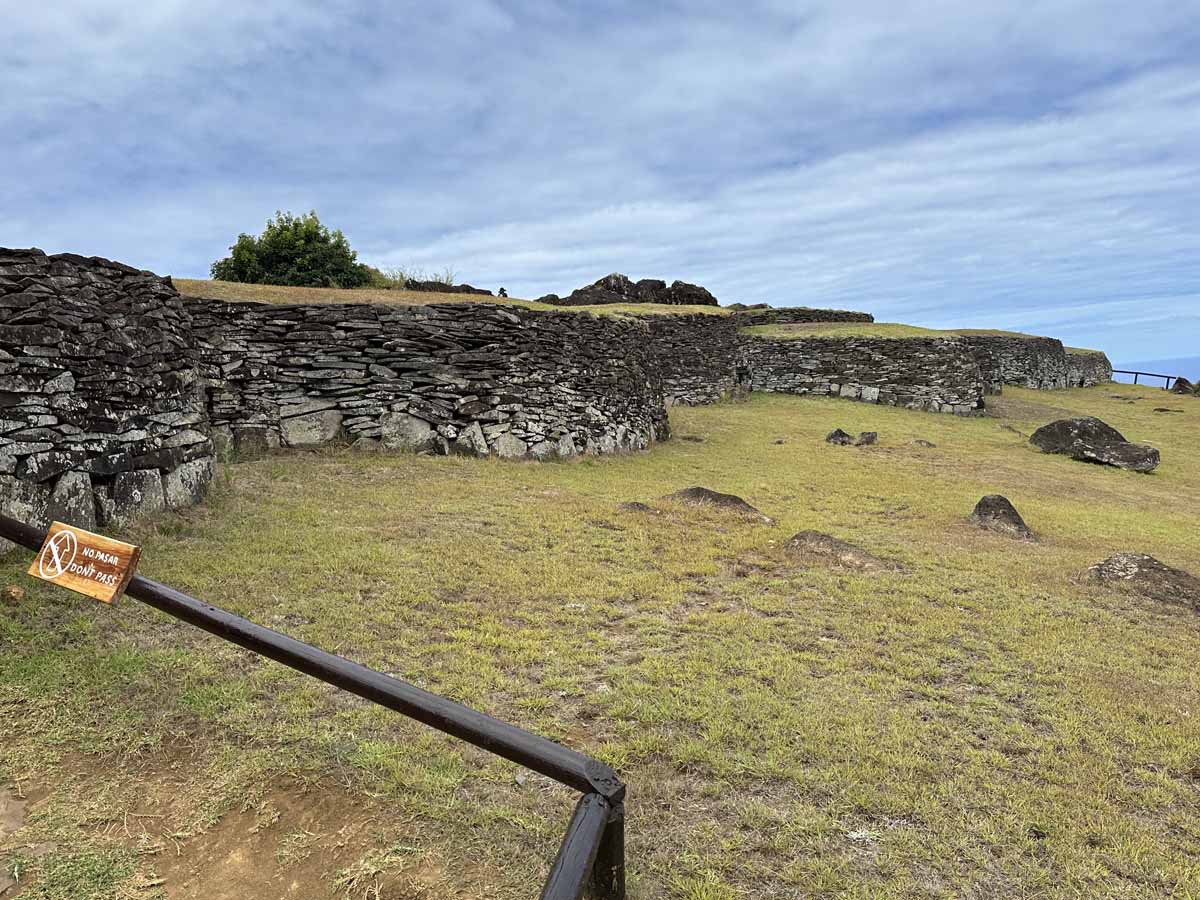
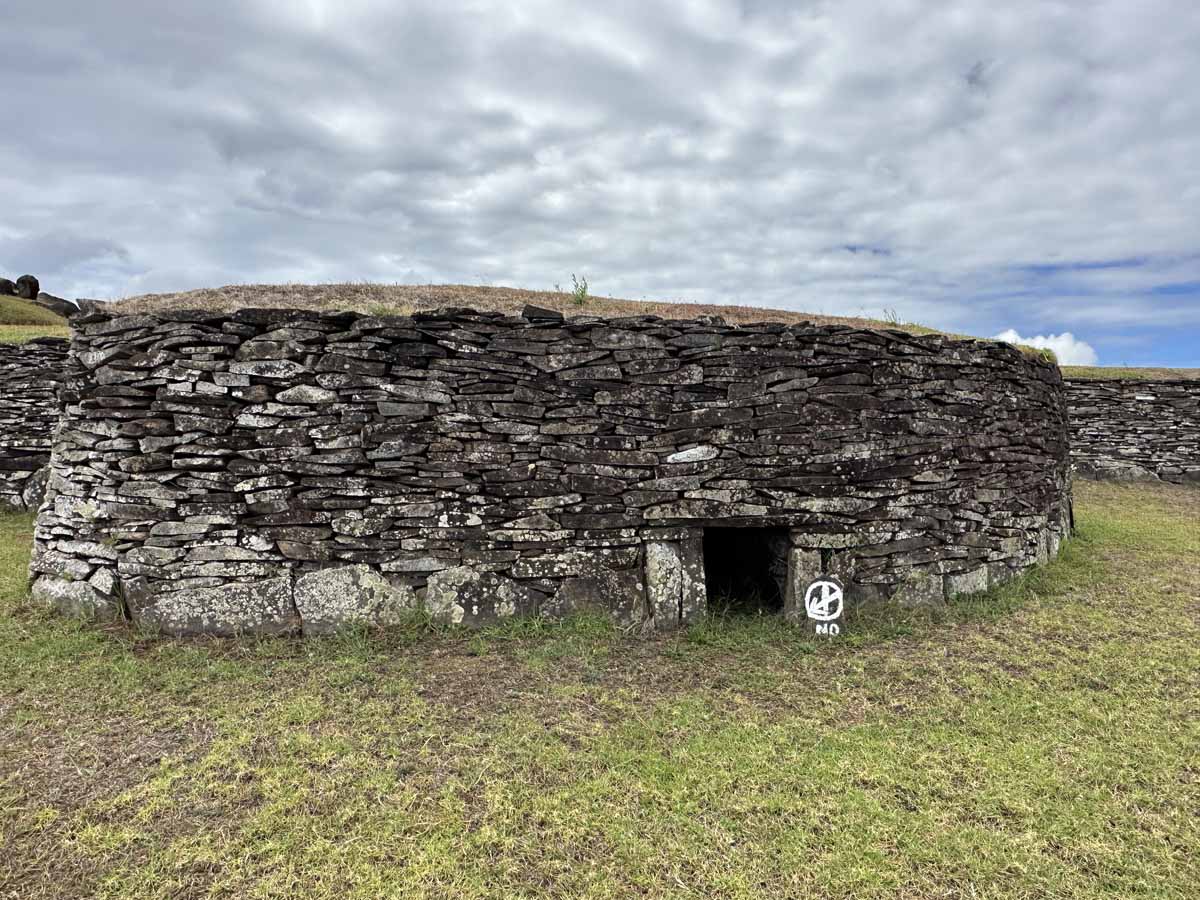
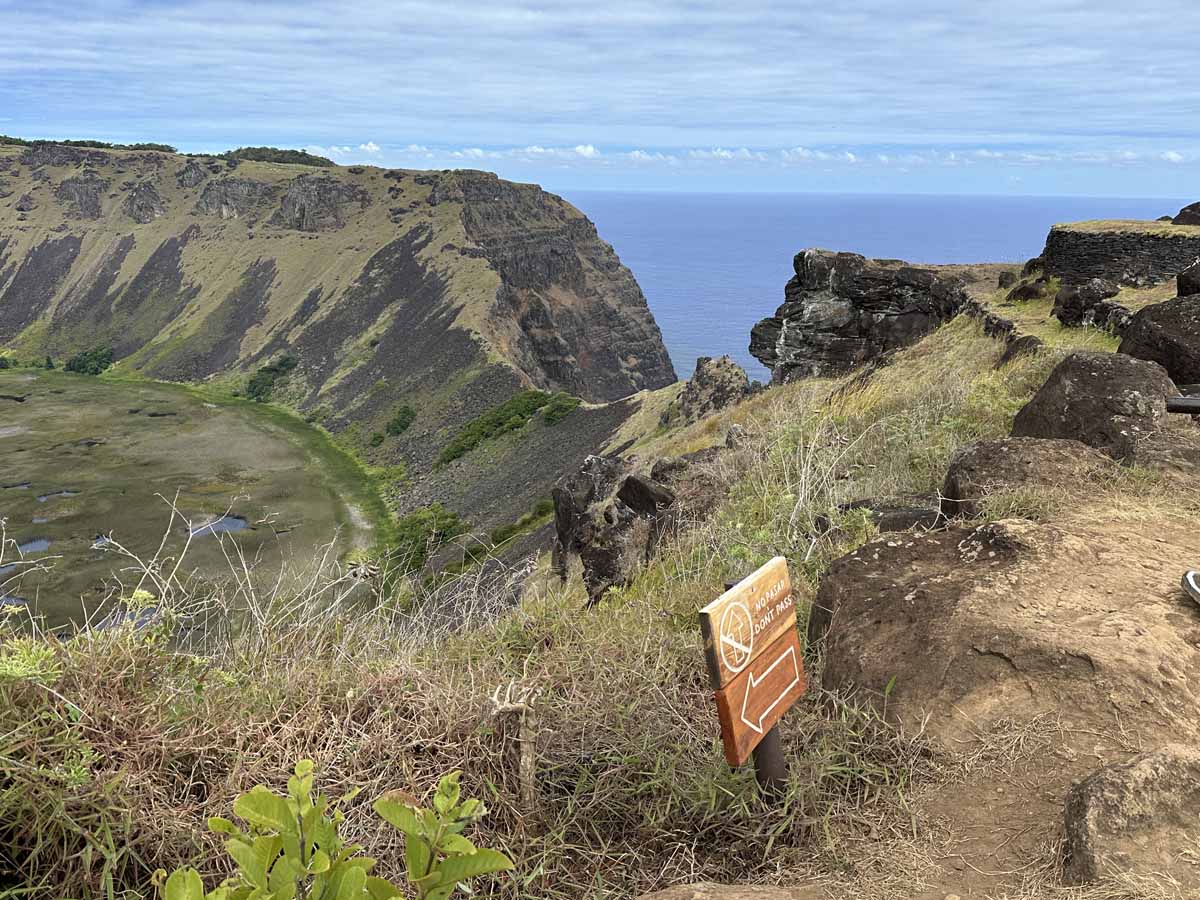
The last Birdman competition took place around 1866-1867. The Birdman cult was ultimately suppressed by incoming Christian missionaries who prohibited the pagan practice. Not to mention the fact that many competitors over the years had died from falls, drowning, or shark attacks!
-
- Edge of crater with cliff face (middle of photo) the competitors had to climb down
-
- One of the rocks with hieroglyphs
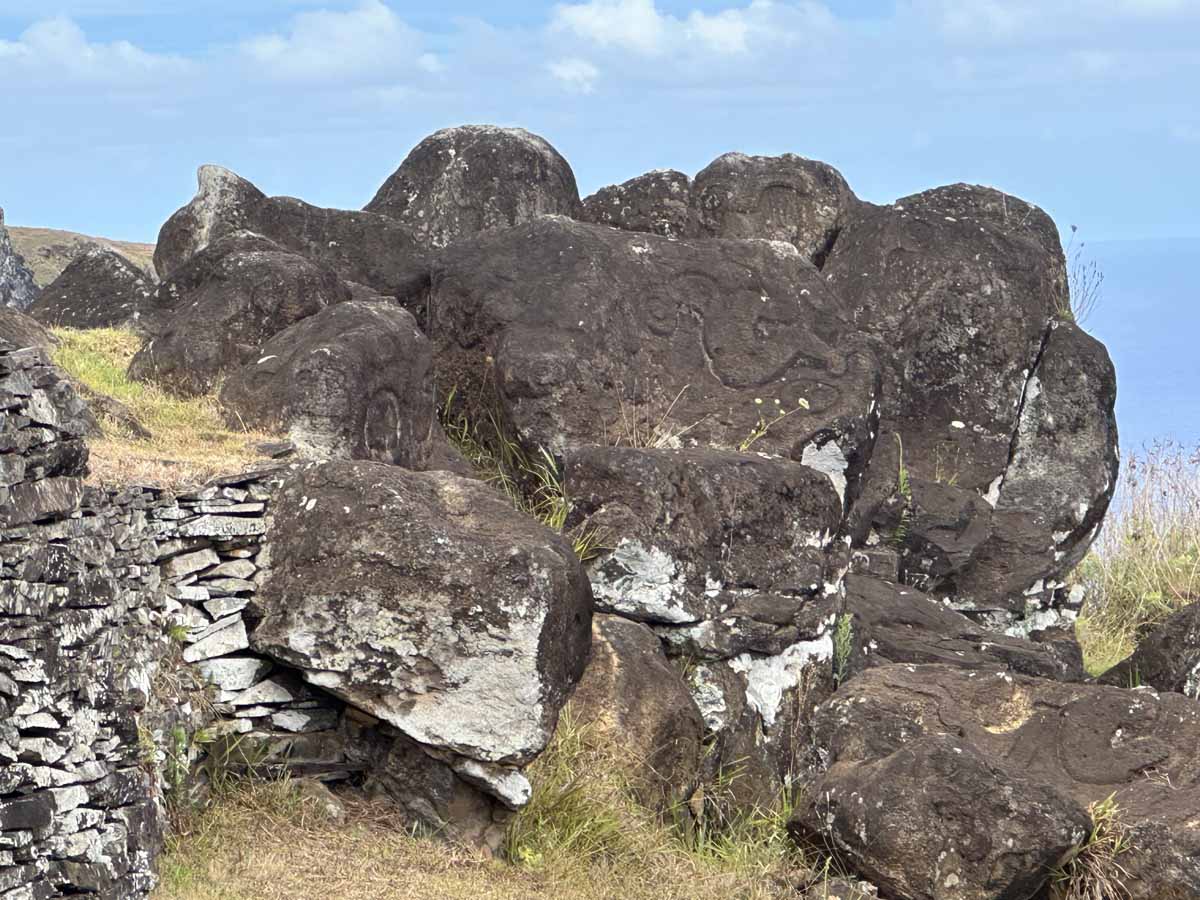
Orongo also contains 1,875 petroglyphs in the sacred Mata Ngarau area. Many of the basalt rock carvings include images of a birdman – a man’s body with a bird’s head, often holding an egg in one hand. There are also carvings of the god Makemake, turtles, fish, and fertility symbols.
Rano Kau Crater & Reed Lake
On the return, the path led us by a large, impressive crater of the extinct volcano Rano Kau. This 324-meter-tall volcano forms the southwestern headland of Rapa Nui. The water-filled (entirely by rain) caldera is around 1.5 km in diameter.
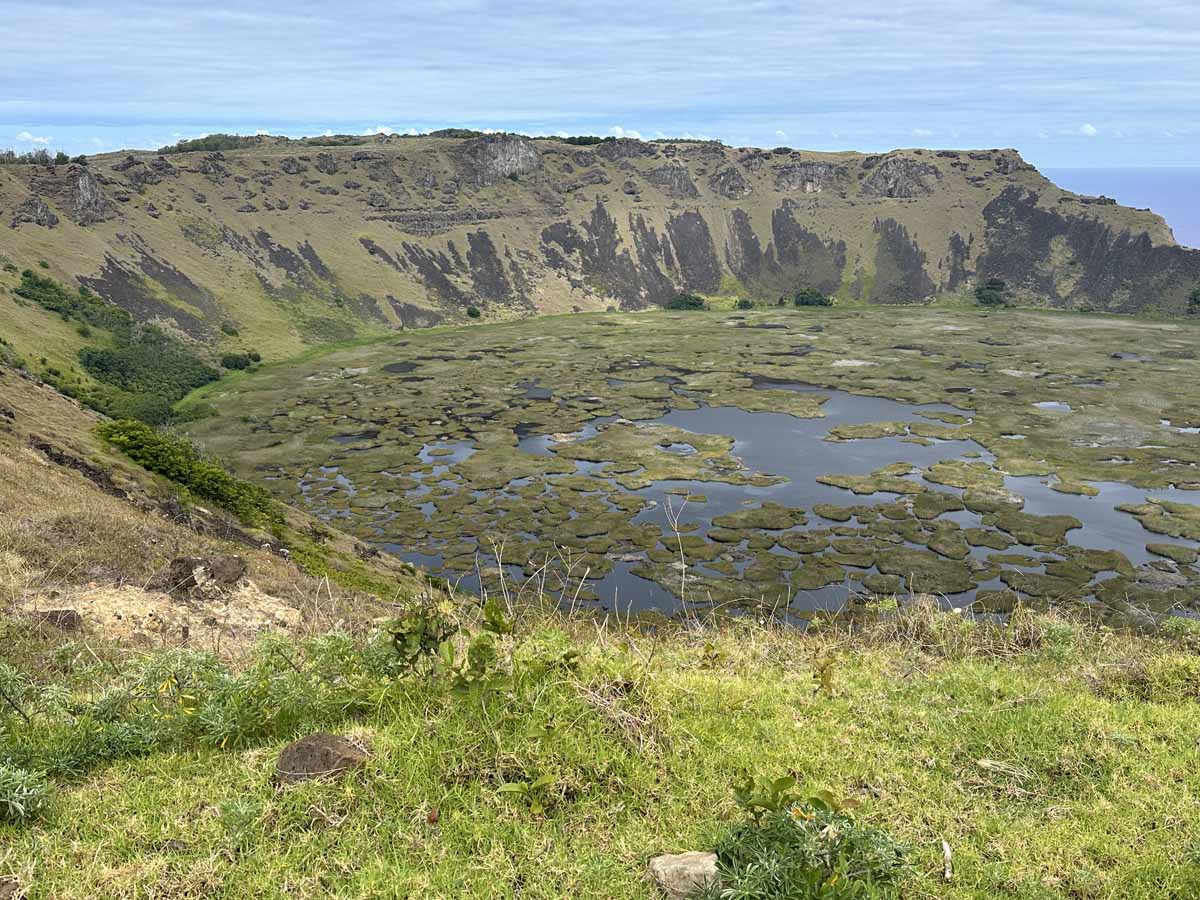
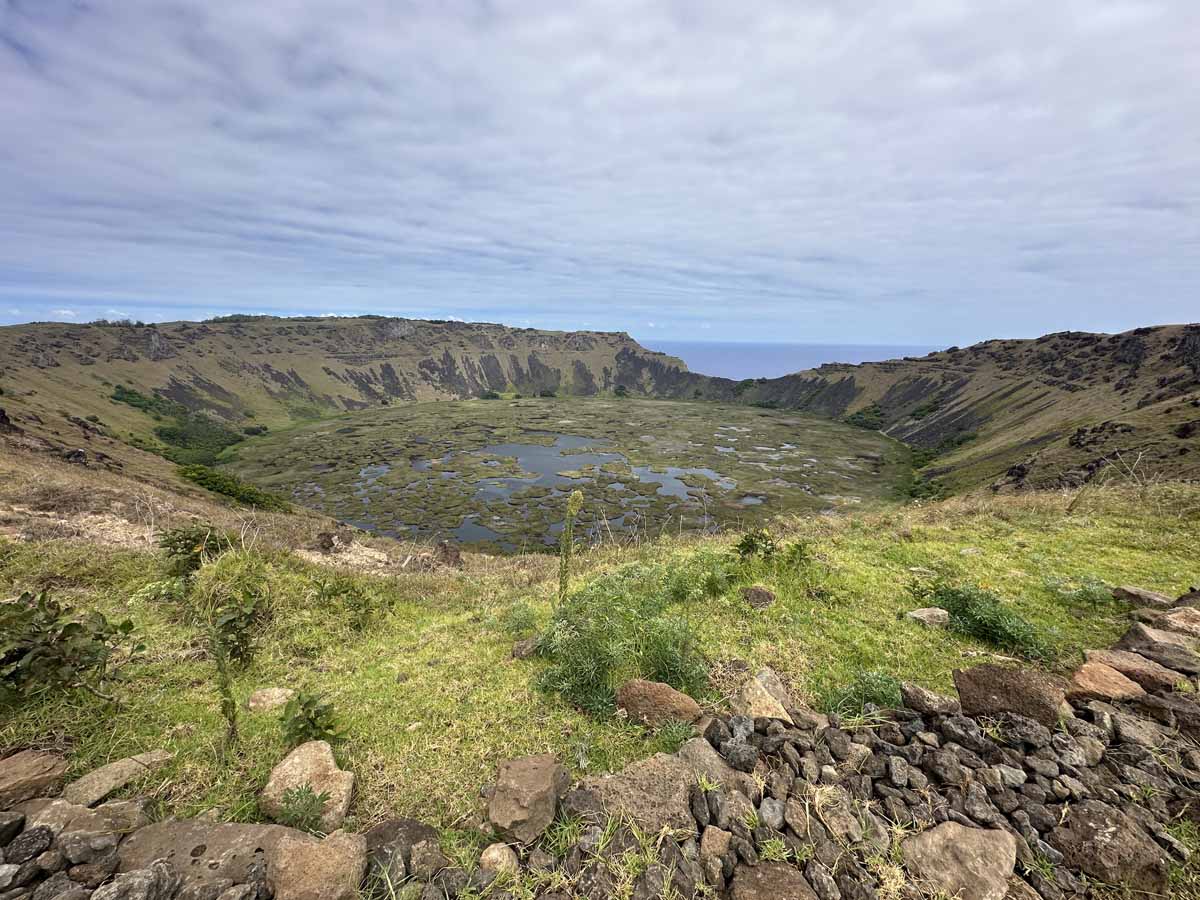
Plus, this beautiful “reed lake” is mostly covered by small, floating islands made of totora reeds. Turns out, these are the exact same reeds found in Lake Titicaca (on the border of Peru & Bolivia) & its Uros floating reed islands (which I visited in 2002).
3) Sunset Viewing at Tahai
Watching a beautiful sunset at Tahai framed by ancient towering moais – on one of the most remote locations on earth – is another unforgettable Rapa Nui experience! Of course, this legendary Tahai sunset viewing was on our itinerary.
The Tahai Moai & Ahu Platforms
Tahai is another important archeological site. It’s located on the island’s rocky western shore, just north of downtown Hanga Roa (roughly a 10-15-minute walk along a coastal path). This ancient complex (restored in 1969-70) contains three ahu platforms – two with a single moai and Ahu Vai Uri containing 5 moai.
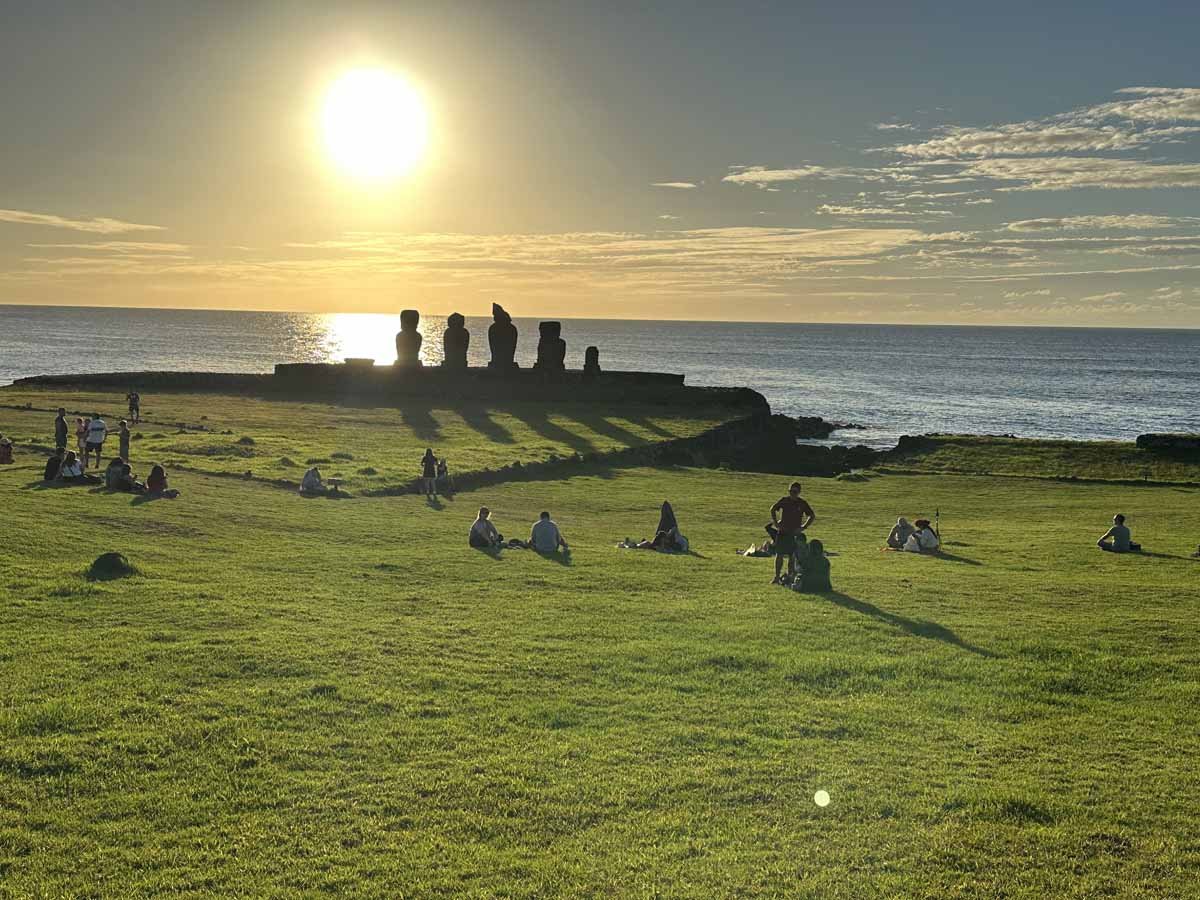
We arrived at Tahai at 8:15pm, in advance of the 9pm sunset. First, Nico gave us a short tour of the site which was located on a large grassy area. Its natural amphitheater is perfect for many people to gather on the comfortable lawn to enjoy each night’s “sky show.” No tickets needed!
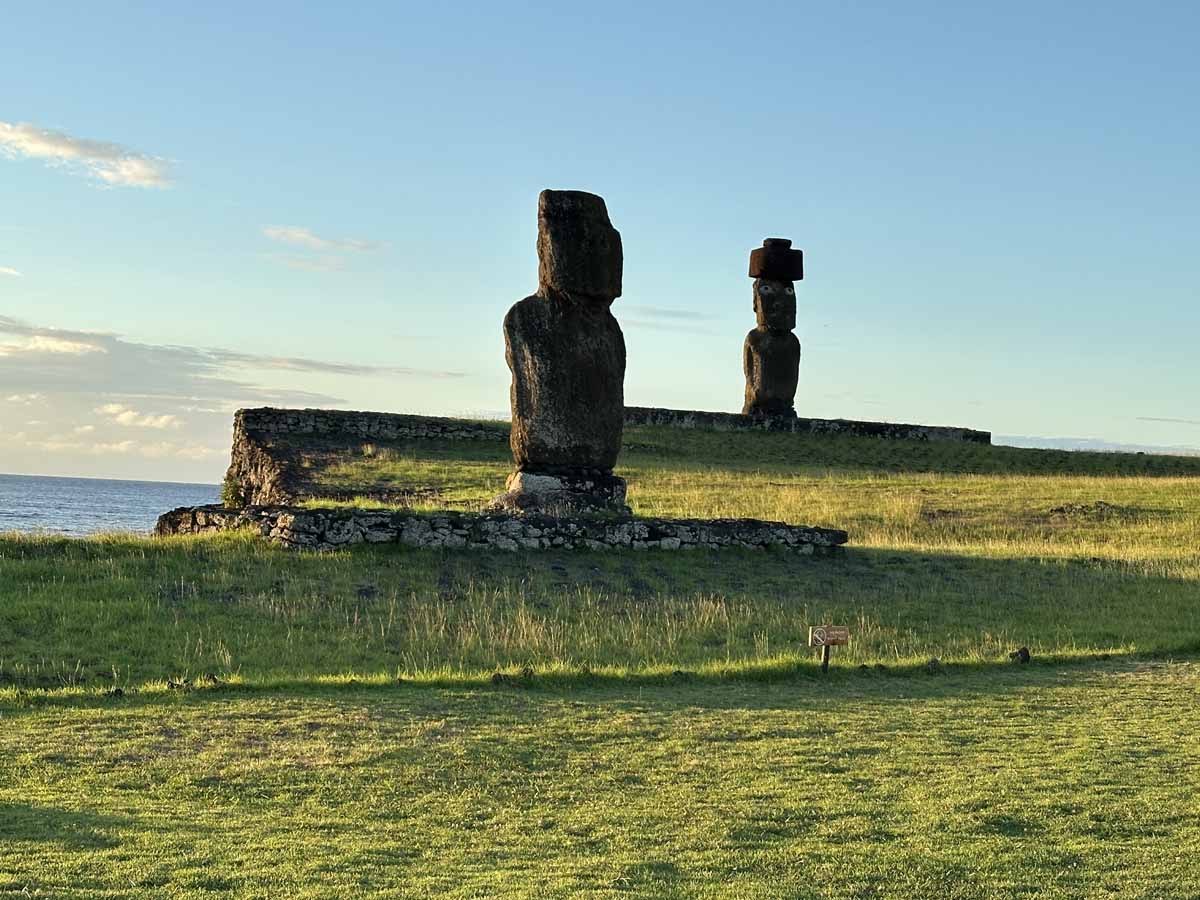
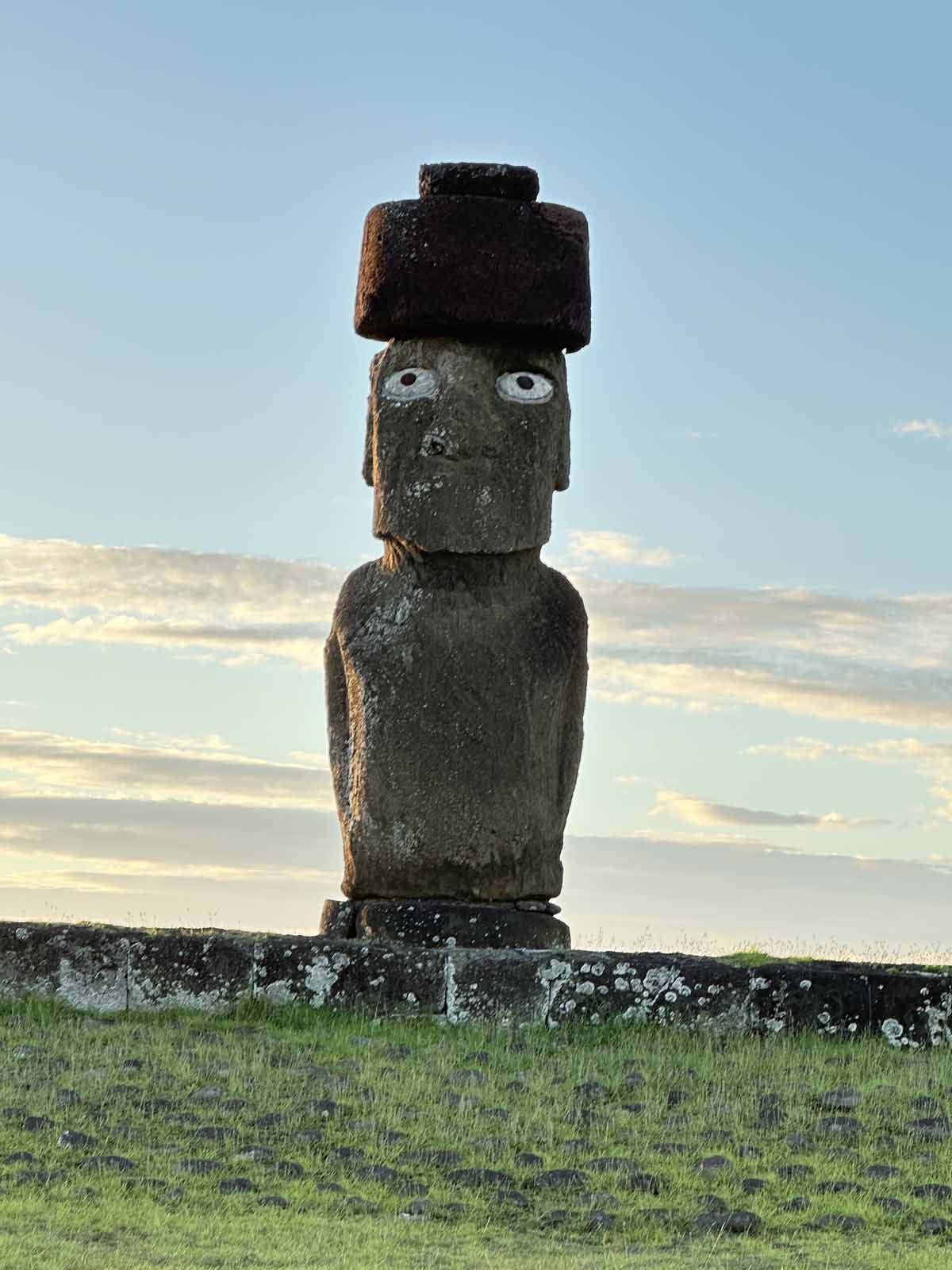 Ahu Ko Te Riku is one of the island’s most photographed moai, primarily because of its white coral eyes (right). Based on unearthed coral fragments found during excavation, archaeologists were able to reconstruct its eyes in the 1970s. This makes it the only moai on the island with permanent restored eyes.
In Rapa Nui belief, inserting coral eyes into a moai was the moment it became spiritually alive, and thus capable of radiating mana over the community it protected. This 5-meter (17 ft) tall moai also has a large pukao topknot on its head.
Ahu Tahai, the other single moai, is Rapa Nui’s oldest statue. This humble, eroded figure with a thick torso and wide neck was built around 690 AD.
Tahai is also the final resting place (in 1978) for pioneering American archeologist William Mulloy I mentioned earlier. He was beloved by the locals & was hugely responsible for the restoration of Ahu Akivi, along with this Tahai site, and the village of Orongo.
Picnic Dinner / Wedding Couple
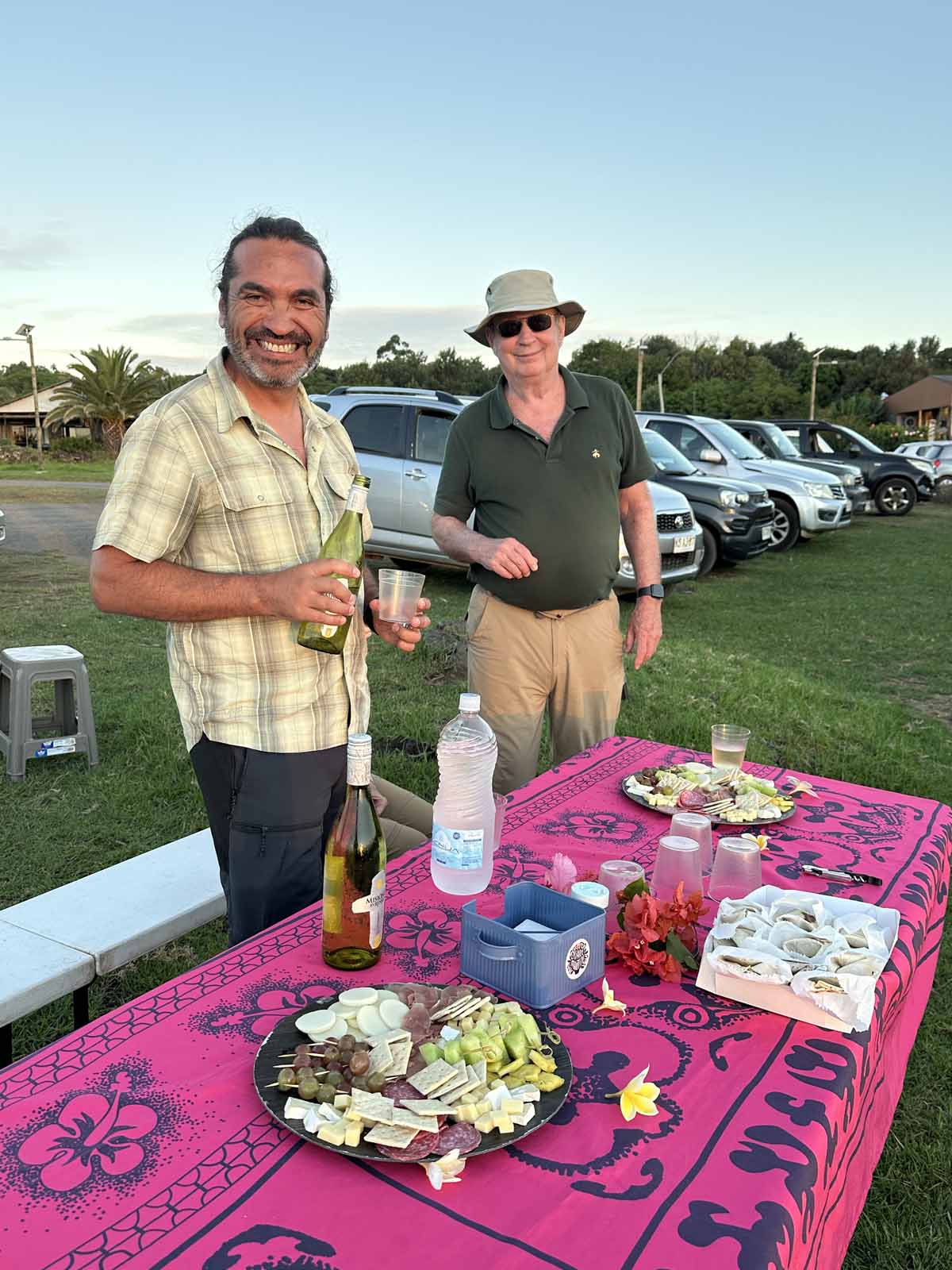
After the Tahai site tour & photo taking, we headed up a short hill to the parking lot where a picnic table had been set up with our dinner and drinks. From our seats, we enjoyed the lovely sunset. Plus, we saw a beautiful couple in traditional ceremonial Polynesian feathered clothing who had just celebrated their marriage on the nearby lawn.
-
- Luis, our OAT Trip Leader & Bob
-
- The happy wedding couple
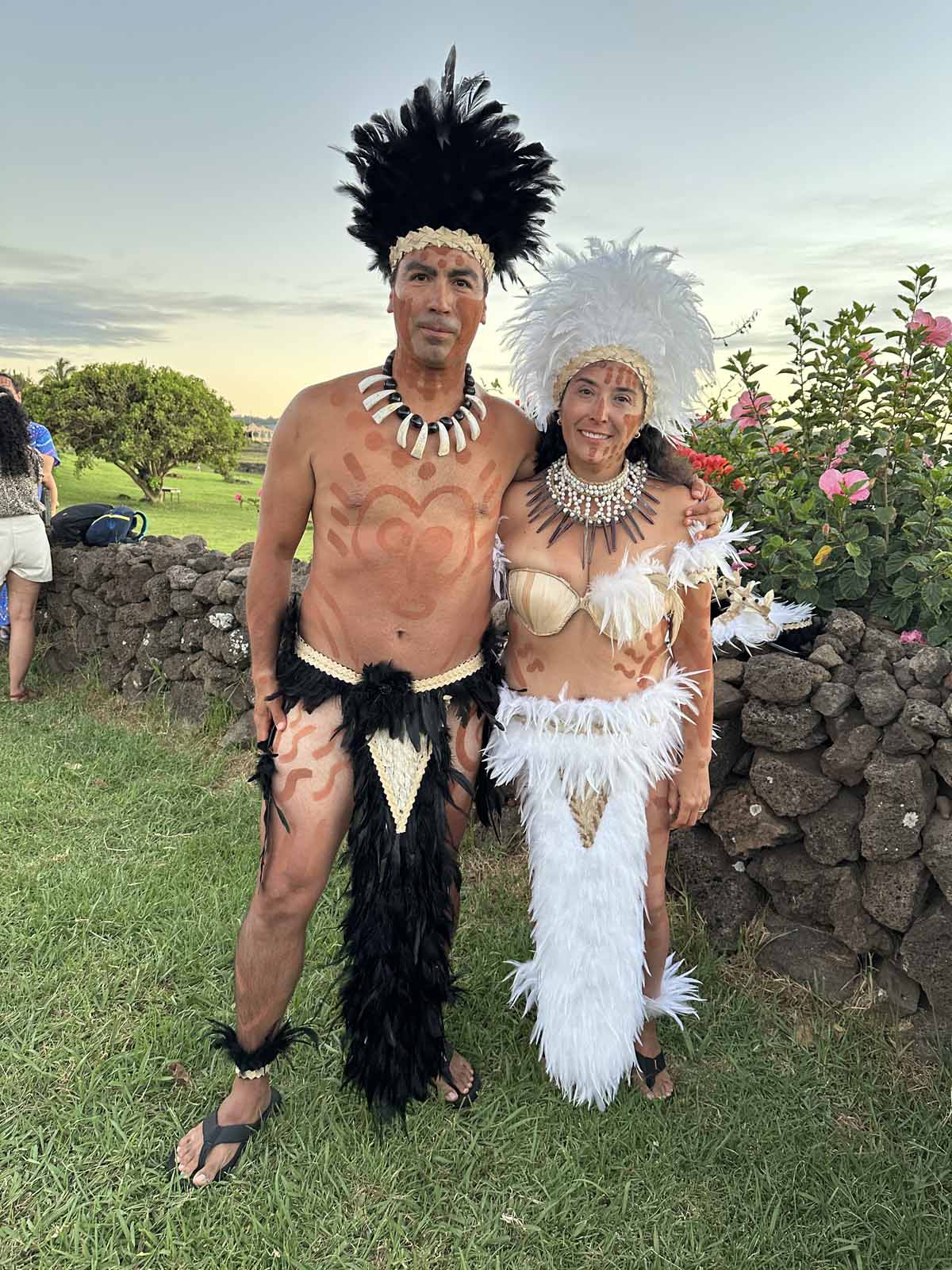
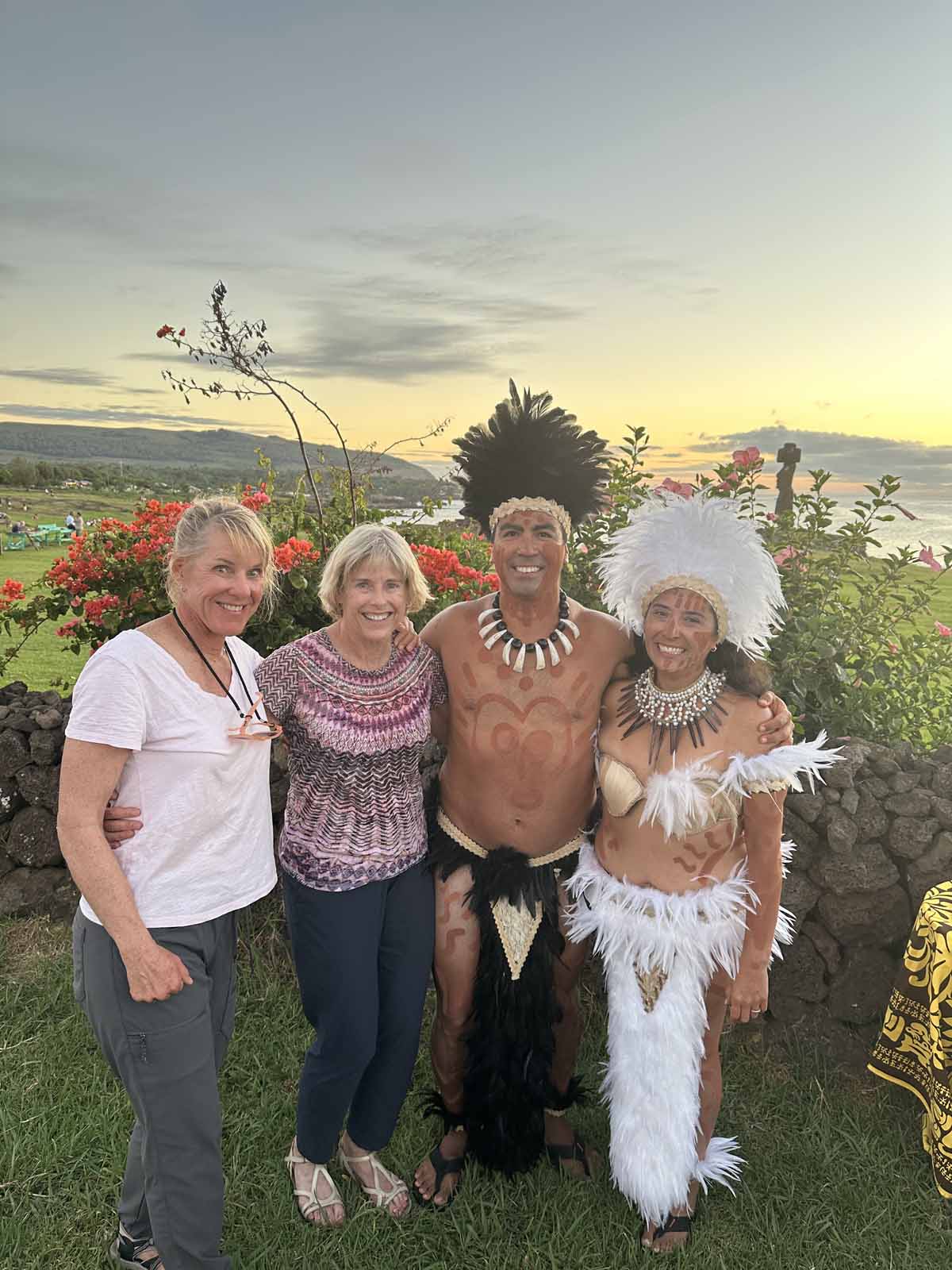
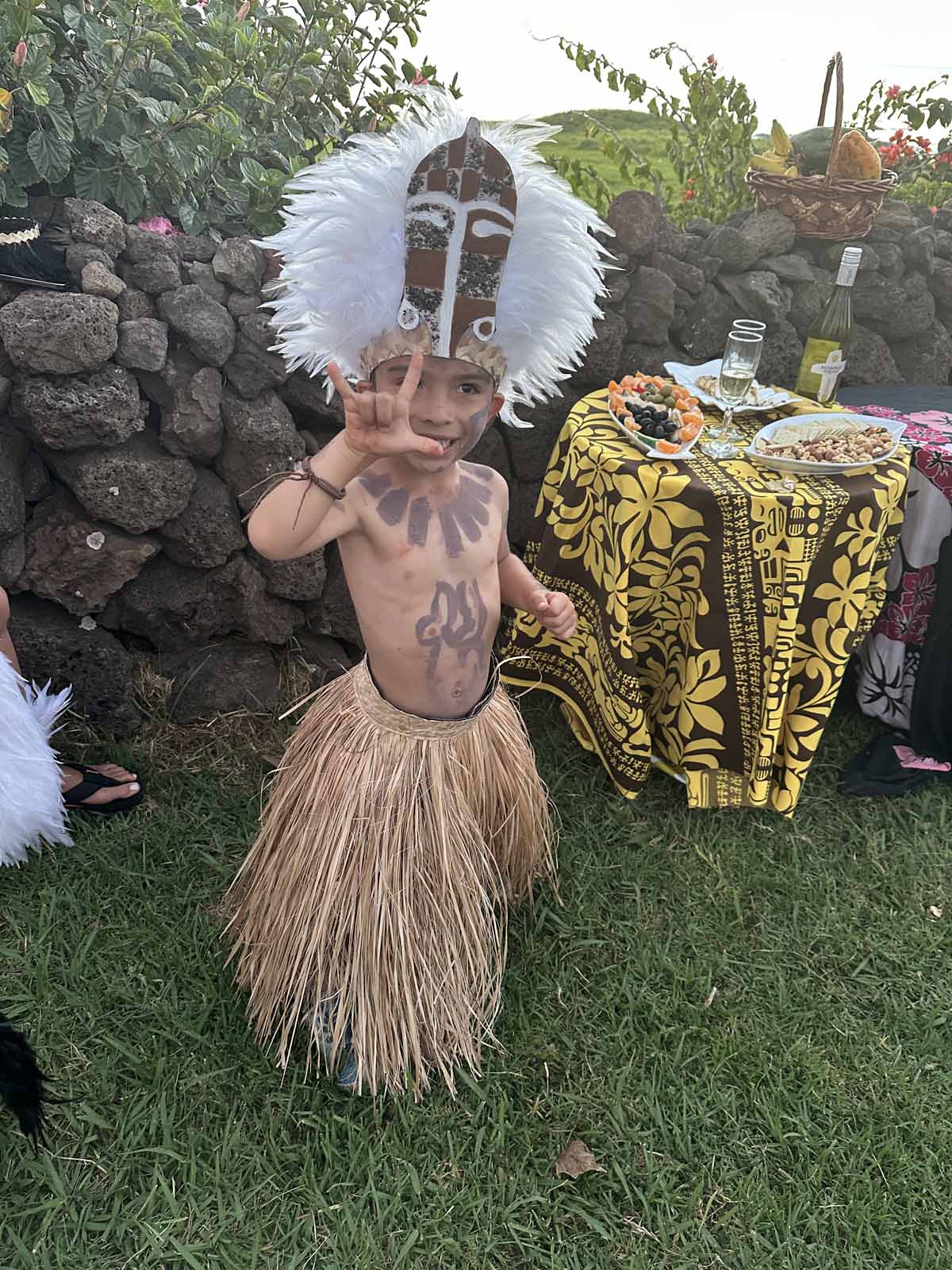
With some prodding from our group (since I badly wanted a photo!), Kim & I went over to offer our congratulations and to say how beautiful they looked. This lovely couple not only agreed to a photo but insisted they get one with us. Plus, their adorable 4-year-old-son also posed for us – so proud in his grass skirt & headdress!
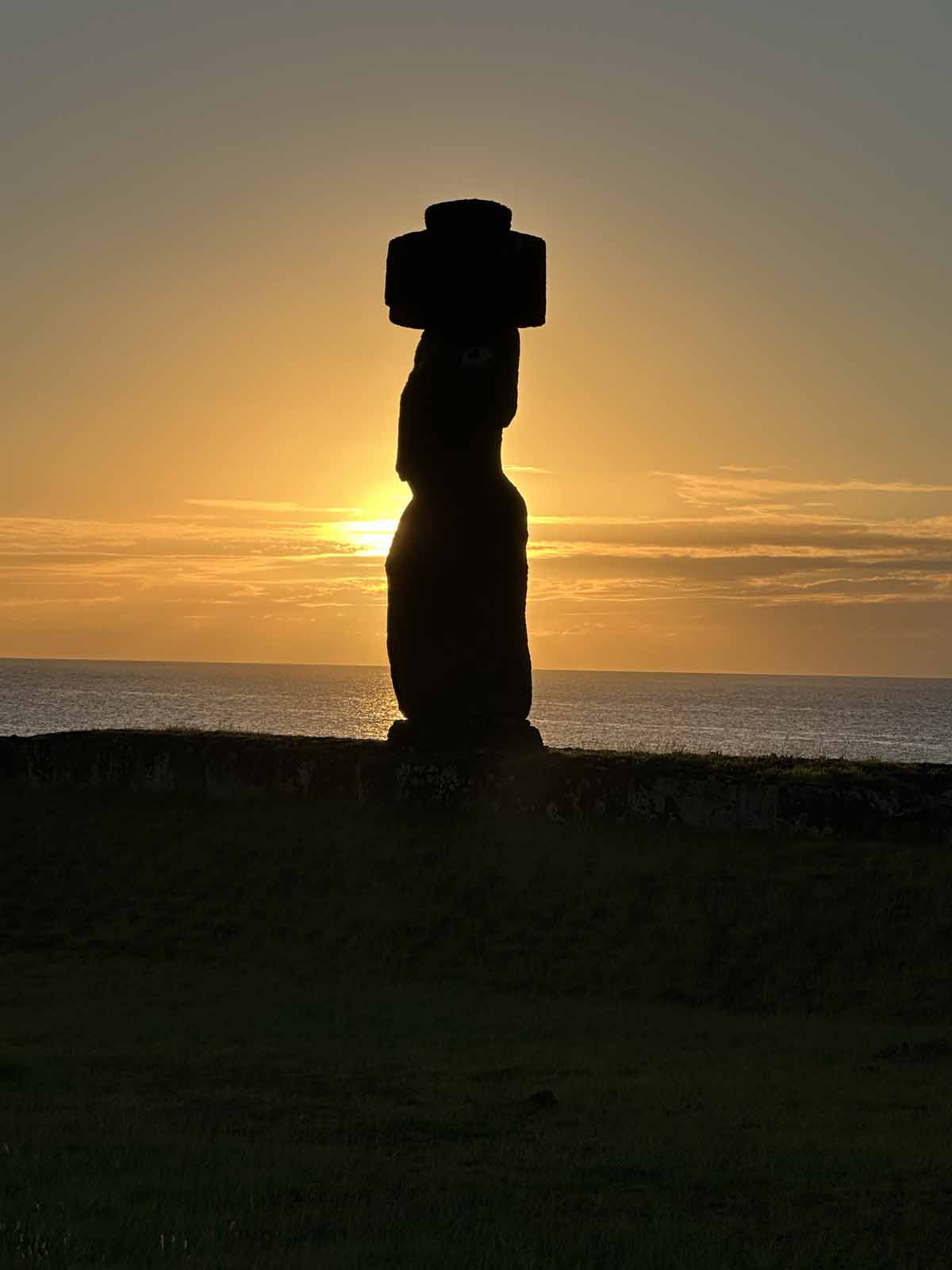
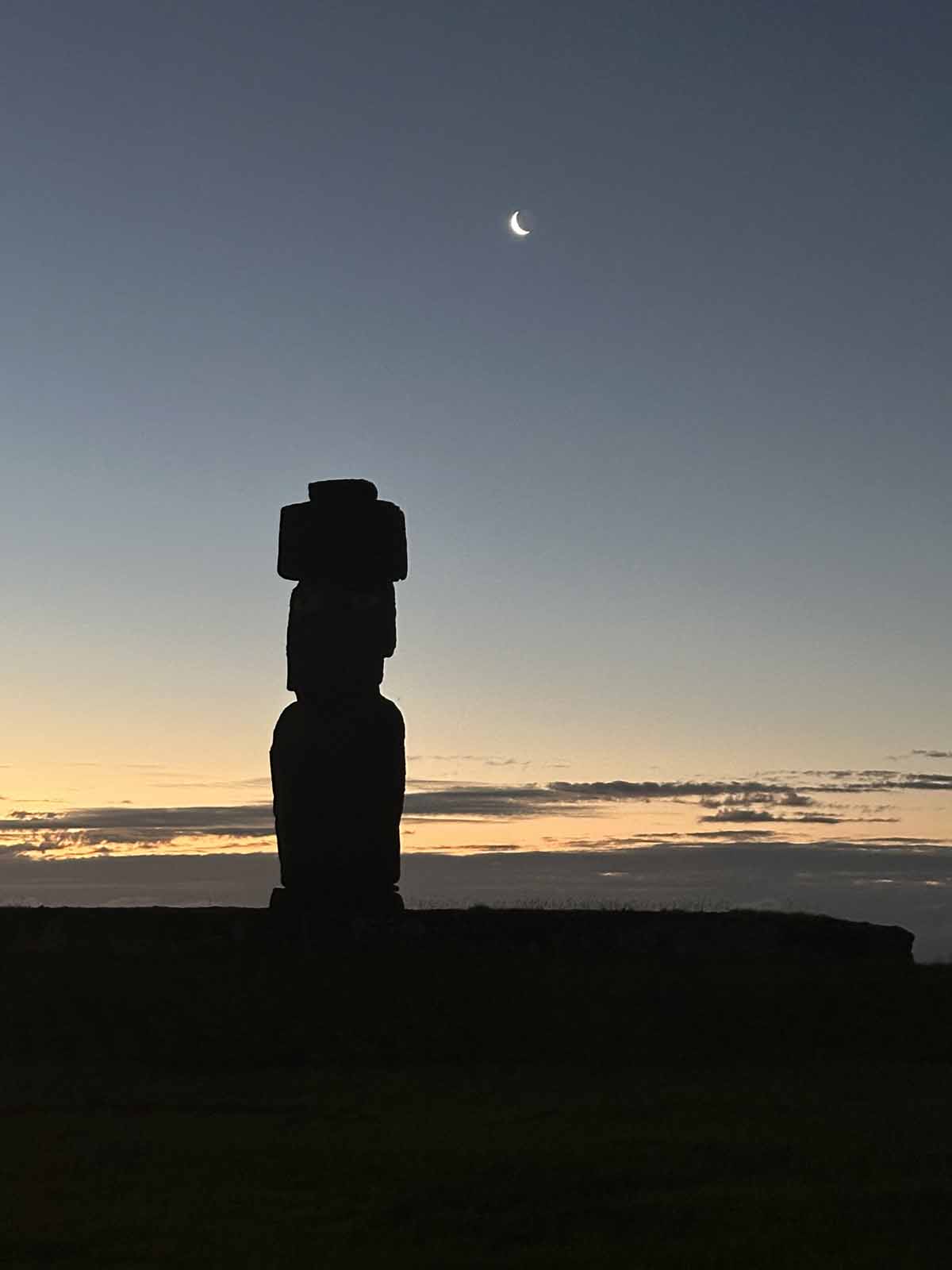
We stayed at Tahai until around 9:45pm, when the skies had darkened and the sliver of a crescent moon was visible hovering over the coral-eyed moai. On the drive home, we rejoiced in the special Rapa Nui evening we had just enjoyed!
4) Sunrise Over Ahu Tongariki
Watching the golden rays of the sun rise behind the 15 magnificent moai of Ahu Tongariki is another one of Rapa Nui’s most magical experiences. This was an optional item (for an additional fee) on our itinerary – but my group was a decisive “hell yes,” even after learning the 6 am hotel departure time.
We had all loved our daytime visit to Ahu Tongariki two days prior. But how could we miss the opportunity to experience Rapa Nui’s most famed moai group in total darkness and watch these stone giants emerge into the light as the dawn breaks.
Our Journey to Tongariki / Stargazing
The morning began with an early wake-up call to meet our guide at 6:20am in the hotel parking area. This time, Nico had the smaller Maururu company van which he drove himself. It took around 30 minutes to reach the site on the other side of the island.
We arrived at Ahu Tongariki’s big parking lot in total darkness, joining a few other vehicles. From the back of the van & using only a flashlight, Nico offered us coffee or hot tea, along with some simple biscuits.
Devoid of light pollution, it was a perfect opportunity for some quick stargazing by the van in the clear, dark skies. The Milky Way was shimmering bright plus we could see the Southern Cross (a thrill for this Northern Hemisphere group!) plus two other bright stars, including Sirius.
Entering the Park for the Sunrise Viewing
We then entered the park (tickets needed!), following Nico, each carrying our beach chair. He knew exactly where to place our chairs for the best viewing – further back from the platform, allowing wider views of the moai with less people directly in front of us.
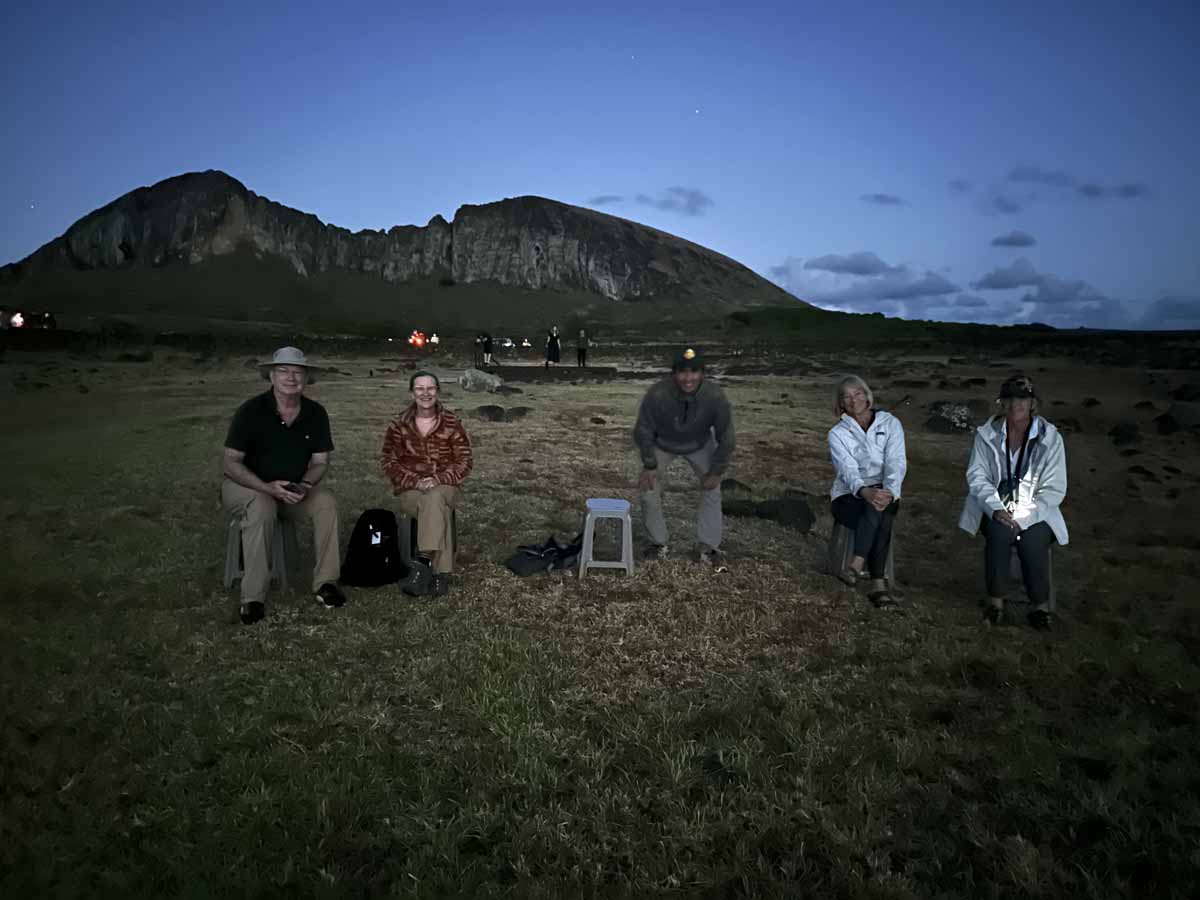
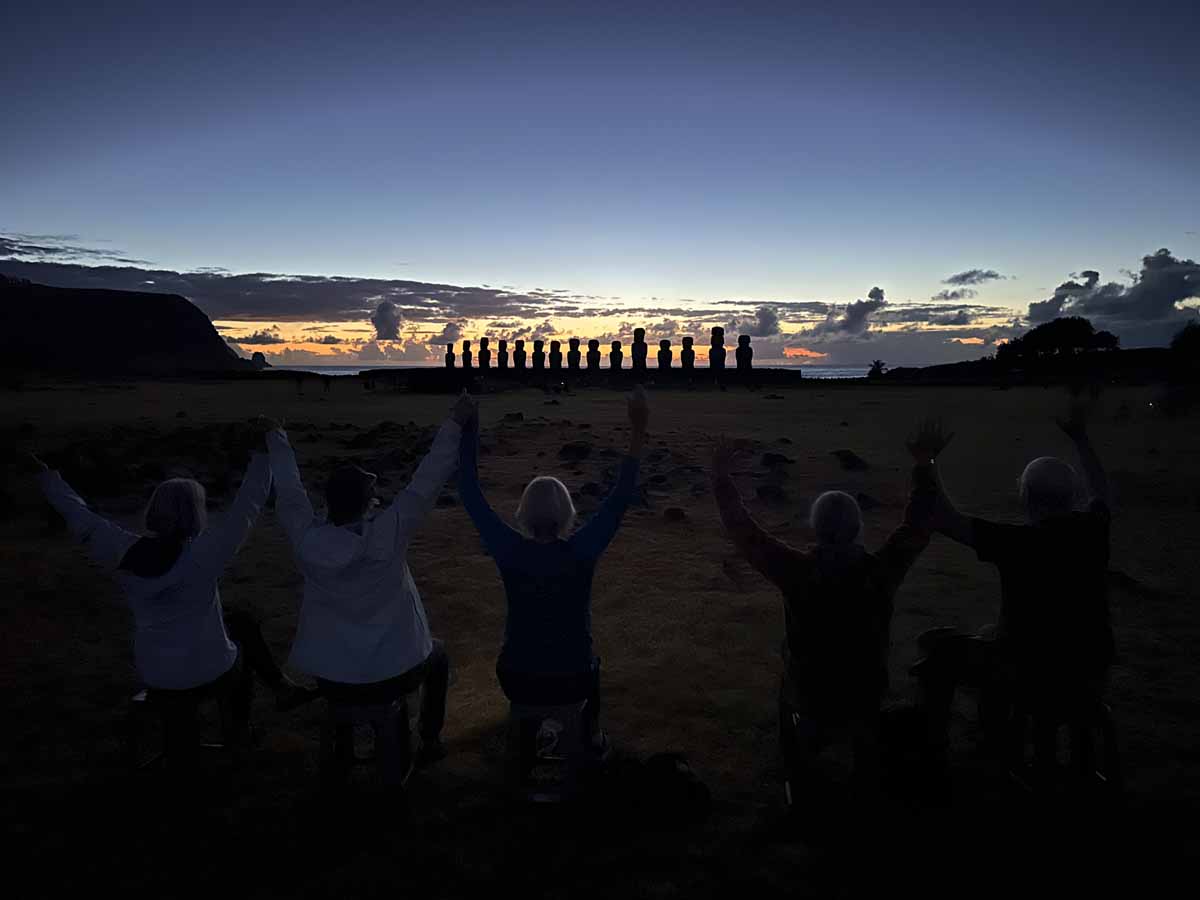
We patiently waited in the dark, as the skies slowly lit. It was such a peaceful, cool scene. I took my first photo at 7:15am with perfect low clouds and continued to snap photos as the light changed.
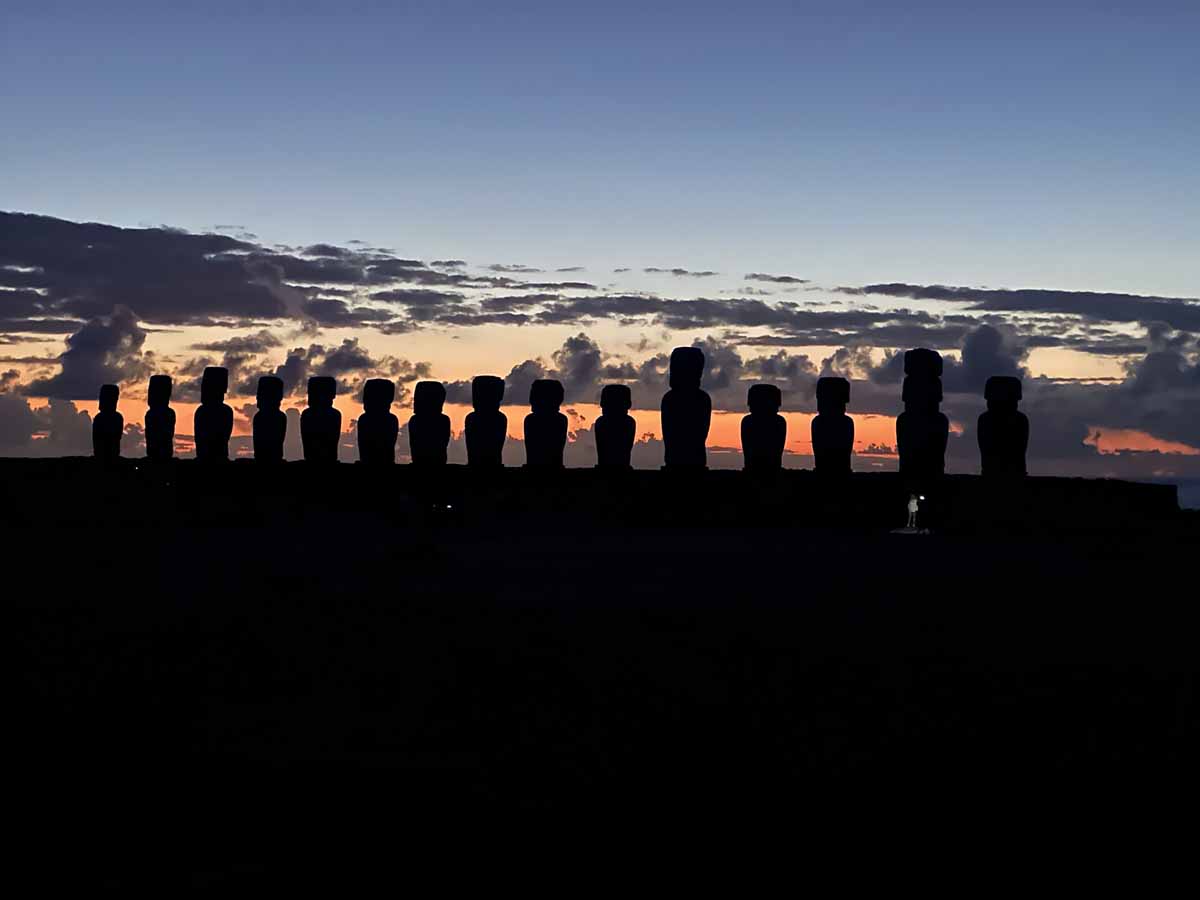
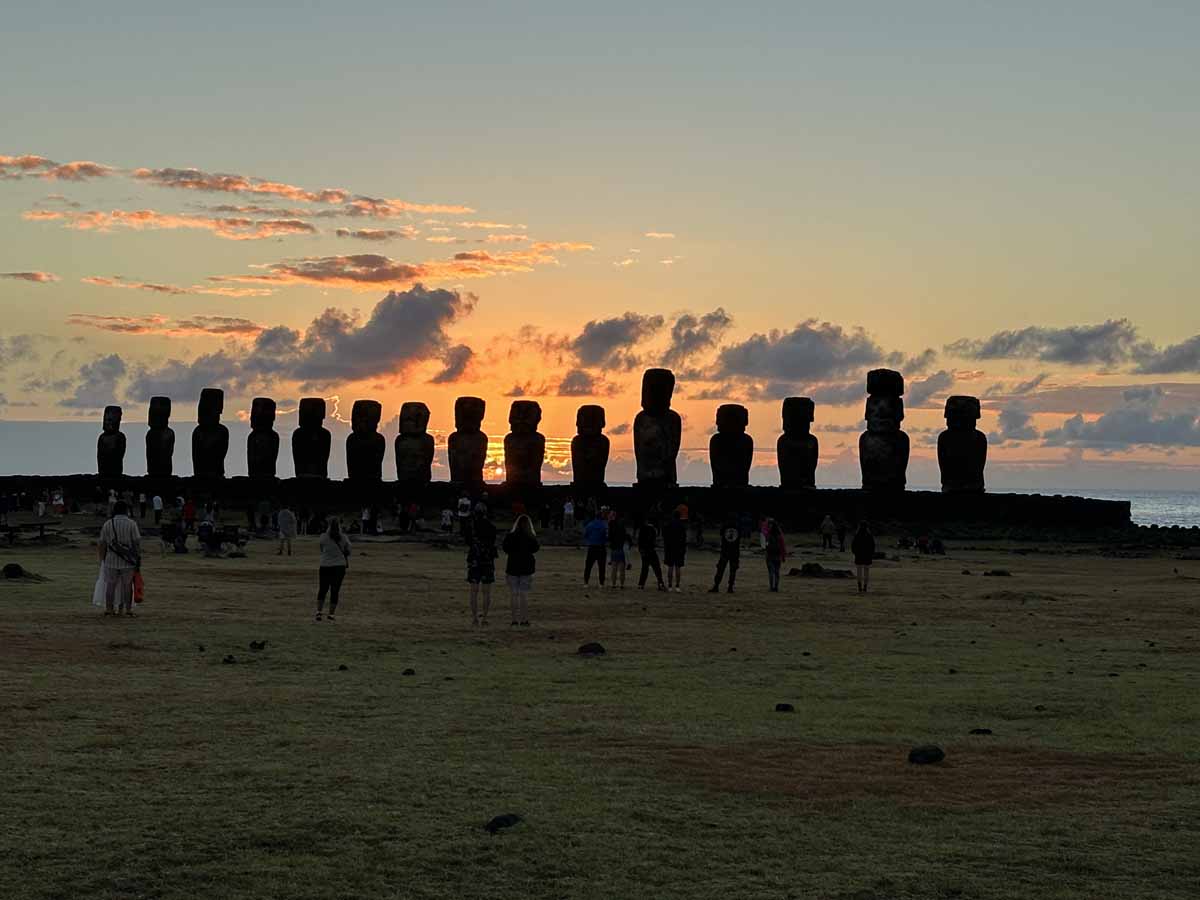
A little before the official sunrise at 8:07am, the sun rays began to emerge – and the sky was changing colors from orangish to golden. The photos will give you a sense – it was magical!
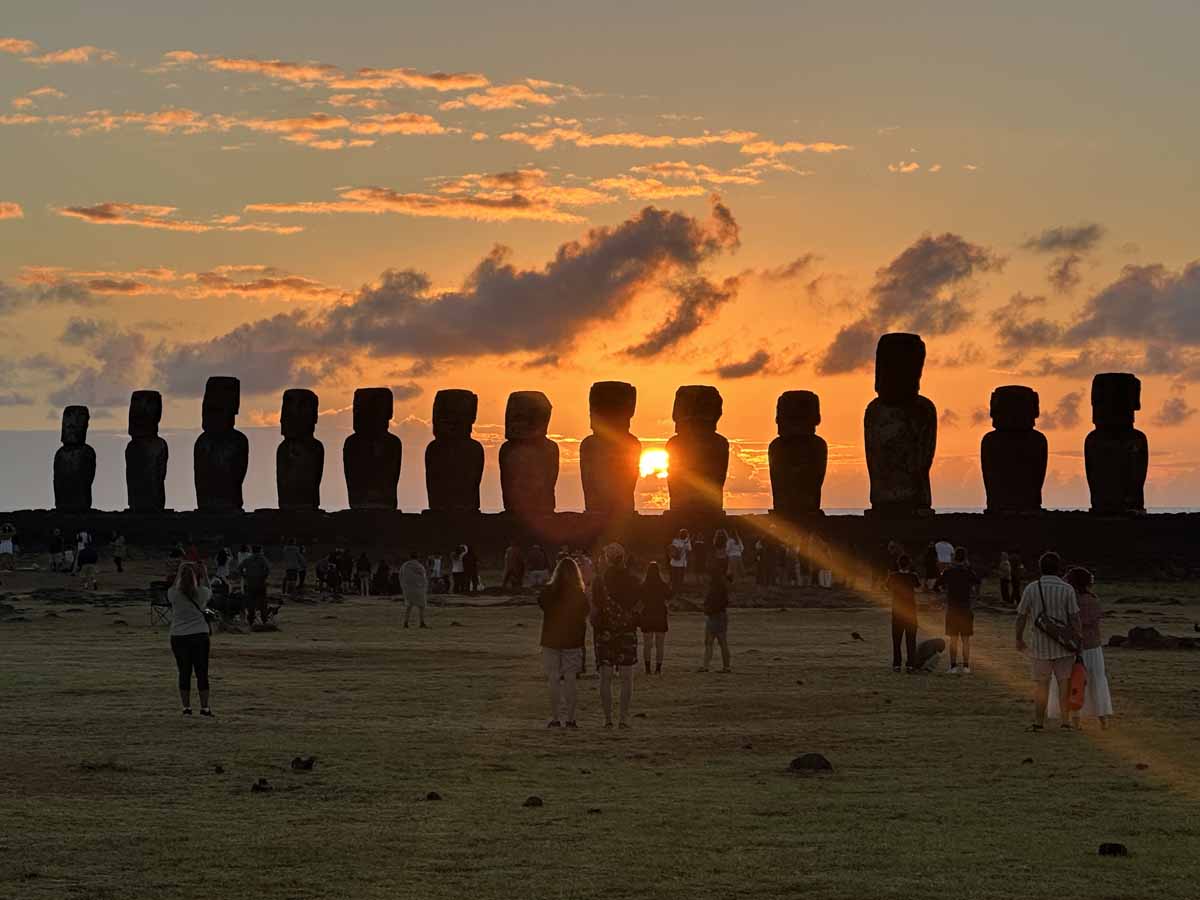
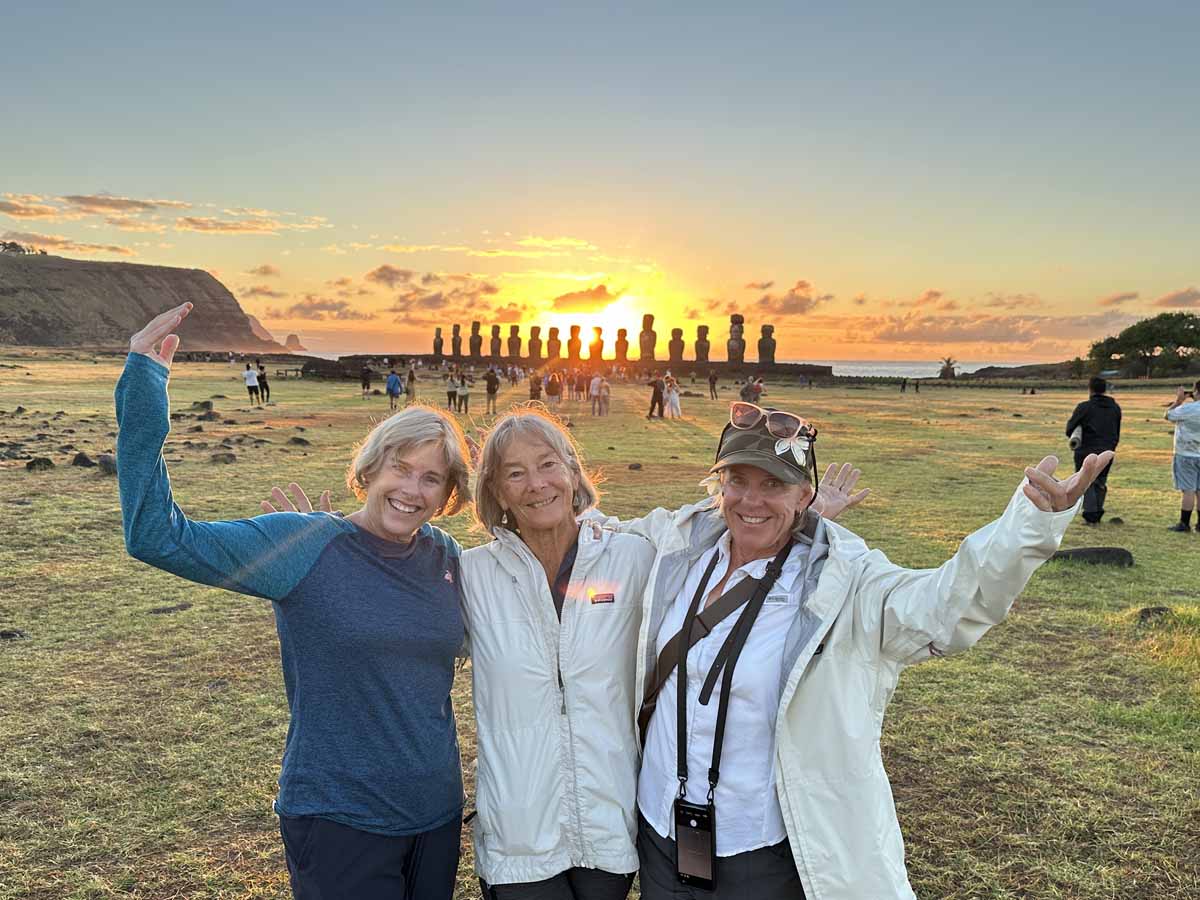
I like this description from AI/Claude: Because the moai face away from the ocean, the first light of dawn hits their backs rather than their faces – creating a warm golden glow around their silhouettes while their faces remain in shadow. As the sun rises higher the light wraps around and gradually illuminates their features. It’s a slow, almost theatrical reveal.
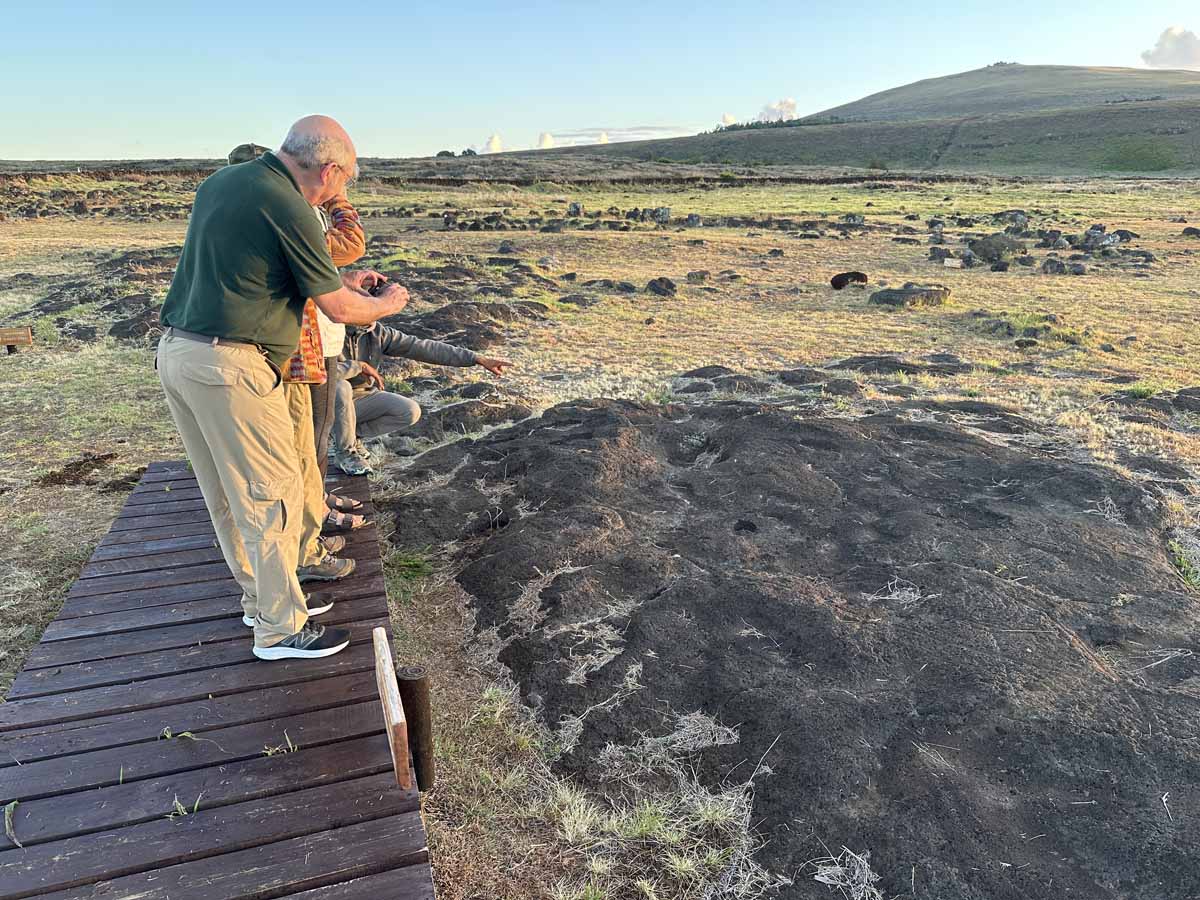
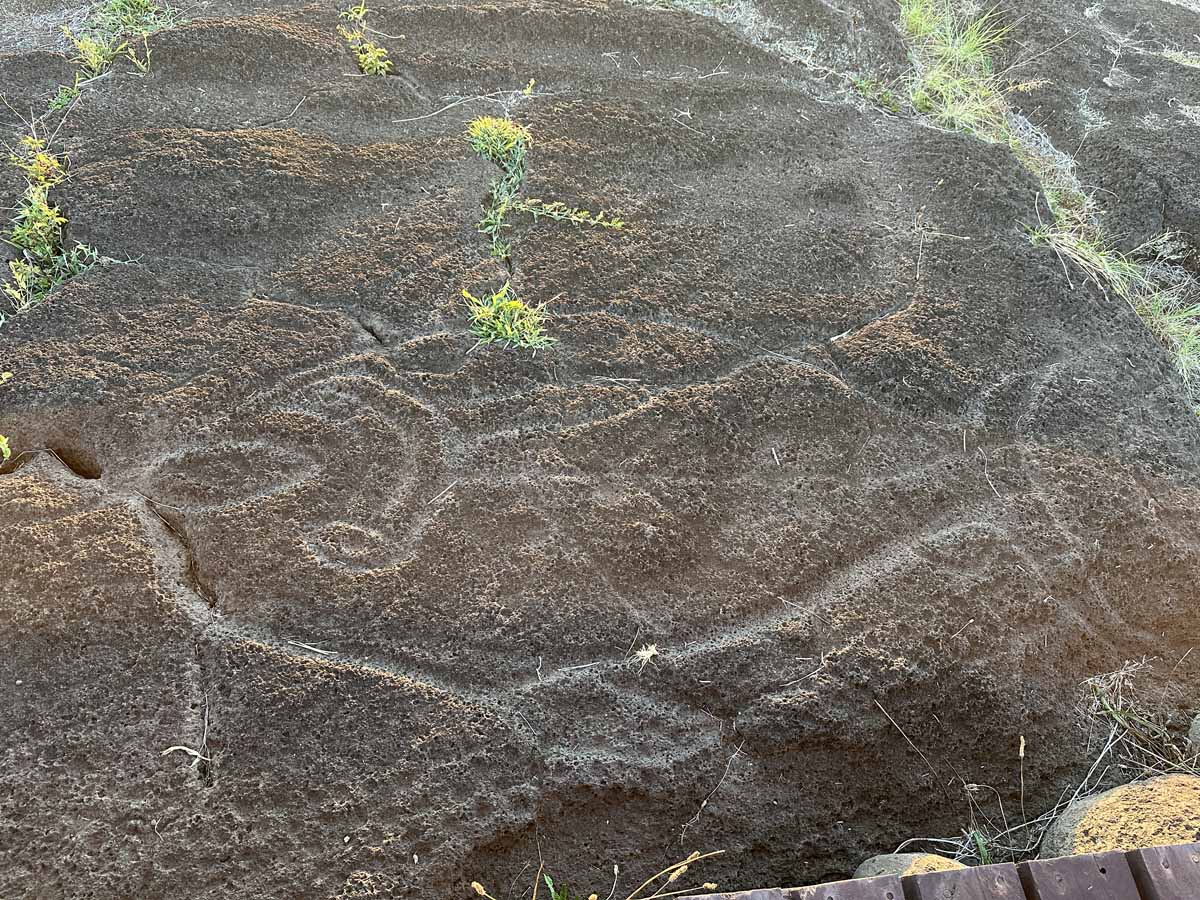
After the sun had risen more and daylight was upon us, Nico guided us to back area of the site (close to the fence by the main road) to show us some large stones on the ground with petroglyph carvings – which we viewed from a wooden platform. (above) It was 8:35am when we departed Tongariki for the drive back to the hotel.
The Perfect End to a Perfect Visit
From a lovely Tahai Sunset the prior evening to the grand finale of a beautiful Tongariki Sunrise this morning – it was a perfect ending to our time on Rapa Nui!
We flew back to the Chilean mainland later that day – all of us feeling immensely grateful we had been able to visit Rapa Nui & experience the many wonders of this very special island!
FINAL REMARKS & RESOURCES
Flights / Getting to Rapa Nui
LATAM is the only airline that flies to Easter Island’s Mataveri International Airport – and only from Santiago, Chile. The 5-hour flight takes place on a Boeing 787 Dreamliner.
Flights are generally once daily, with up to 2 flights during their summer high season (December through February). During the low season (with cooler, rainier weather), LATAM may reduce its schedule to just 3 to 5 flights per week.
-
- View of Rapa Nui runway from hill above
-
- LATAM widebody plane
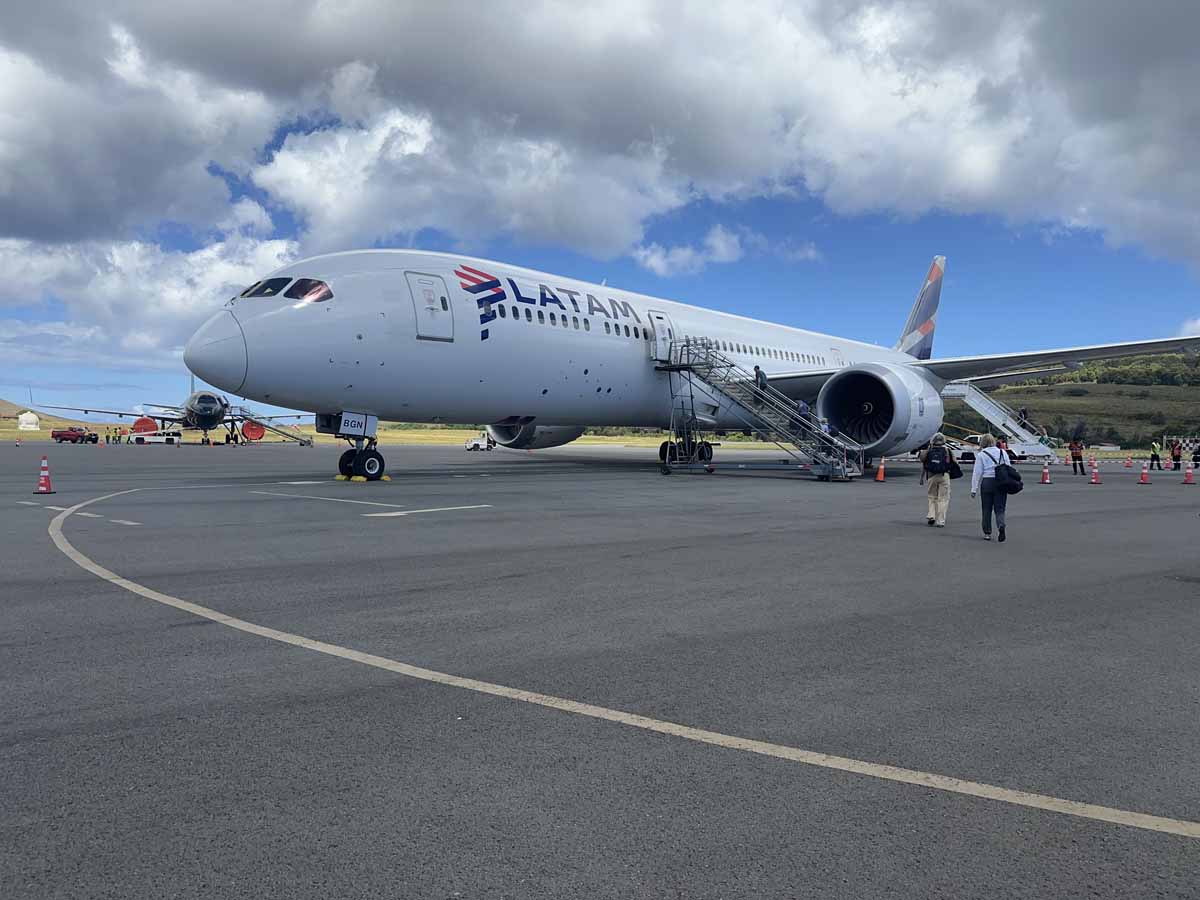
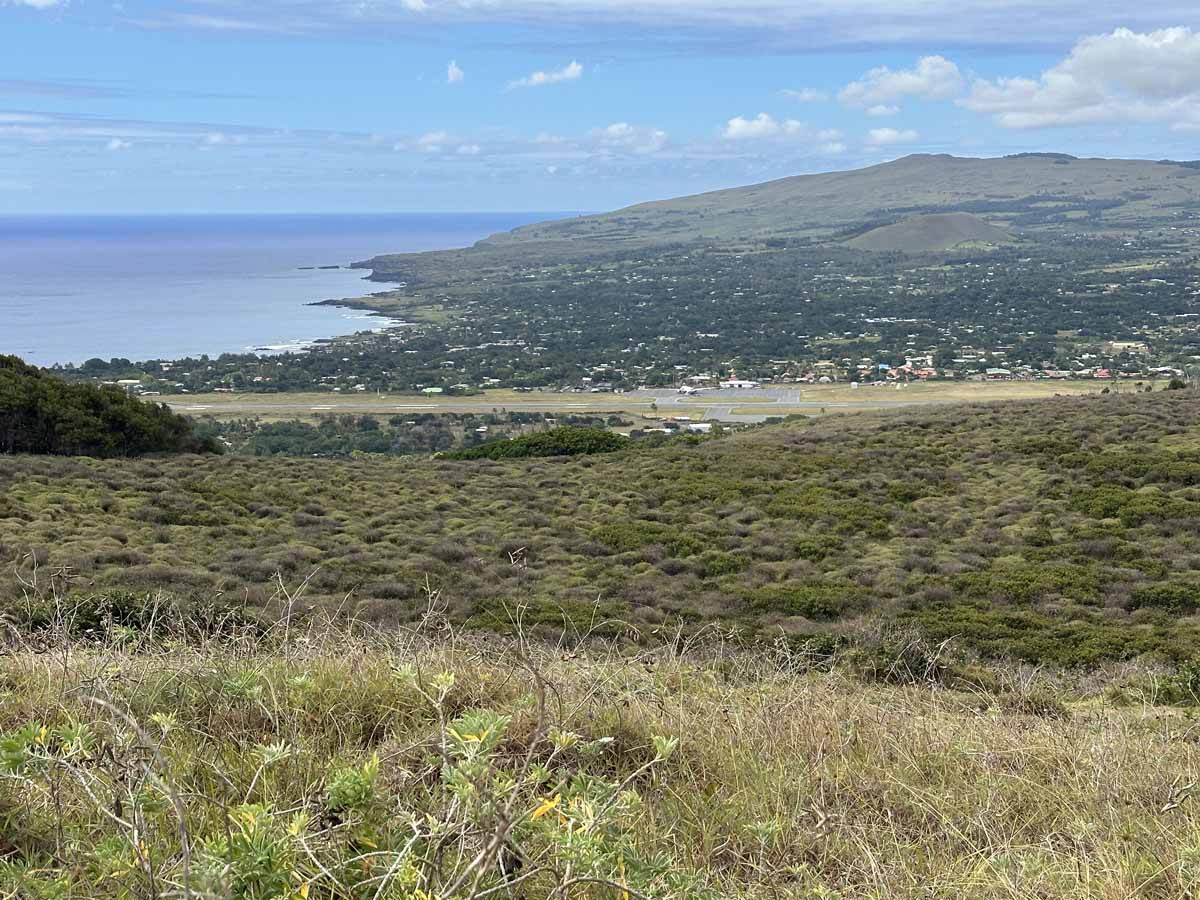
FUN FACT: The original airport in Rapa Nui was built in 1967. However, the runway was extended in 1987 to allow NASA to use Easter Island as an emergency landing site for the space shuttle. This was a joint U.S.-Chile project, fully funded by NASA.
Turns out, Rapa Nui has never been used for that shuttle purpose. But there was a silver lining. The longer runway allowed wide-body jets to use the airport, which further boosted tourism to the island. And this 3.3-km (2 mile) runway runs almost entirely across the narrowest width of the island. (above left)
About Our Hotel
We spent three nights at the Iorana Hotel Easter Island. This lovely hotel, located on a rocky coastline just south of the airport runway, is a 10-15-minute walk from the central part of Hanga Roa.
Iorana is not a fancy hotel, but it has the perfect Rapa Nui Polynesian feel with its architecture & tropical grounds. The hotel was opened back in 1981 (so it’s 45 years old!) and is still managed by the four daughters of their visionary founding parents!
-
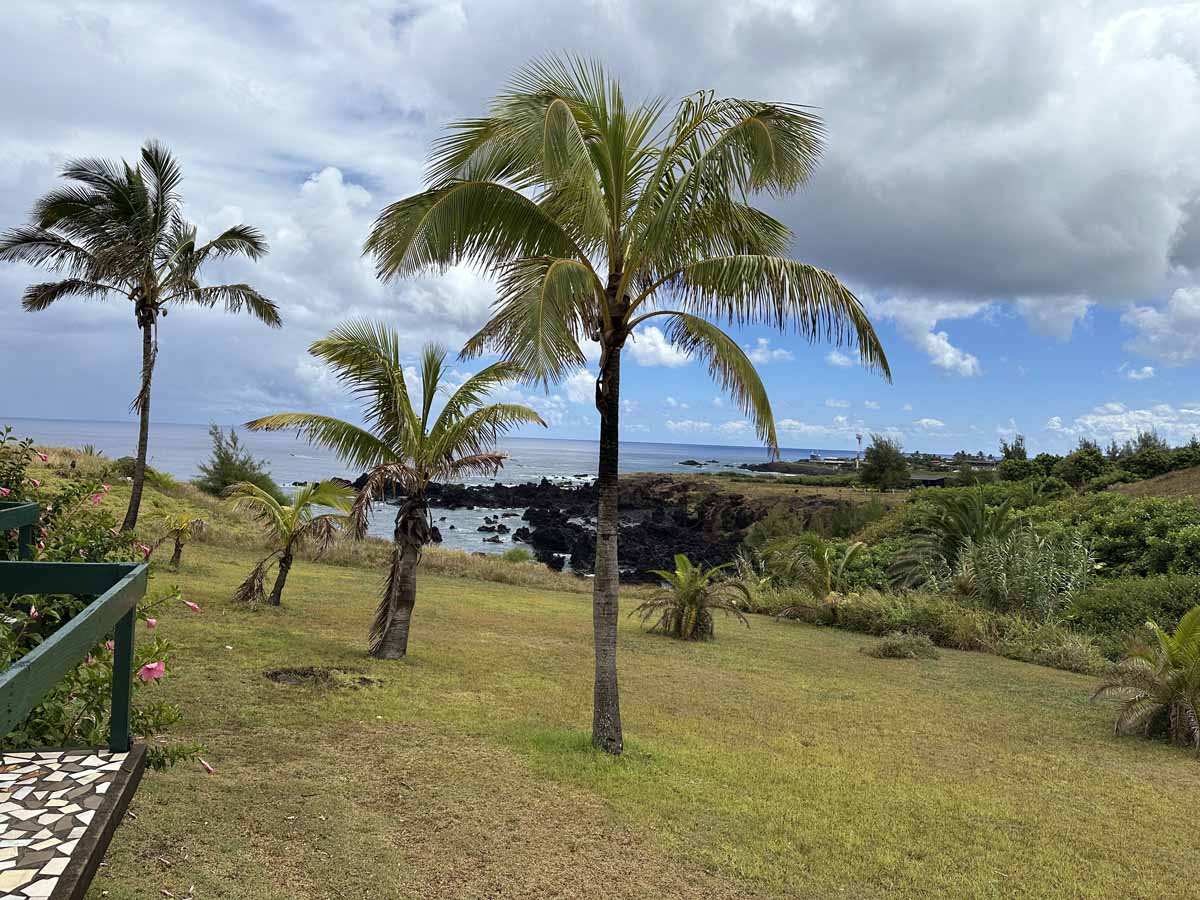
- View from my hotel room balcony
-
- View from pool of dining room & coastline
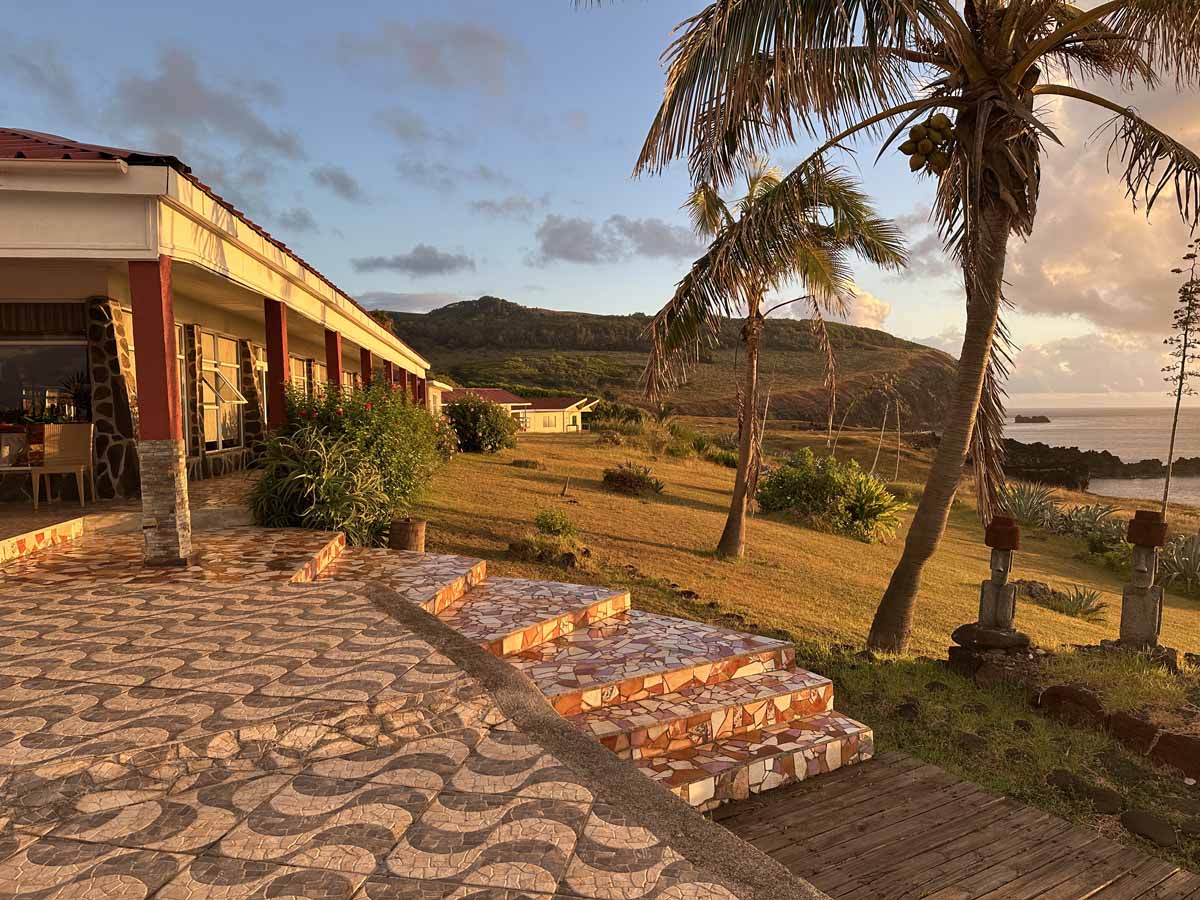
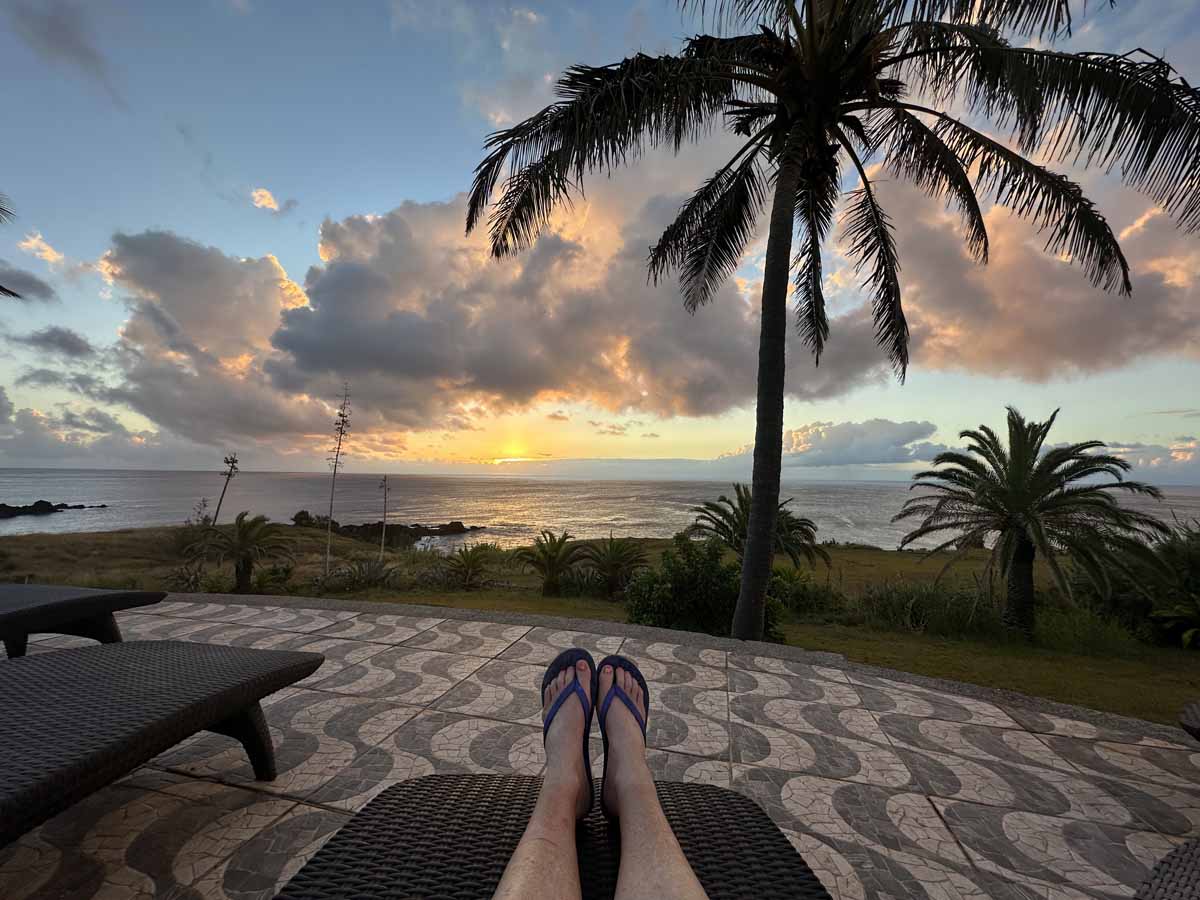
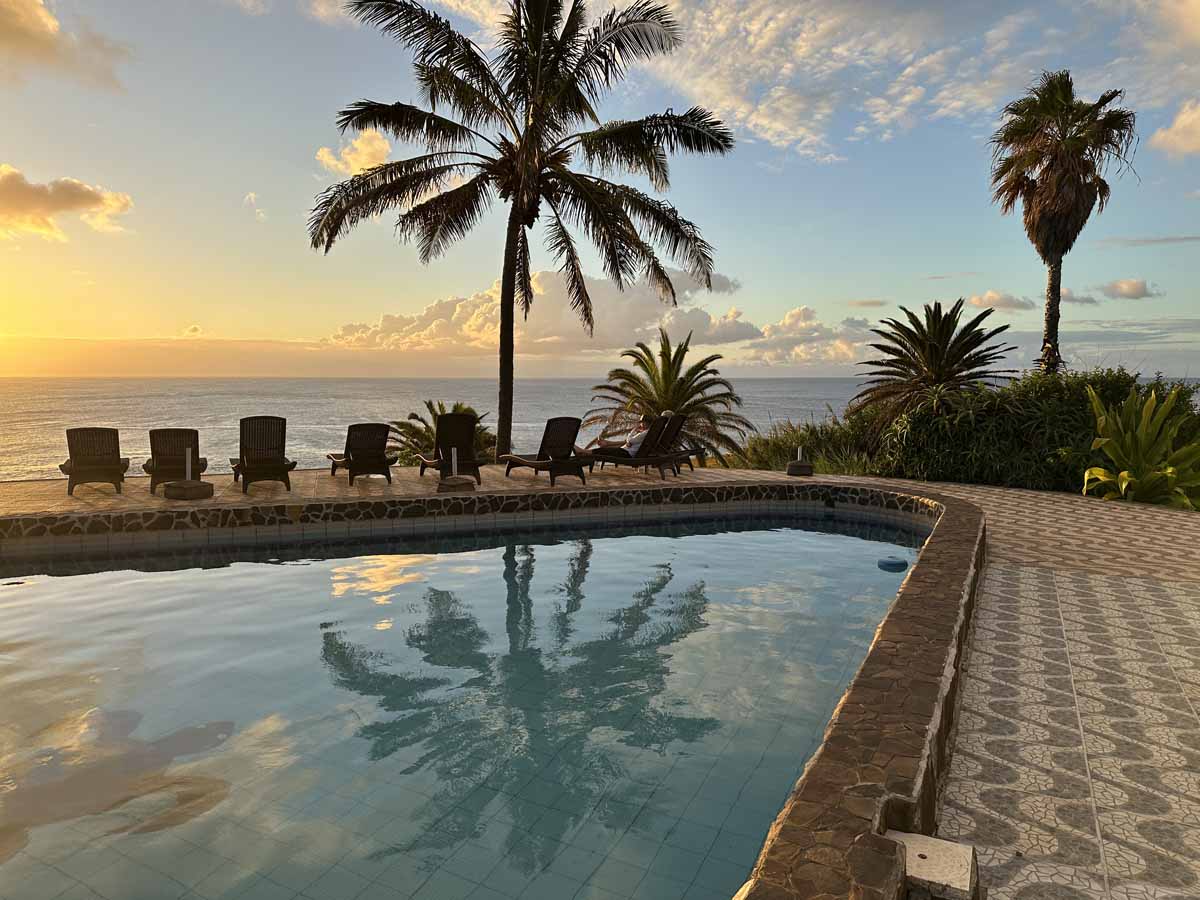
The hotel offered pretty views from our sea-facing room balconies. (above left) One evening, we watched a great sunset from the comfort of a lounge chair at the pool area. (below) Plus, the first afternoon, I was blown away by seeing the LATAM wide body plane landing almost right in front of me – watching from my hotel balcony!
Other Interesting Facts
An official guide is mandatory for visiting the majority of the island’s sites. Since August 2022, if you want to visit any of the Rapa Nui National Park sites, you must be accompanied by an accredited local guide or a Rapa Nui host over 18 years of age.
During COVID, the island closed completely to all commercial flights, starting in March 2020 to prevent the spread of the disease. After almost 28 months of isolation, the first airplane with tourists arrived in August 2022. The locals deliberately & slowly reopened the island with sustainability as their priority.
 Good Websites About Rapa Nui
- Chile’s Official Tourism Site – click here
- Imagina Rapa Nui – click here
- Easter Island Travel – click here
- Rapa Nui Travel Guide – click here
A Final Thank you to AI / Claude who was extremely helpful with the large amount of research I did for this article. I feel like Claude & I are now good friends!
Rapa Nui is such a fascinating place, with so much history and ongoing archeological discoveries to further the understanding of the ancient Rapa Nui people and their culture.
Here again is a map of Rapa Nui island
Map Credit: Encyclopedia Britannica / Click to enlarge
FINAL COMMENTS: Have you been to Rapa Nui? Is it a place that was already on your bucket list? Or have I inspired you to pay a visit?

An excellent post, with great photos and descriptions! I definitely want to visit Rapa Nui! Thank you!
Thanks, Roseanne. So glad you enjoyed! And knowing your love of travel and geologist background, you will find Rapa Nui particularly fascinating! Hope this post will help with your travel planning!
Super photos, Super travel descriptions! you have brought back all my memories of this amazing island
Thanks so much, Libby for your kind words. Yes, it was an incredibly special trip – so fun to share this grand adventure to Easter Island with you!