

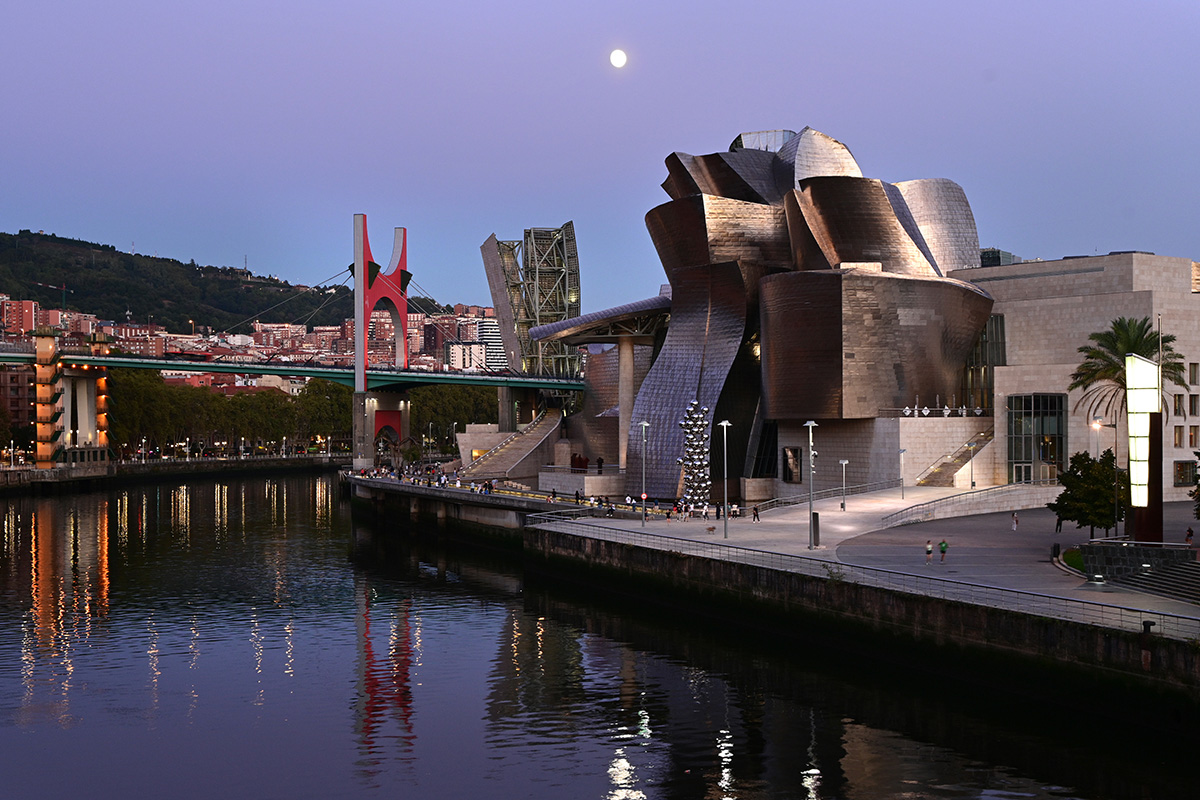
Guggenheim Museum Bilbao – on a Moonlit Night / Photo by Jack Daulton (copyright)
Perched alongside the river Nervión, Bilbao’s world-famous Guggenheim is a modern architectural wonder. Opened in 1997, the museum showcases the best in contemporary art – both inside & out!
I had seen photos of the Guggenheim Bilbao, but nothing prepares you for the thrill of experiencing this stunning structure up close & personal. Designed by famed architect Frank Gehry, the building’s flowing curves and exterior panels made of shimmering titanium will dazzle.
This lovely Basque town charms its visitors in other ways. You can stroll along peaceful riverside promenades lined with beautiful buildings and walk historic Old Town streets filled with shops, cafes & lively bars. Plus, Bilbao is known for its vibrant culinary scene.
My Visit to Bilbao / This Blog Post
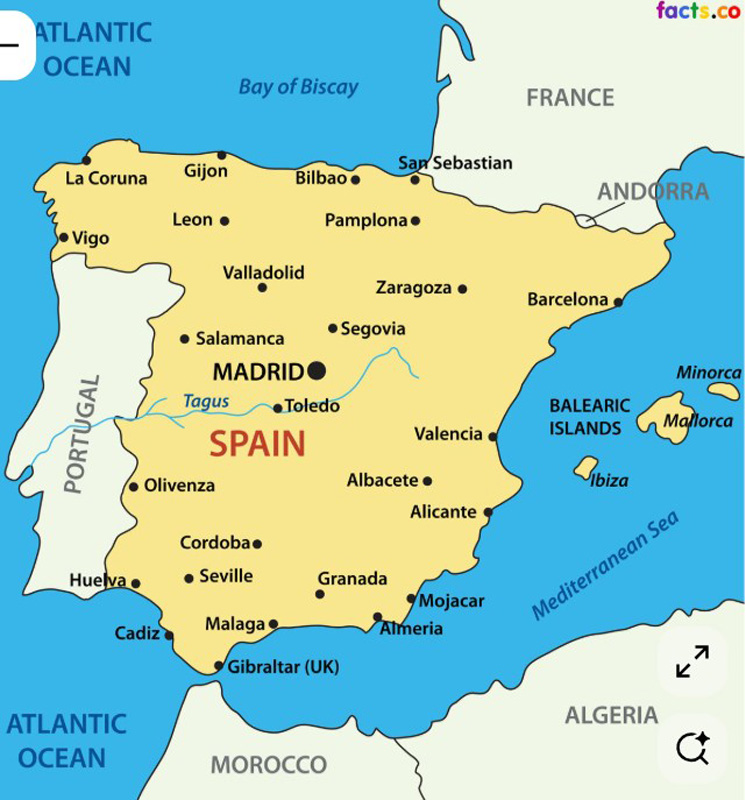
Map of Spain / Credit: Pinterest_Edythe Hendee / Click to enlarge
My boyfriend Jack & I recently visited Bilbao (late September 2026). We were doing our own 2.5-week tour of Spain by car. We spent our first week in beautiful Basque Country – enjoying 3 nights each in Bilbao, San Sebastian and Pamplona. (more about Basque Country at bottom of post)
In this blog post, I share photos & details about our visit to Bilbao – and the things we did that I recommend for your visit. This includes visits to the Guggenheim, riverside walks, a stroll through charming Old Town lanes, and enjoying delicious Basque tapas (called pinxtos).
Bilbao’s History & Urban Transformation
Bilbao is quite the urban success story with its transformation from an industrial port city into one of Spain’s most exciting cultural destinations. The 1997 opening of the Guggenheim Museum was a key catalyst & symbol of this remarkable change.
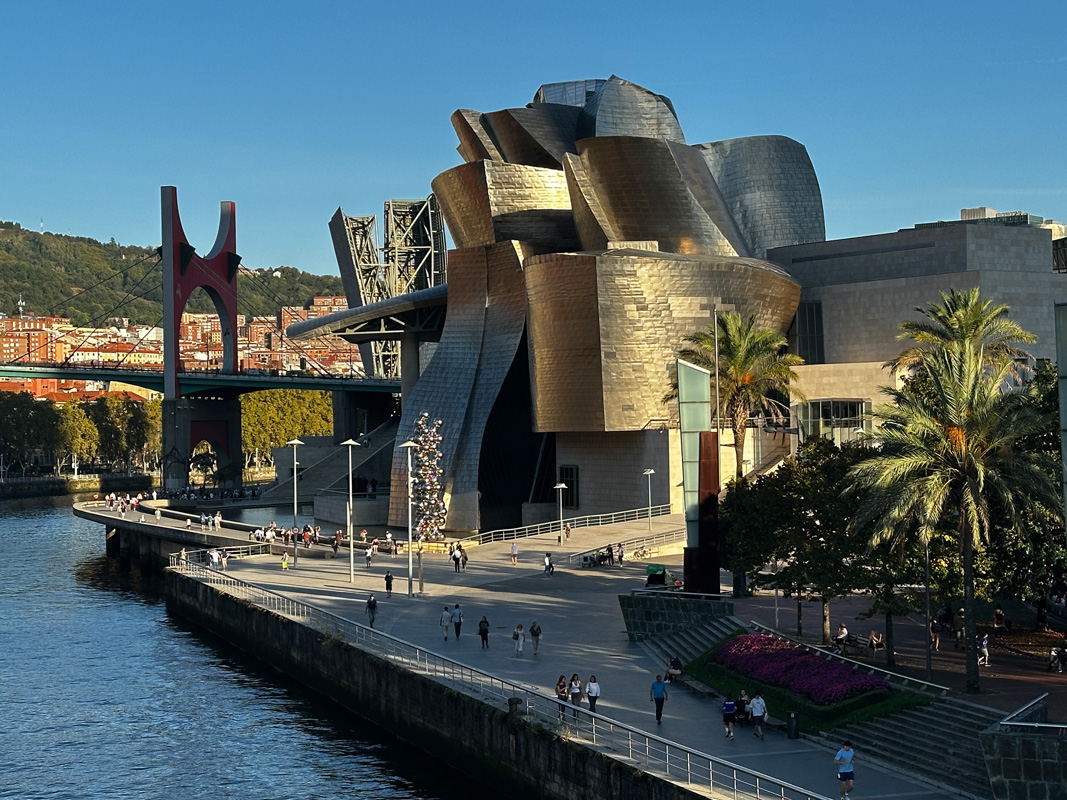
Click on all photos to enlarge
As Bilbao’s traditional industries (like ship building & iron production) declined in the 1970s & 80s, the city embarked on an ambitious project to revitalize its industrial waterfront, improve public spaces, and invest in architecture, culture, and the arts.
Port operations were moved farther down the river’s estuary toward the Bay of Biscay. Today’s modern Port is located roughly 10–20 kilometers (6–12 miles) northwest of central Bilbao (where the main visitor sights are located!).
In addition to the Guggenheim, new urban neighborhoods and a convention center were built, along with parks & attractive promenades. As you’ll see, Bilbao is clearly a poster child for the power of cultural innovation and visionary urban planning, masterfully executed.
Put on your virtual walking shoes – Let’s begin our tour of Bilbao…
Riverside Promenade along the Nervión
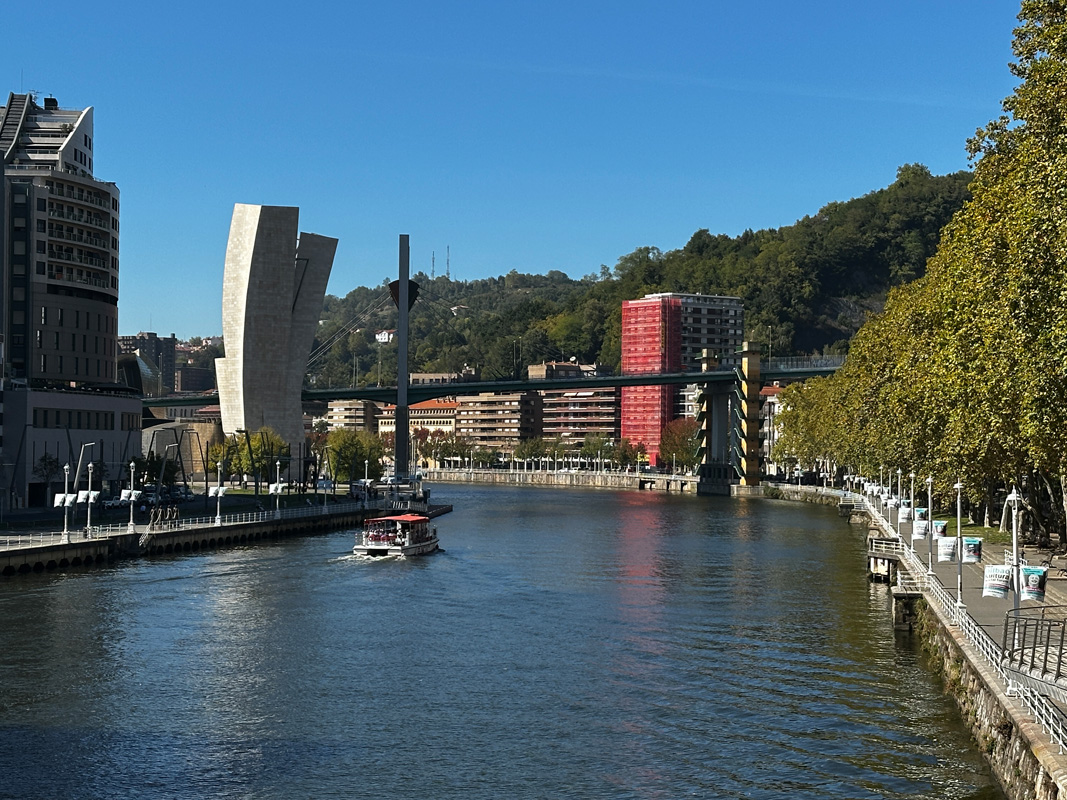
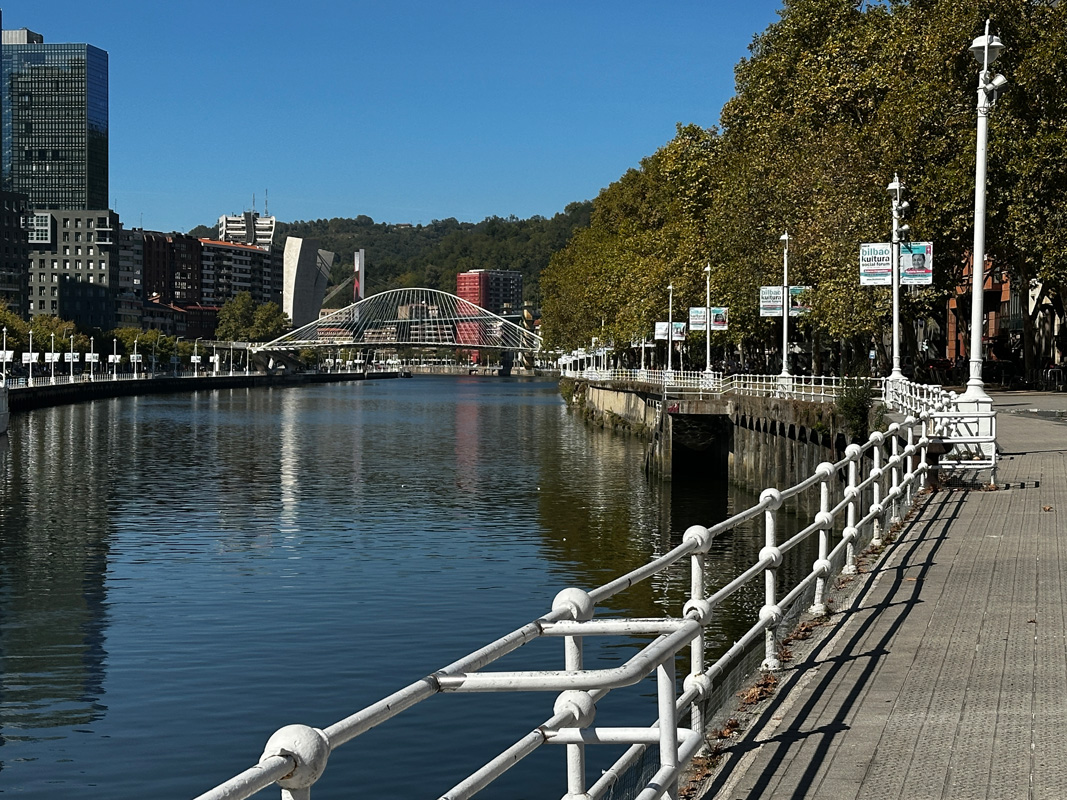
The Nervión river winds its way through the heart of central Bilbao, connecting the city’s historic roots with its modern transformation. It’s lined on both sides by lovely riverside promenades, where you’ll find people strolling day and evening.
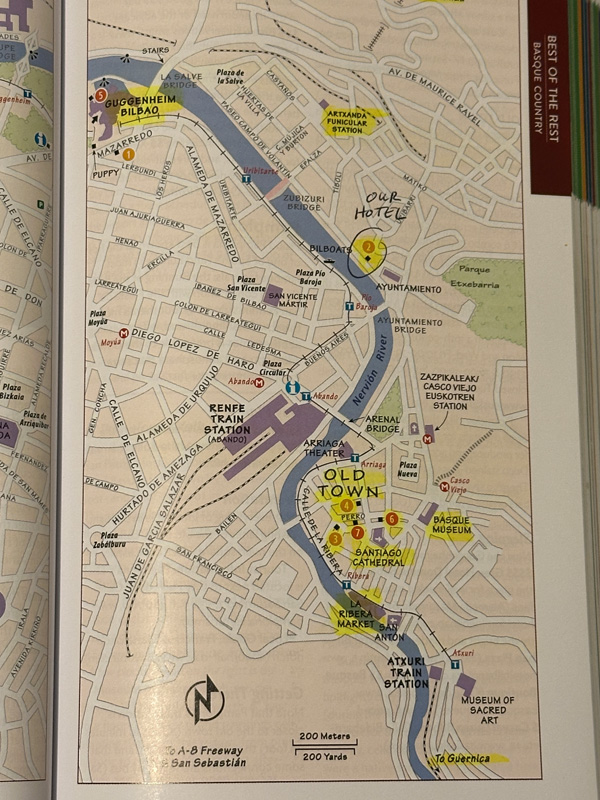
Bilbao Map Credit: Rick Steves / Click to enlarge
We stayed at a hotel with an excellent riverside location. It was just a short 10- minute walk north to the Guggenheim Museum & 10-15 minute walk south to Old Town. Perfect! (see map of Bilbao city center)
In addition, the riverfront is lined by a variety of beautiful buildings in striking architectural styles (old & new!), along with public art & green spaces.
The river is crossed (at frequent intervals) by distinctive, eye-catching bridges – some only for pedestrians.
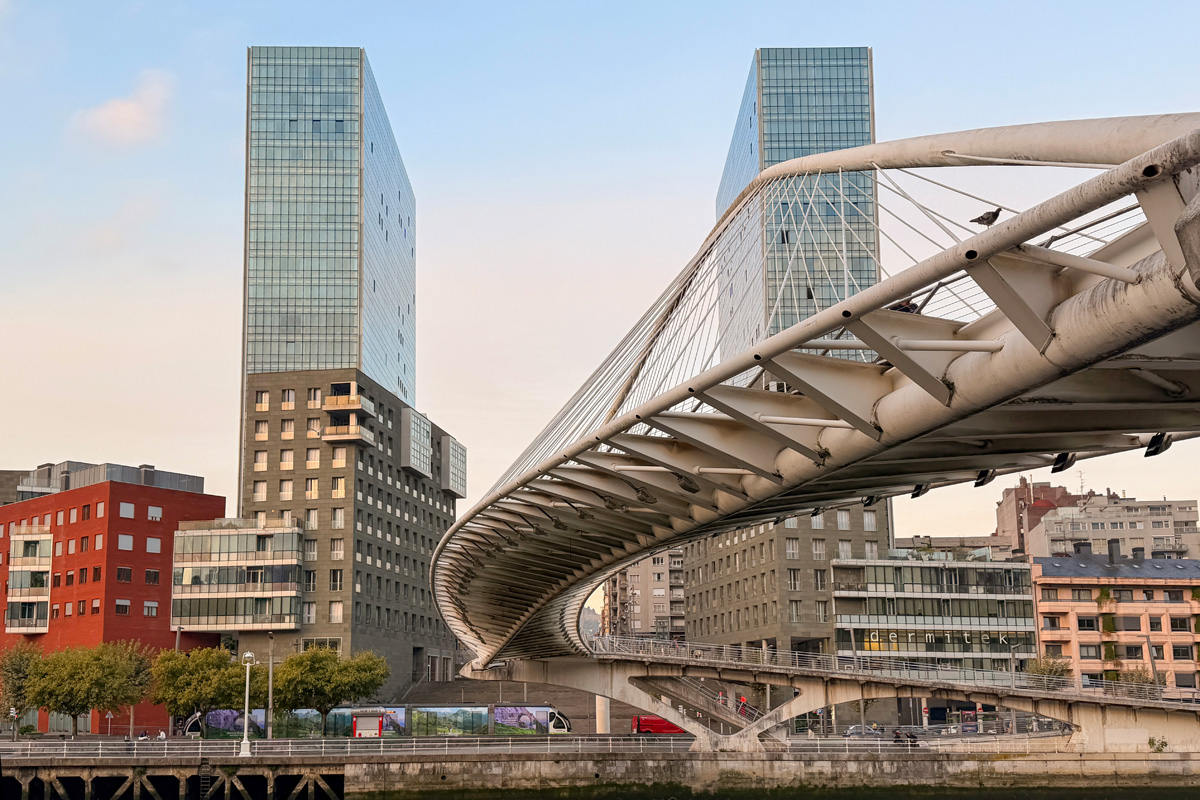
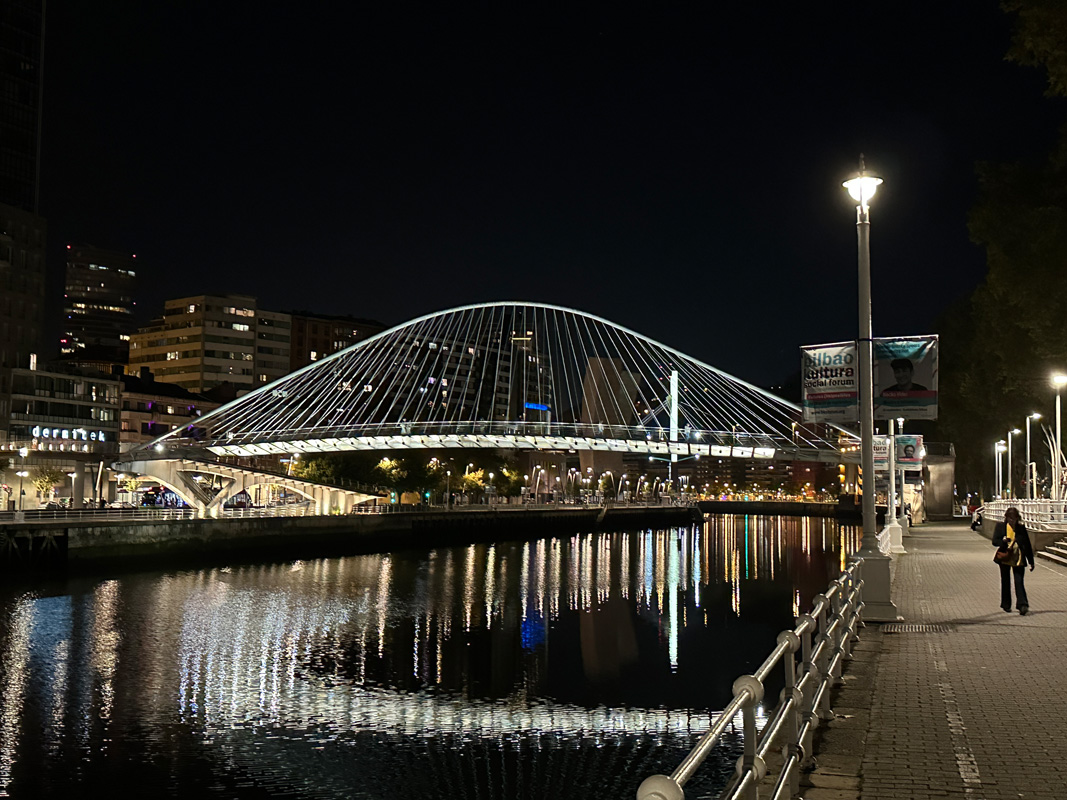
We particularly loved the modern white suspension-style pedestrian Zubizuri Bridge (below). We crossed it quite a few times on our way back and forth to the Guggenheim – to which we made many visits (at different times of the day).
-

- Zubizuri Bridge (day & eve) / Photo Credit: Jack Daulton
Our First View of the Guggenheim
Arriving in Bilbao on a Tuesday, we finally headed out at 7pm excited to take our first exploration walk of the town. We headed north along the riverside promenade towards the Guggenheim. We wanted to get our first glimpse of this architectural marvel while it was still light (sunset was at 8:05pm)!
Nearing the Guggenheim, we were awed by the beautiful La Salve bridge “floating” high above the river. First built in 1972, its green steel roadway is supported by cables attached to tall towers. When the Guggenheim was later built, architect Frank Gehry cleverly incorporated the bridge into the museum’s setting.
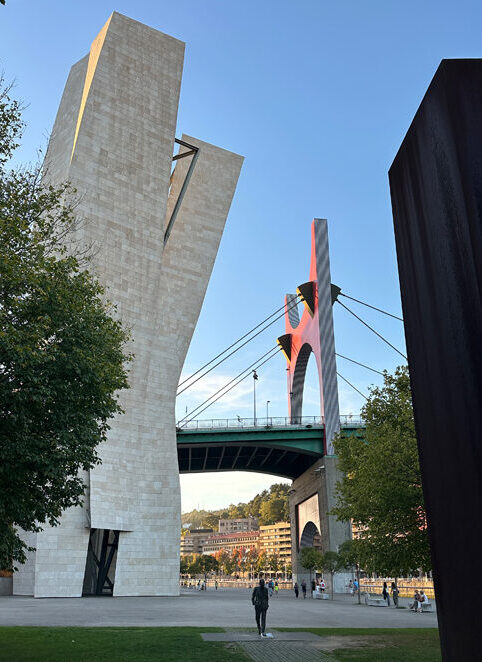
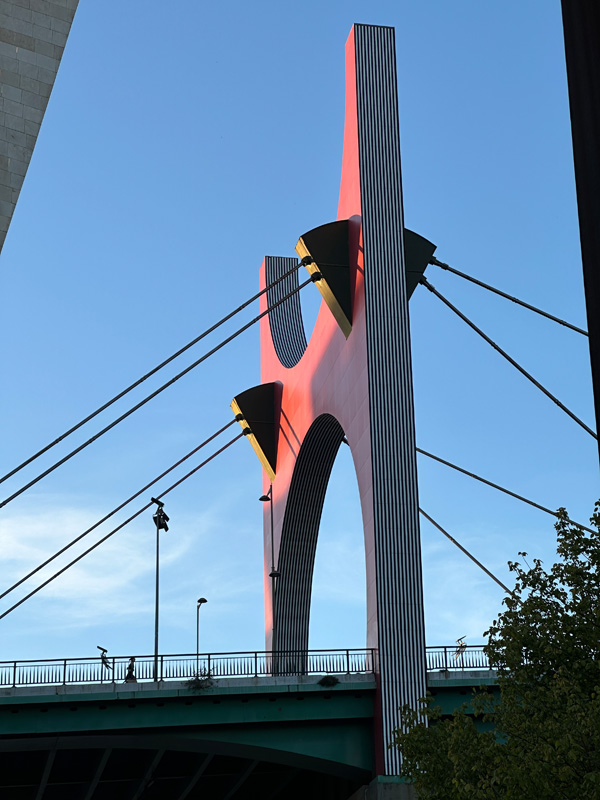
In 2007, to mark the museum’s 10th anniversary, a French artist added the dramatic red structure known as L’Arc Rouge (The Red Arch) to the bridge. Its vivid color is a striking contrast with the museum’s silvery titanium curves. And, as you’ll see, the bridge is also quite photogenic.
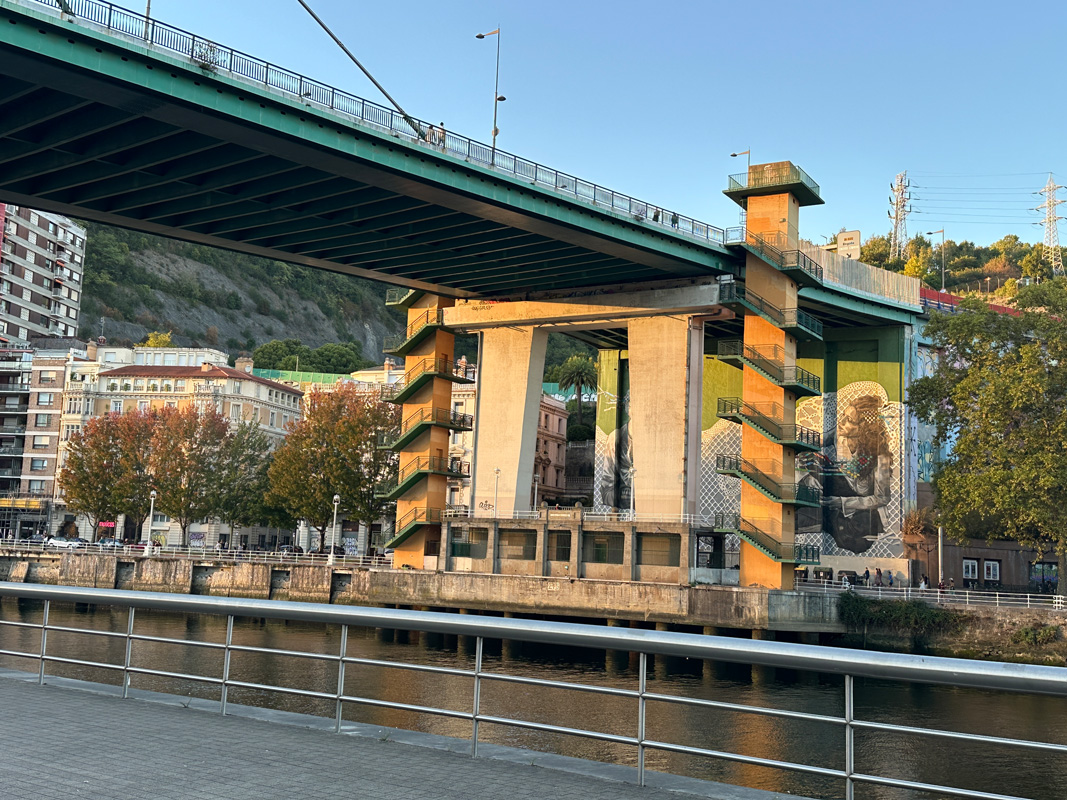
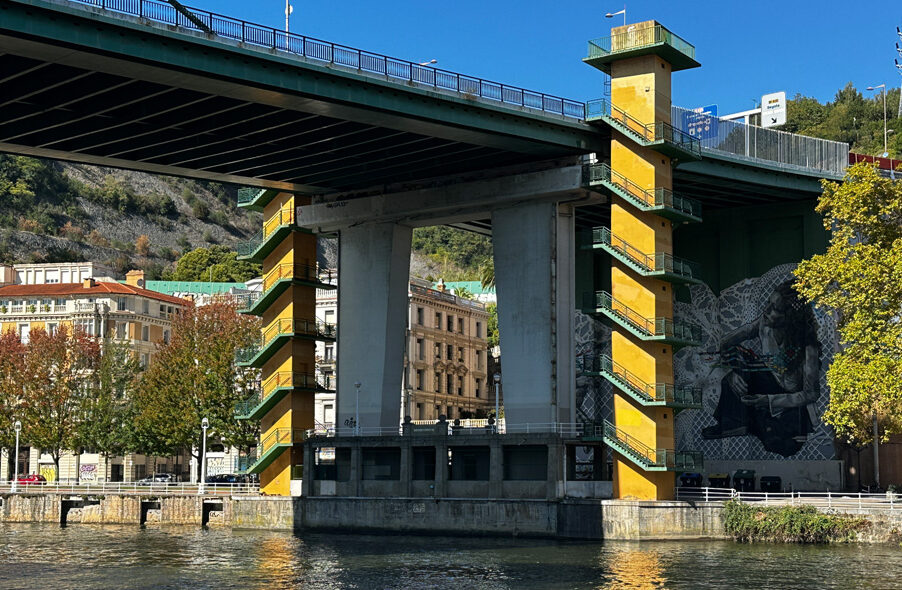
On the other side of the river, the bridge has two tall ochre-yellow concrete towers that house the bridge’s pedestrian access elevators & outer staircases (in contrasting green metal). They spiral down the side of the towers to the street below, creating a delightful visual spectacle!
Guggenheim Riverside Terrace & The Spider
As we approached the Museum’s lovely Riverside Terrace, we were welcomed & instantly mesmerized by “Maman”– a giant metal sculpture of a spider with very long legs!
-

- The Maman Spider / Credit: Jack Daulton
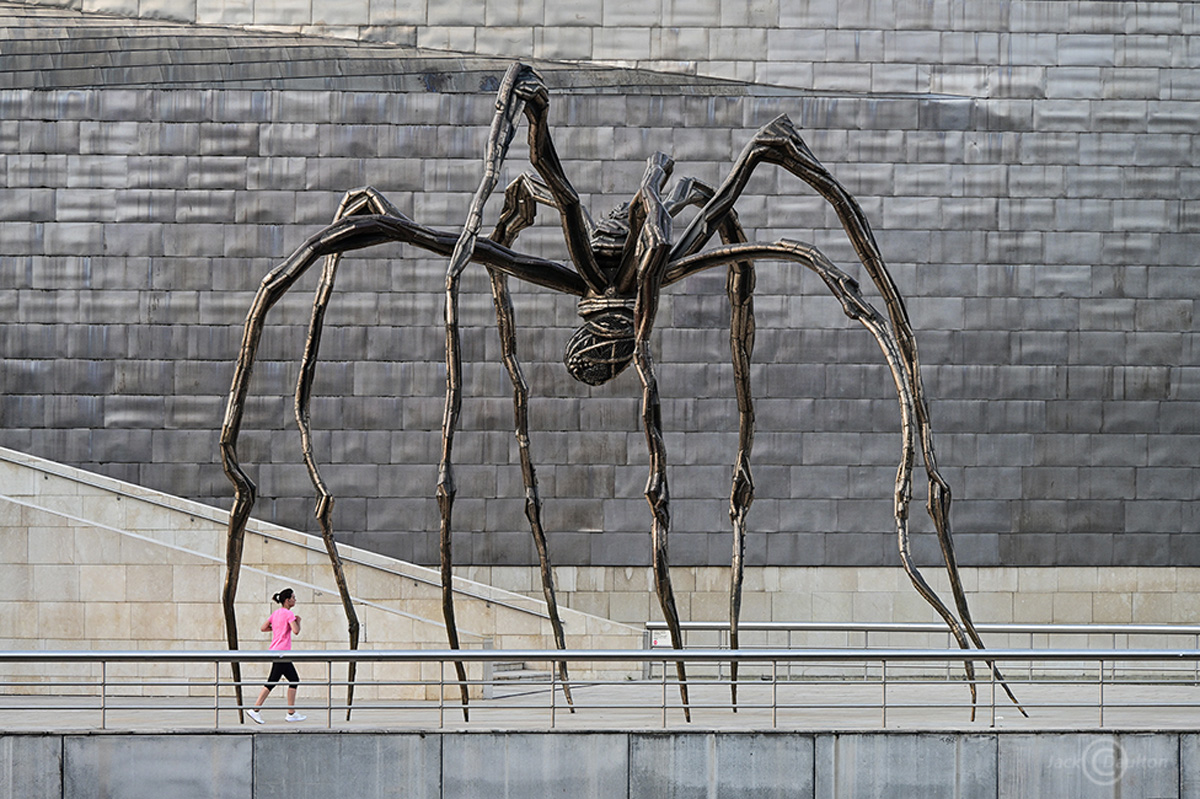
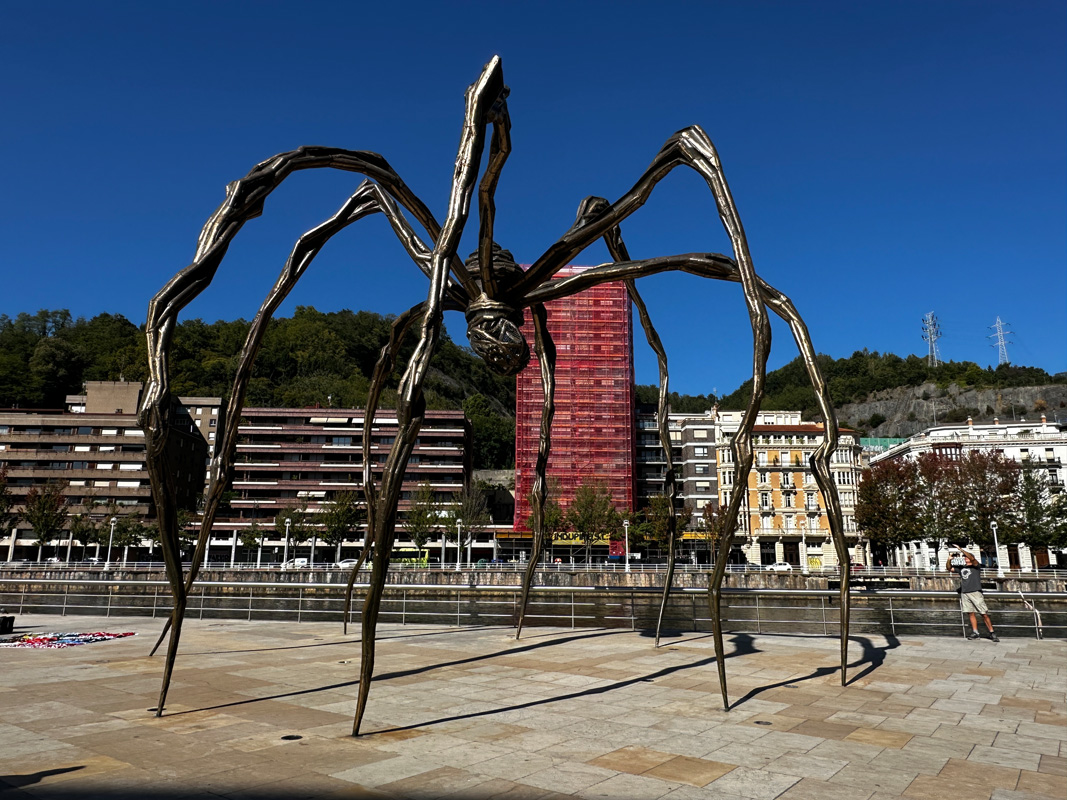
Created in 2001 by French-American artist Louise Bourgeois, the spider stands nearly 9 meters (30 feet) tall and about 10 meters (33 feet) across. Its name Maman is French for “Mommy” or “Mama.” Turns out, the sculpture is a tribute to the artist’s own mother who was a masterful weaver.
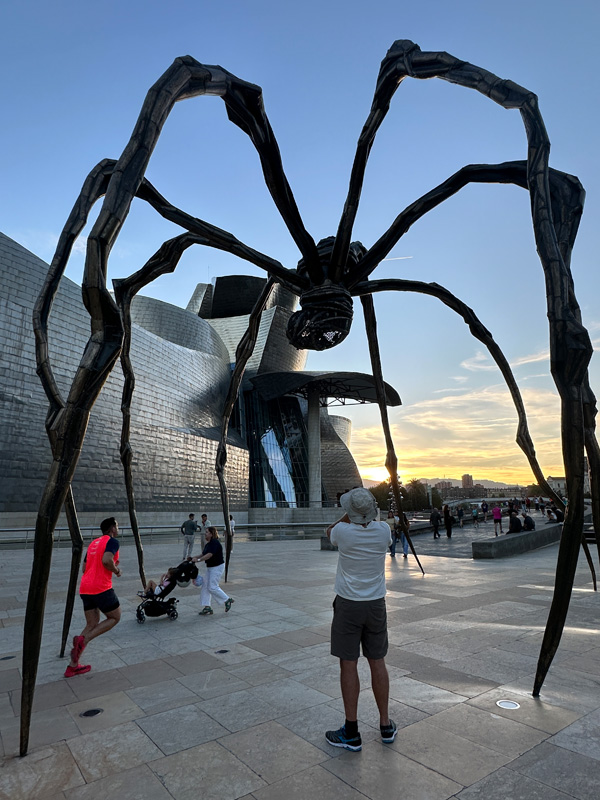
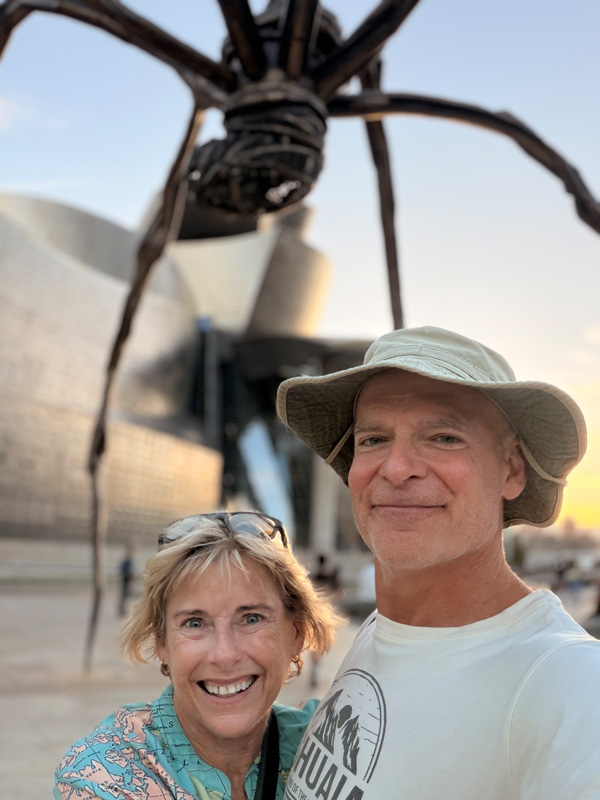
As you might imagine, Maman is one of the Guggenheim’s most recognizable works of art – and it’s beloved & much photographed (including countless photos taken by my boyfriend Jack Daulton – including above!)
Guggenheim Bilbao’s Amazing Exterior / Architect Frank Gehry
As mentioned, Frank Gehry (1929–2025) is the famous architect (a Canadian-American) who designed the Guggenheim Bilbao. The Walt Disney Concert Hall in Los Angeles, which opened in 2003, is another of his well-known creations.
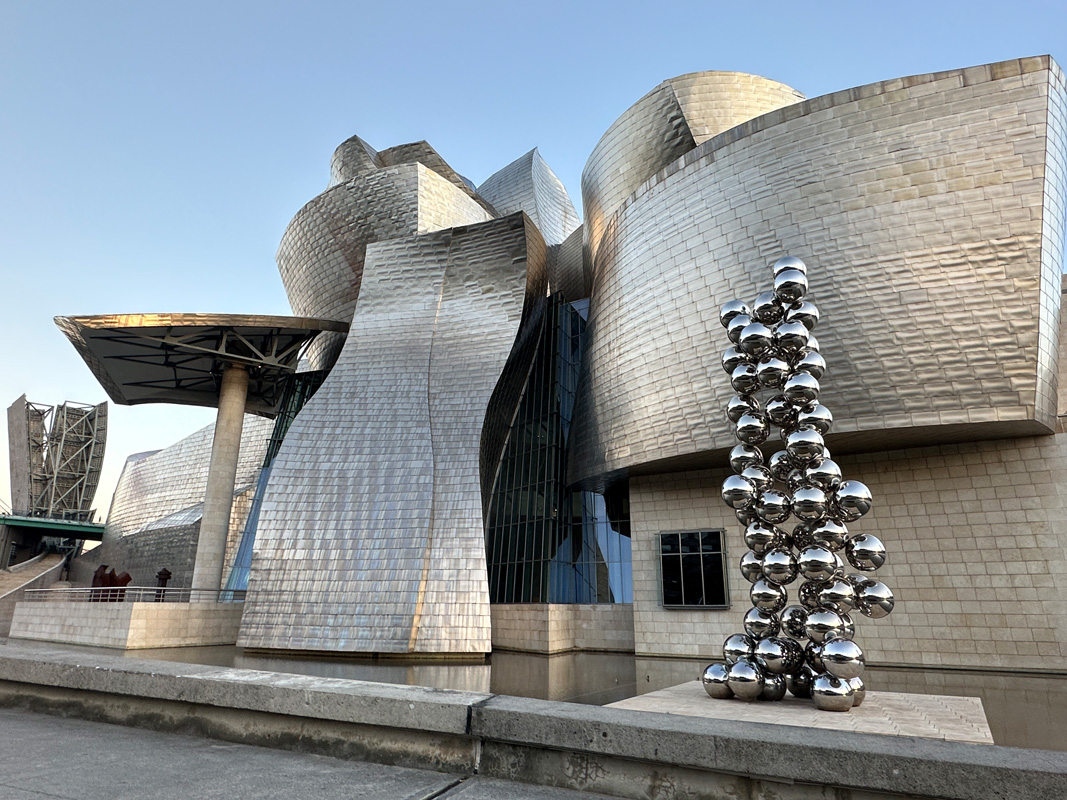
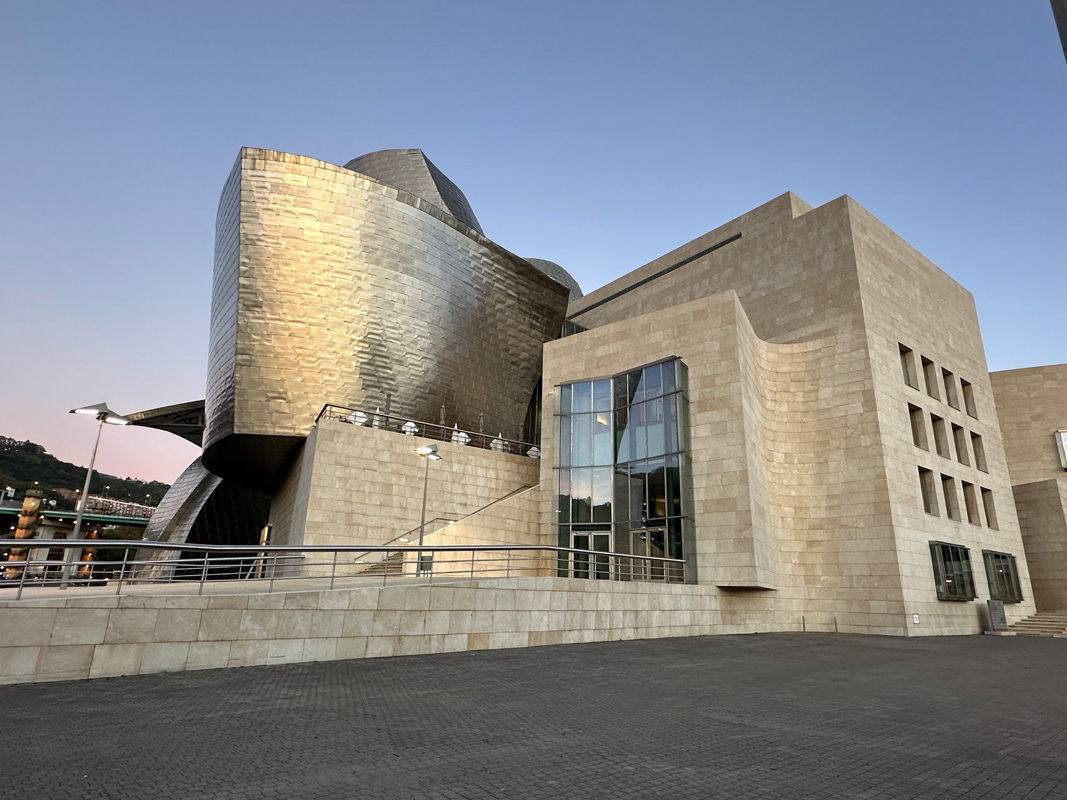
Gehry was celebrated for his deconstructivist style, sculptural undulating forms, and pioneering use of unconventional materials like titanium, stainless steel, and aerospace 3D modeling software.
-

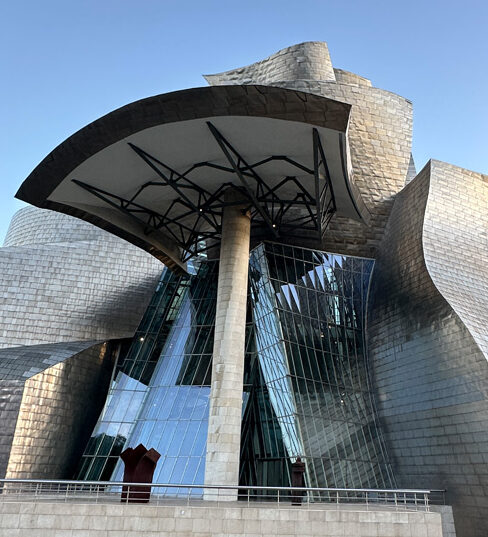
- Photos showing the same exterior section of the Guggenheim in day and evening light on its glass windows & titanium metal panels!
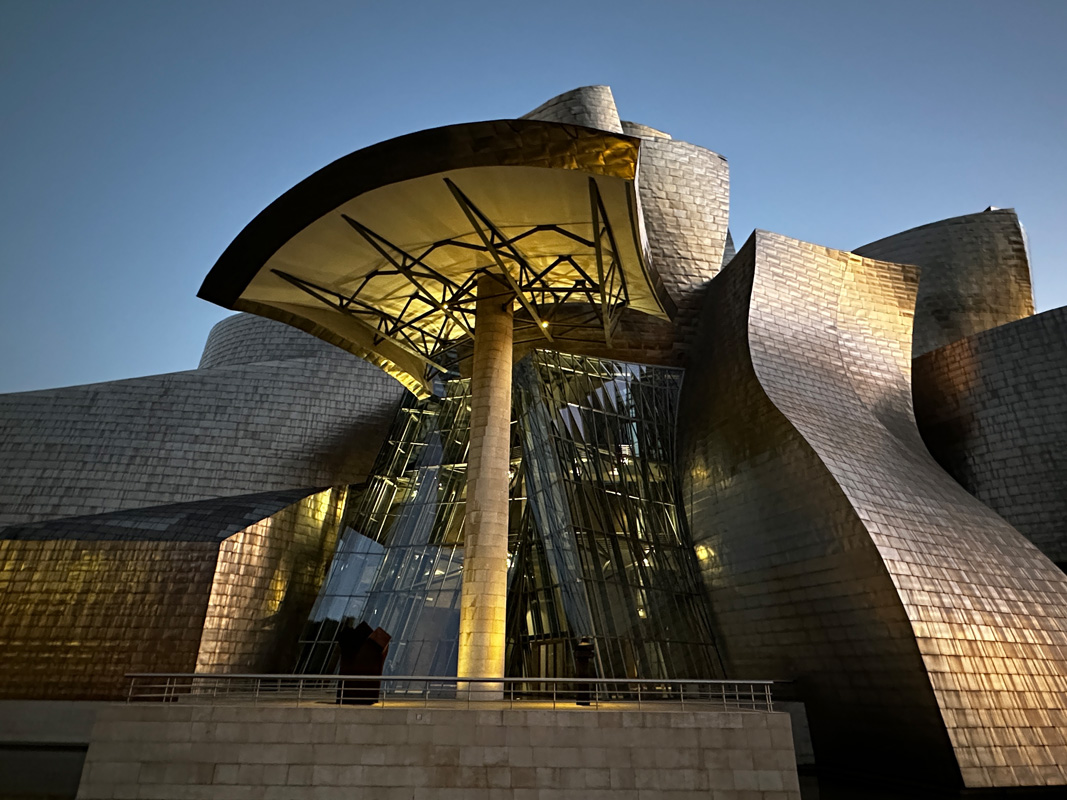
The Guggenheim exterior, particularly as viewed from the riverside, is truly stunning! The building’s extraordinary curves & shapes and shimmering titanium metal panels (with a scale-like texture) are constantly changing in appearance, depending on the light and reflections.
Guggenheim Main Entrance / Puppy Sculpture
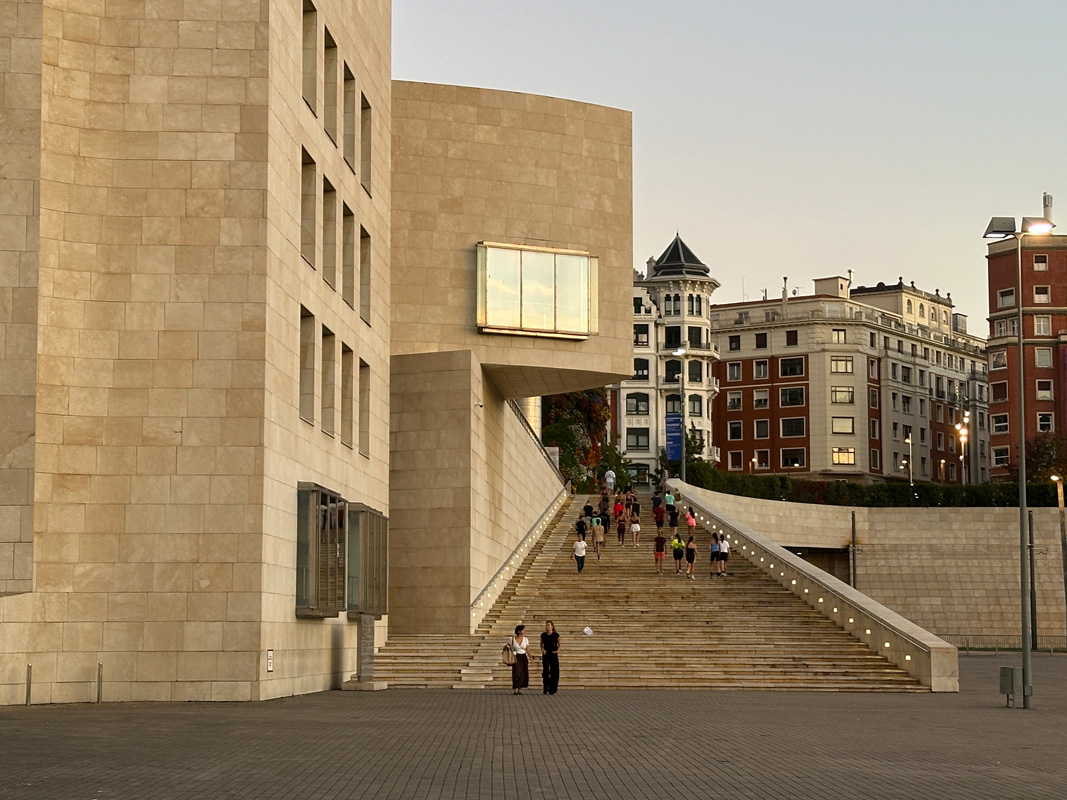
We slowly worked our way around the expansive building – first from the riverside terrace area to the side facing north. There, we walked up a monumental staircase of warm, golden-beige limestone that led to the museum’s main entrance at the upper plaza.
-
- Staircase to the upper plaza
-
- Upper Plaza & Main Museum Entrance
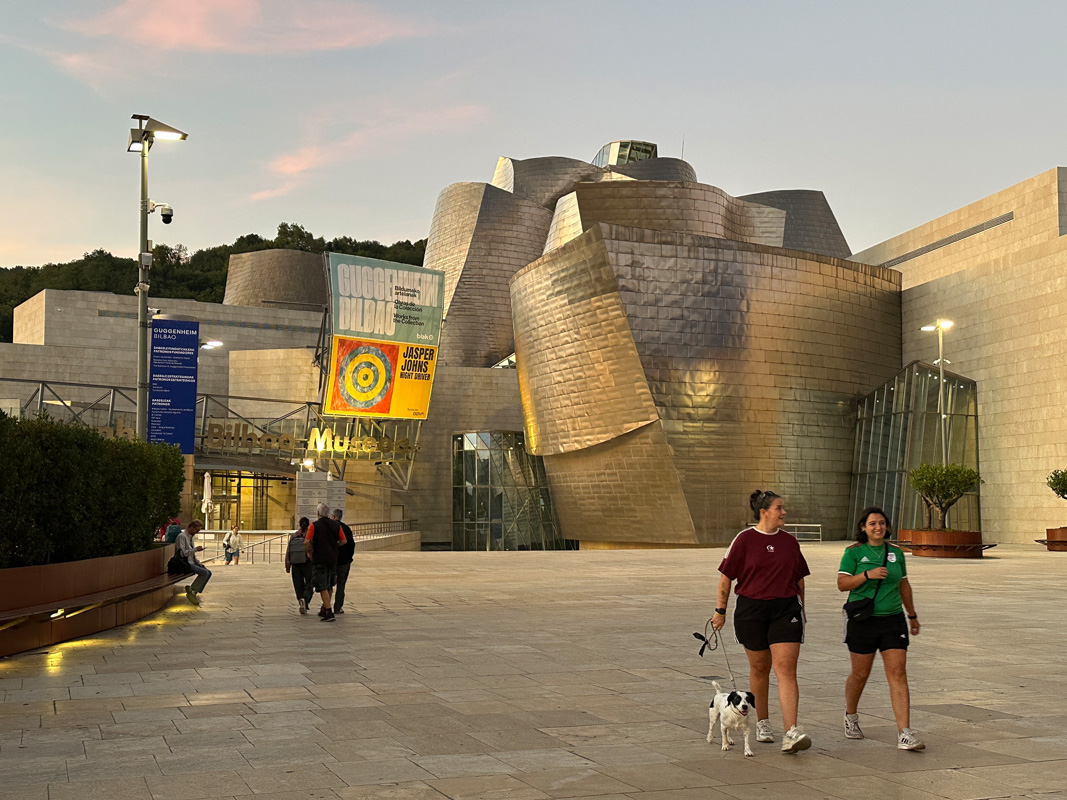
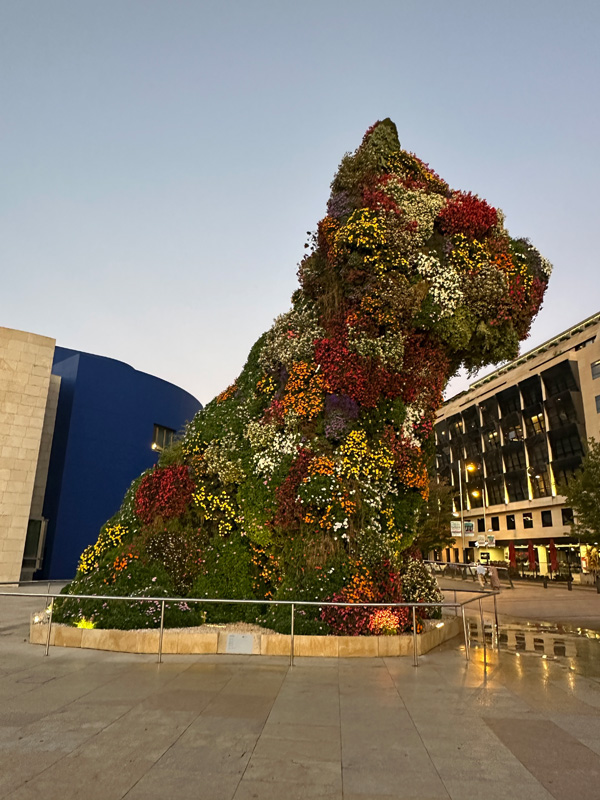 On this city-side plaza, we encountered another unique sculpture. This time, it was a 42-foot-tall West Highland Terrier, nicknamed “Puppy.”
Amazing to learn that it’s made from 60,000 plants & flowers that grow in concert through steel mesh!
This sculpture by artist Jeff Koons was originally meant to be temporary but apparently the people of Bilbao fell so in love with Puppy that they bought it. I’m certainly glad they did – what a unique sight!
Circling the Guggenheim / Crossing La Salve Bridge at Night
It was now around 8:30pm, thus starting to get dark. We continued our walk around the museum’s massive structure – along the street on the west side and then onto the pedestrian lane of La Salve Bridge which runs along the south side of the Guggenheim.
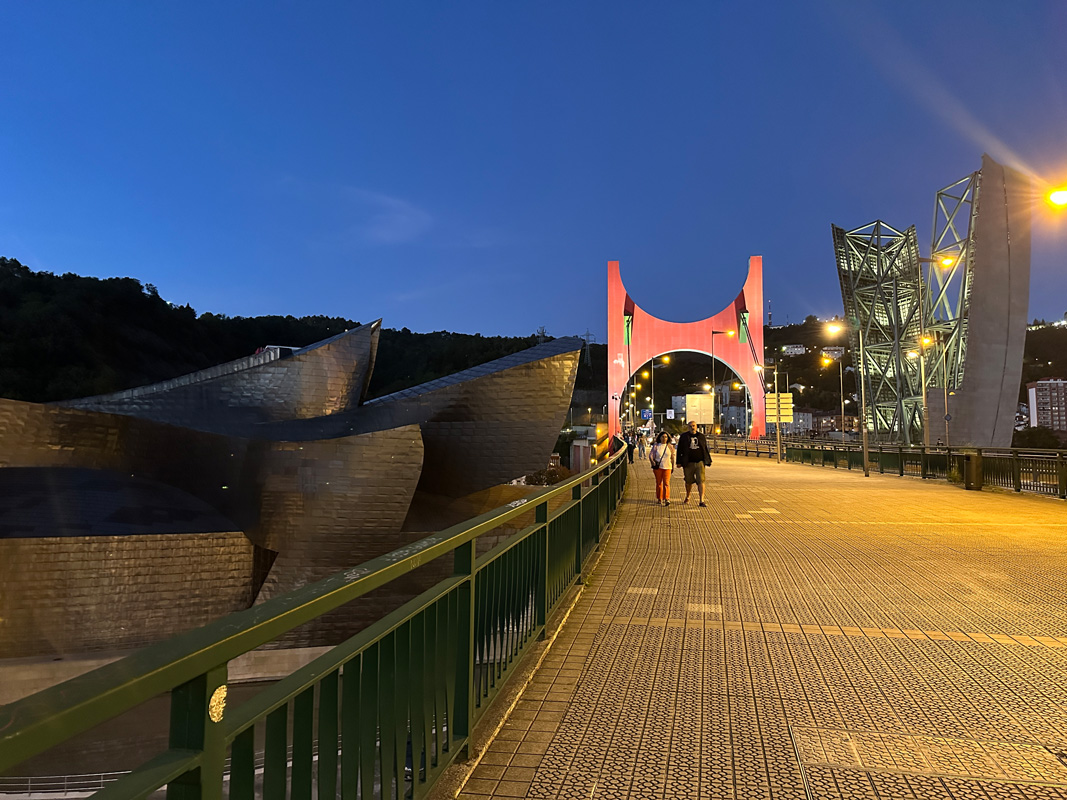
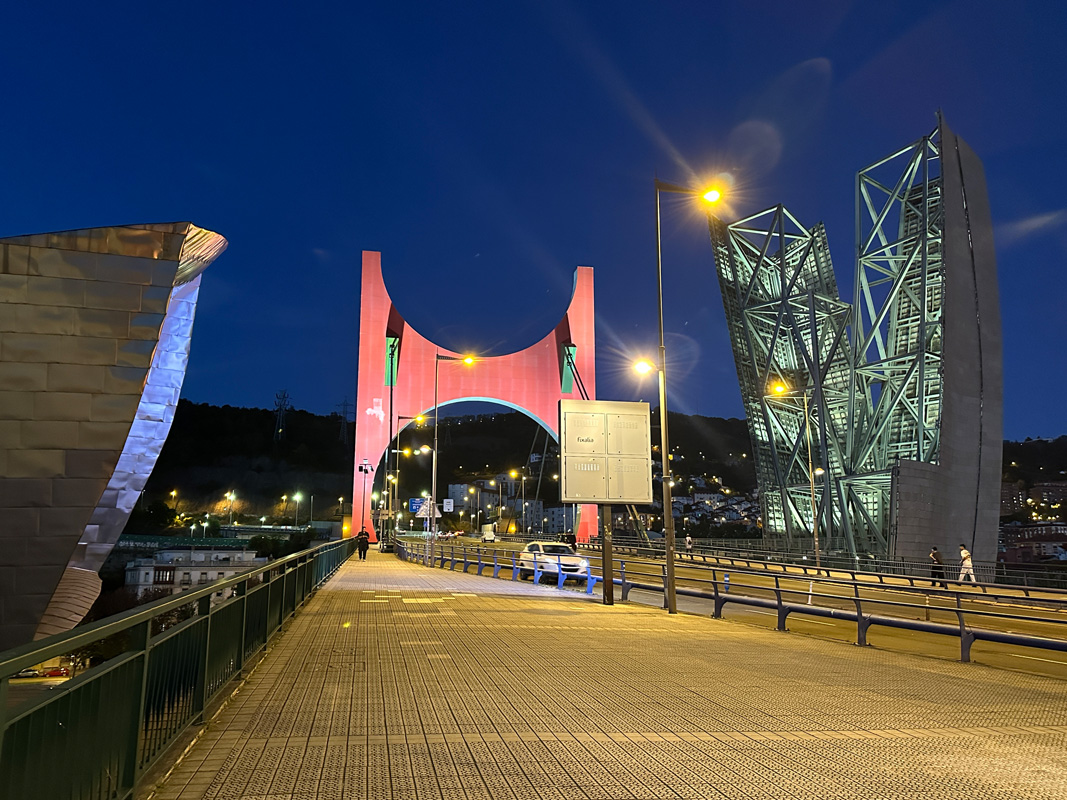
We enjoyed (and photographed!) some gorgeous night views of the Guggenheim below with twinkling lights reflected in the river, as well as the bridge with its illuminated red tower.
-
- The Guggenheim Night Views are also stunning!
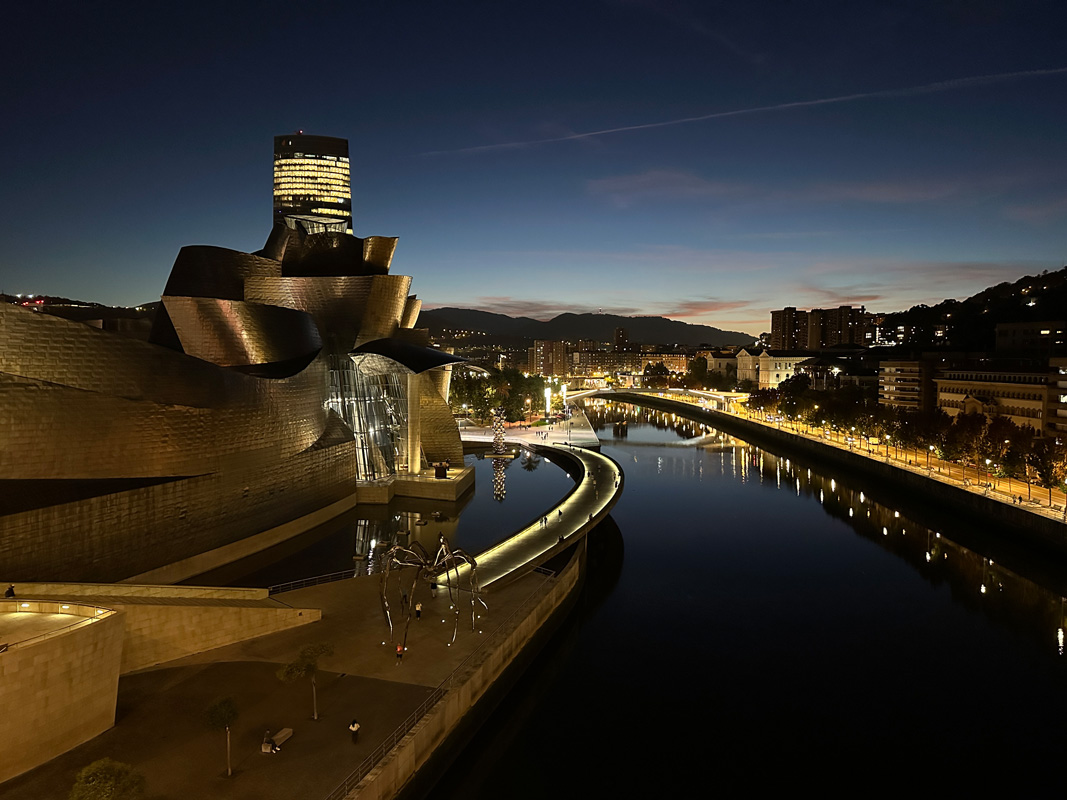
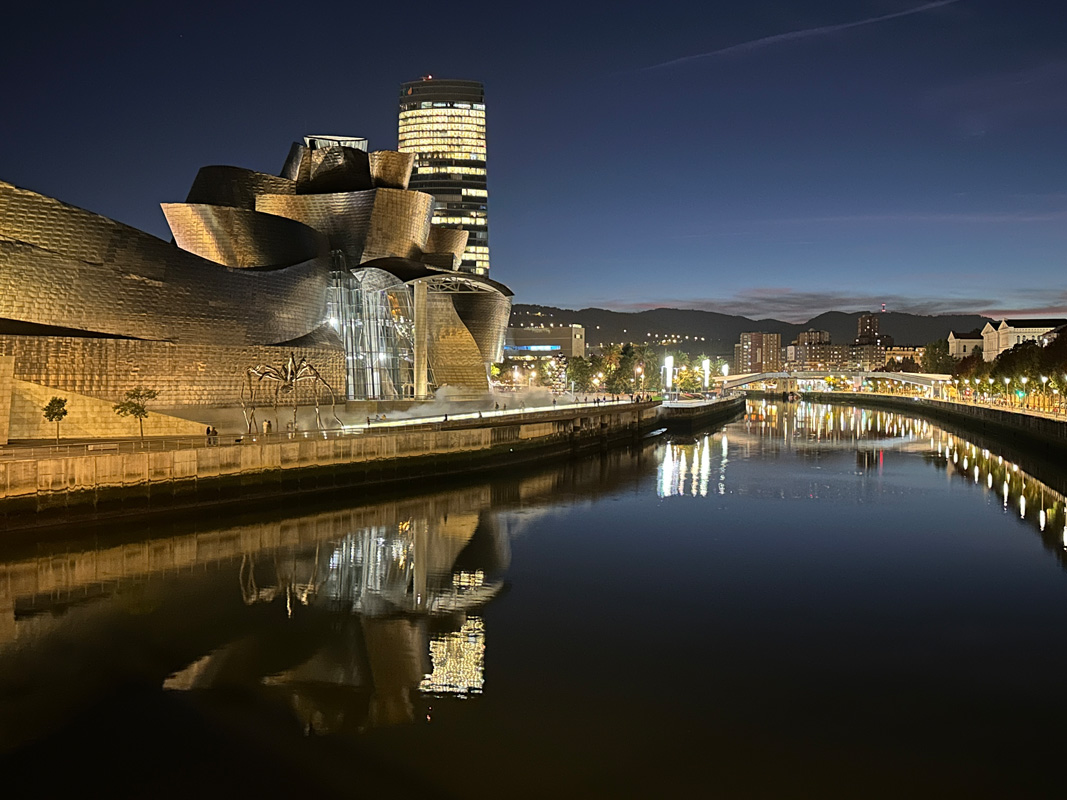
We crossed over the bridge and walked down the many flights of the green steps circling the yellow concrete towers – to reach the riverside promenade on the other side for our walk back to the hotel. A great first evening!
Visit #2 to the Guggenheim – Touring Inside The Museum
We returned to the Guggenheim on Thursday afternoon to visit the inside of the museum – to see both its art & marvel at its beautiful interior architecture. The museum attracts over a million visitors annually, making it one of Spain’s top tourist destinations.
Rick Steves (in his guidebook) says that “even visitors who aren’t particularly interested in modern (or contemporary) art will find the Guggenheim fascinating.” I wholeheartedly concur – the museum is a must see (both inside & out!).
The museum’s main entrance is reached via the upper plaza level. The adult admission fee was 18 euros (around $21 USD), which we bought on-site. We immediately entered the light-filled central Atrium, the museum’s spectacular heart, which is another Wow!
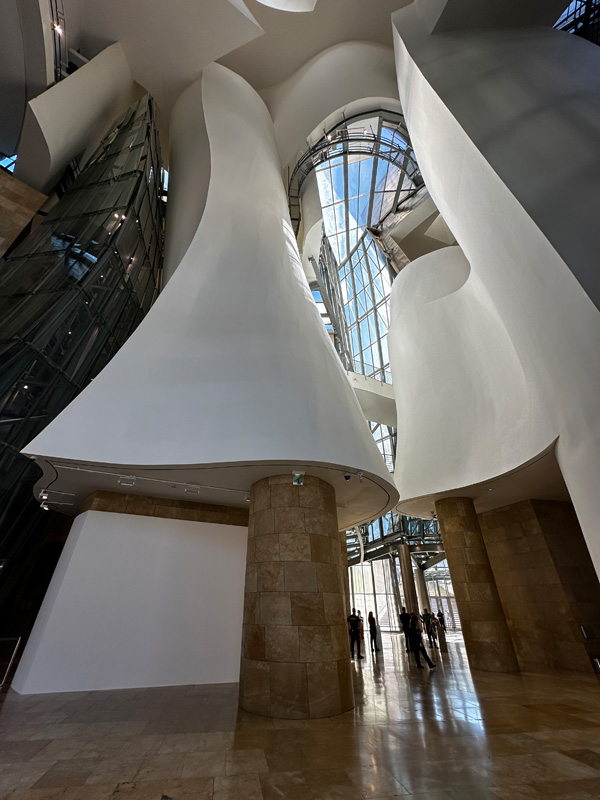
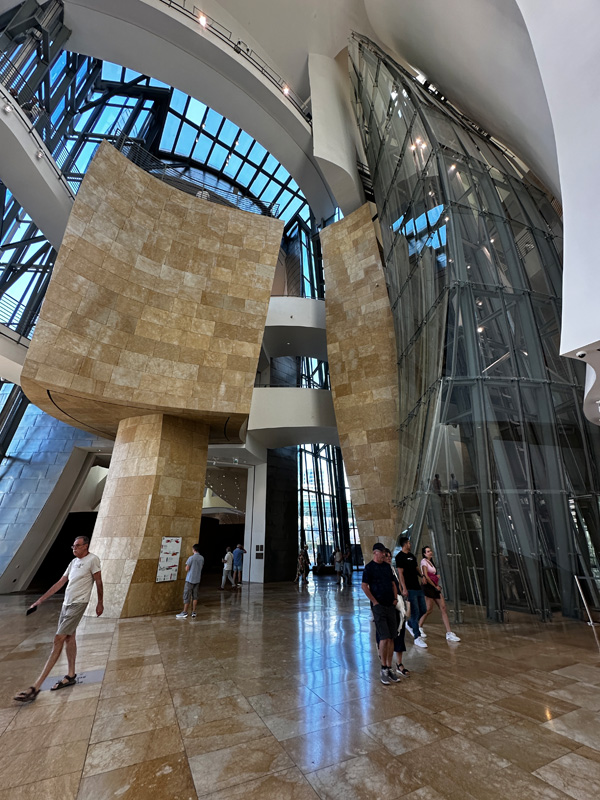
The Atrium rises approximately 164 feet (50 meters) beneath a large glass skylight. Curving walkways span the open space, linking the museum’s three levels. Glass-and-titanium elevators and staircases carry visitors up and down between the floors & the 20 galleries.
Just like the museum’s exterior, there are virtually no straight lines. The walls are sensually curved, and large glass walls provide lovely views of the riverside terrace & the Nervion River.
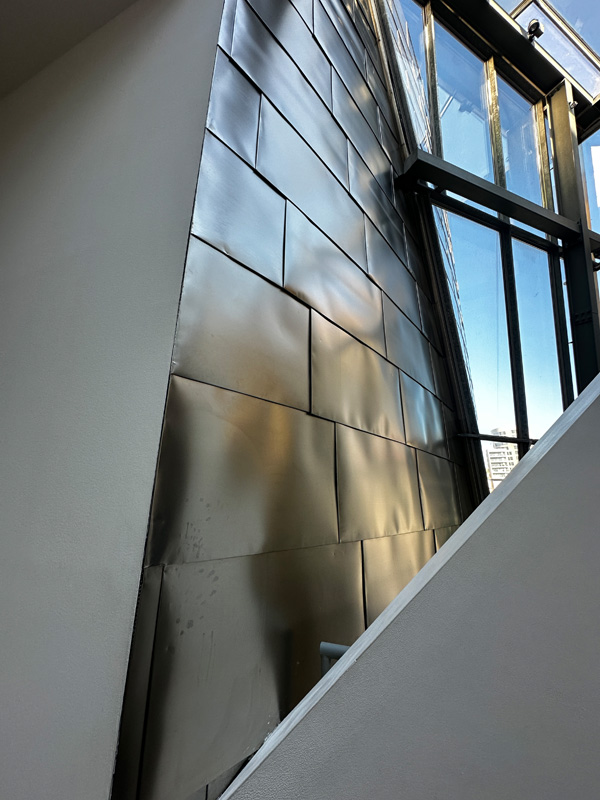
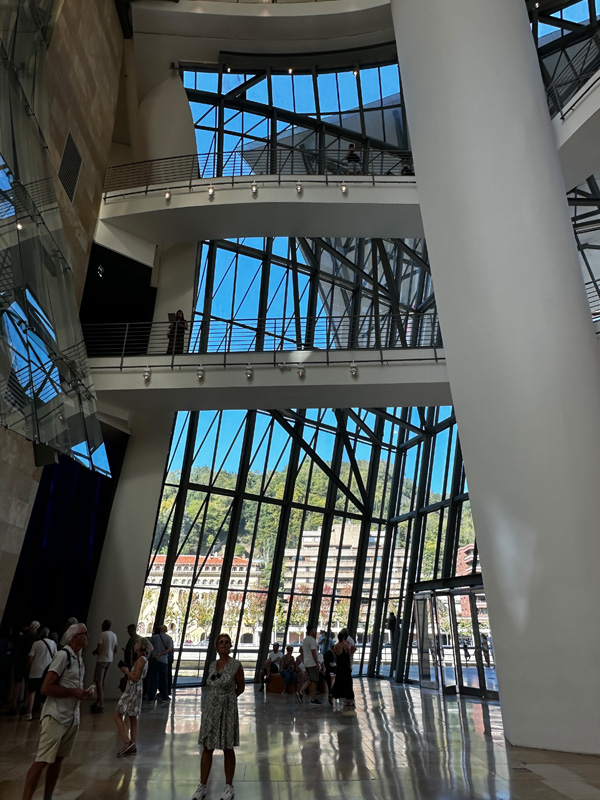
The building interior is comprised of contrasting textures of glass, steel and titanium, as well as limestone columns & floors (that look like marble). Just like the museum’s exterior, it’s another visual masterpiece!
“The Matter of Time” Exhibition
Frank Gehry designed the museum’s vast ground floor mainly to house often-huge modern-art installations. While most of the Guggenheim collection comes and goes, “The Matter of Time” sculpture in the largest gallery is permanent. So, we headed there first.
The installation was created by American sculptor Richard Serra, who became internationally known for his monumental sculptures made from industrial steel. And that’s “monumental” with a capital M!
The Guggenheim commissioned a series of works for its Gallery 104. The installation was completed in 2005, when 7 additional sculptures joined an earlier work, originally created for the museum’s opening in 1997. Together, they form the installation known as The Matter of Time.
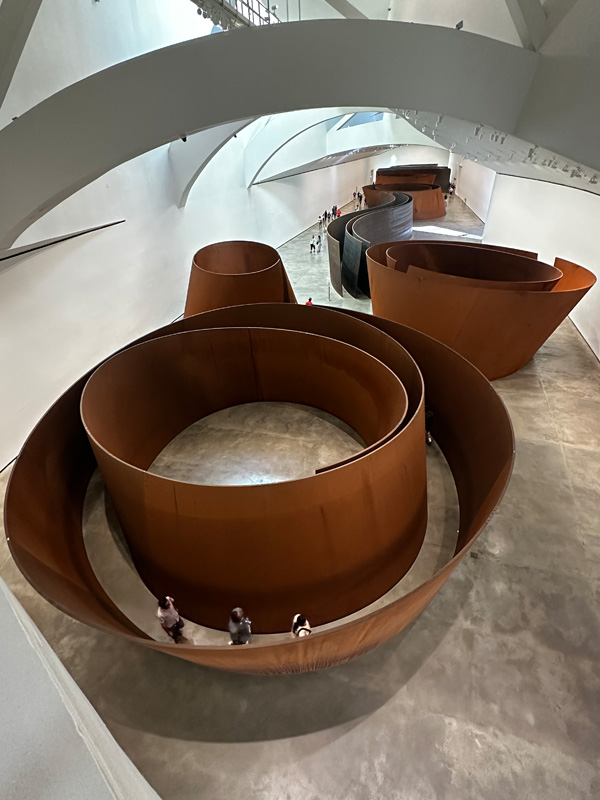
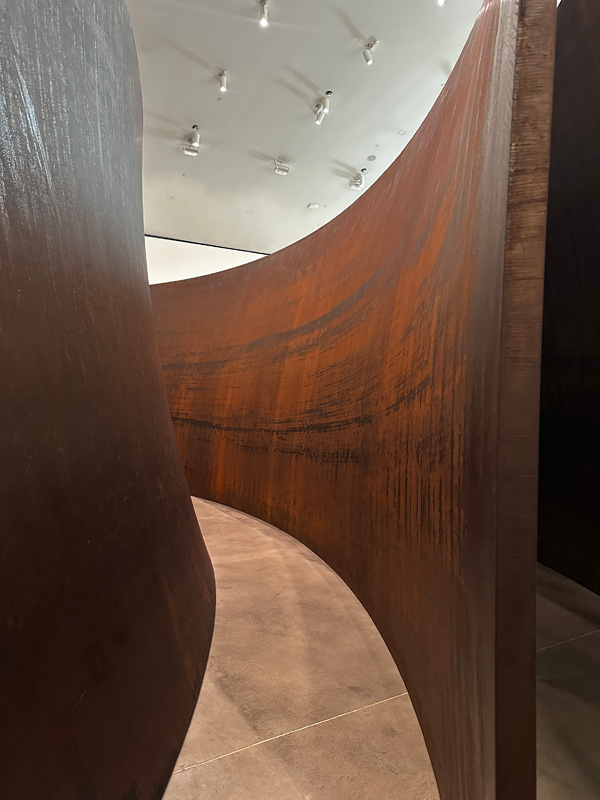
The eight sculptures are certainly not traditional art pieces that you passively look at & admire – instead you walk through enormous, curving walls of weathering steel (in a deep reddish-brown color) to become part of the experience.
Each sculpture has its own shape – some are simple oval passages and others have increasingly complex spirals and curved corridors. Plus, each wall rises several meters above the visitors.
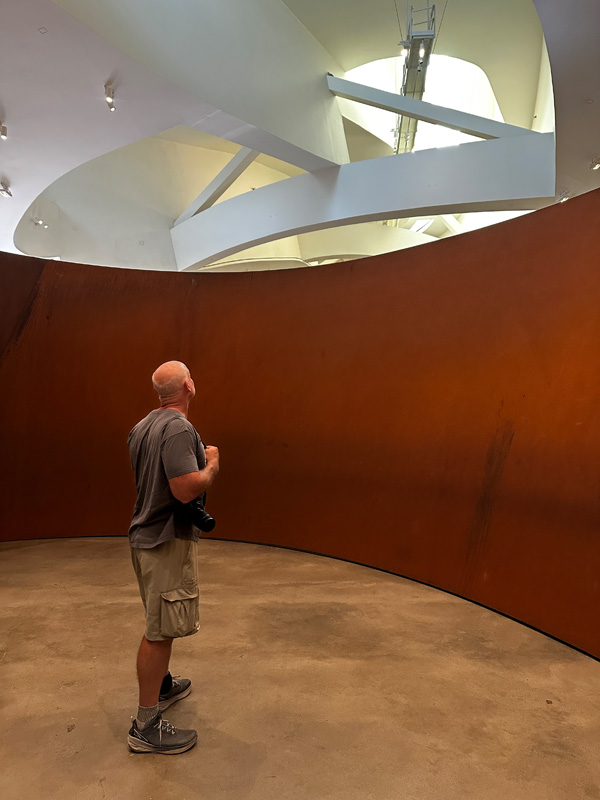
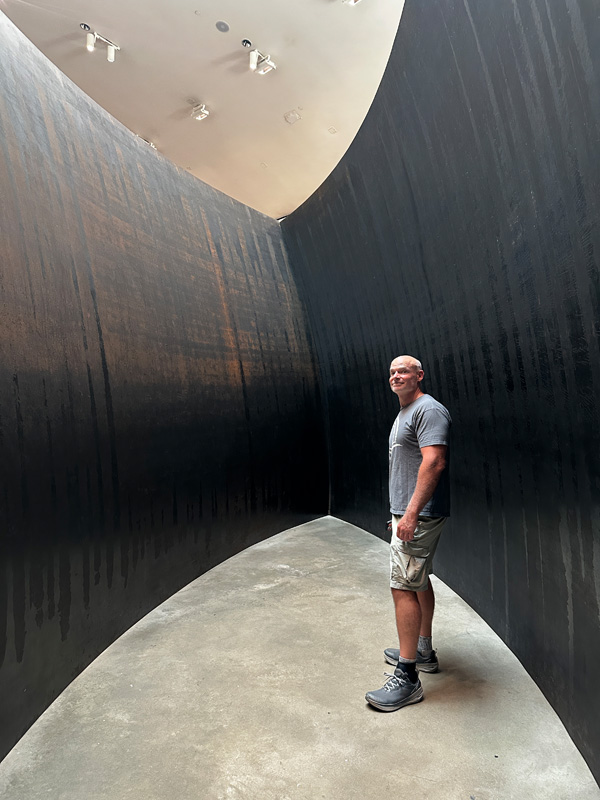
As we wandered through each of these massive sculptures, we marveled at just how the artist could have created and moved these multi-ton sculptures into this museum space. It was easy to see why this installation is a permanent exhibit!
Visiting the Rest of the Museum
The Guggenheim displays an impressive collection of contemporary art, with works by renowned artists. Exhibitions are rotated regularly, showcasing both established and emerging artists. Often, this includes ambitious, large-scale installations.
We visited the museum’s Special Exhibit (on the 2nd floor) entitled “Night Driver.” It featured artist Jasper Johns, an American painter, sculptor, and printmaker who helped transform modern art in the 1950s and 1960s.
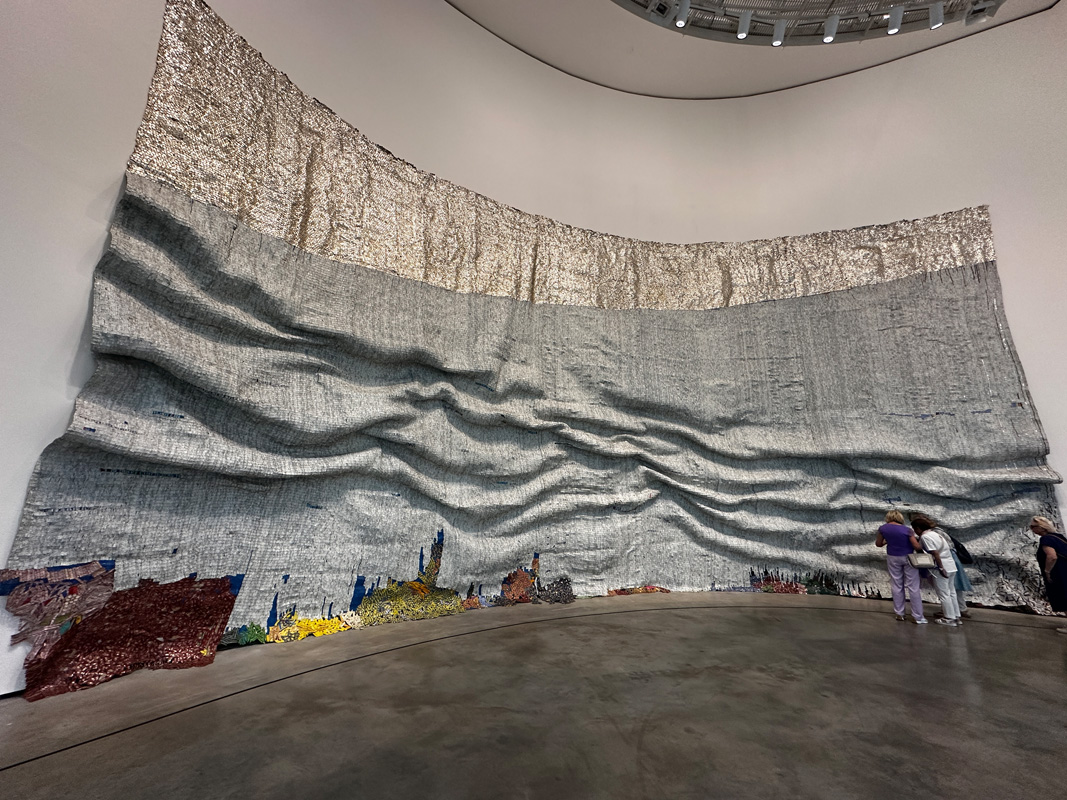
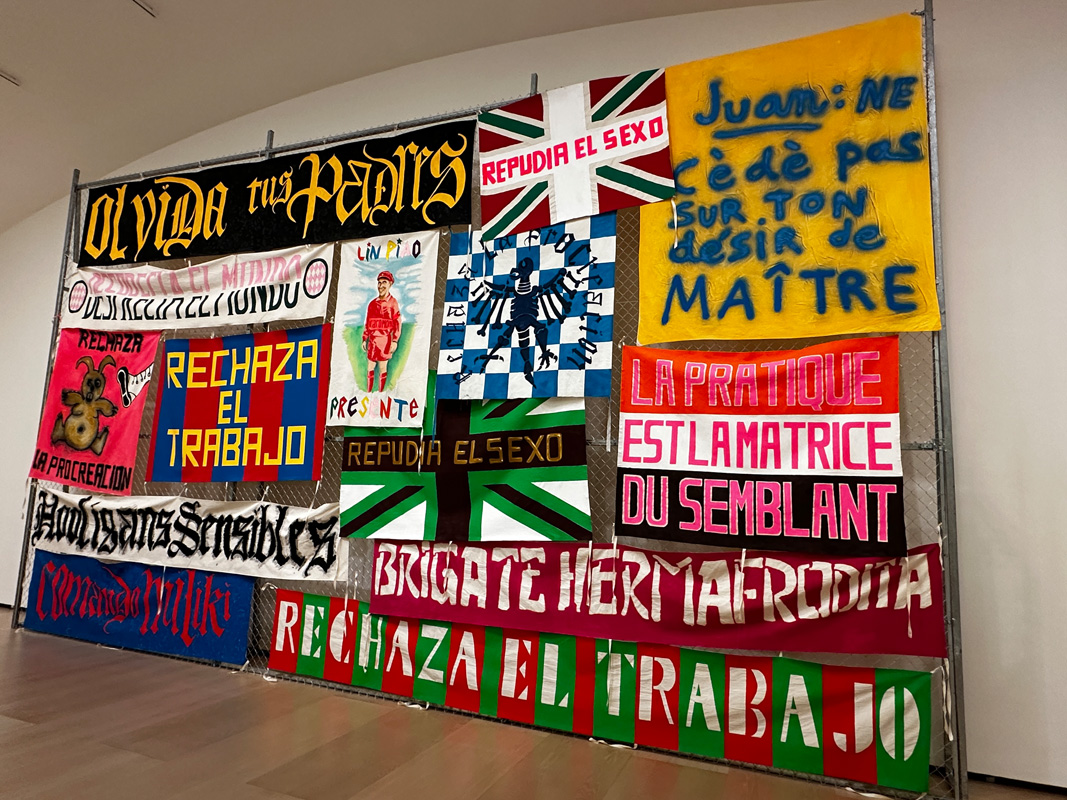
We also did a quick tour of several other smaller art exhibits (see above), after which we stepped outside onto a small terrace that overlooked the pond in front of the building.
It was around 6pm when we said a final goodbye to the enchanting Atrium & walked to a small adjacent park where we enjoyed a drink & snack at the outdoor café Ona. We had spent two delightful hours exploring inside the Guggenheim – and Jack & I felt complete. Of course, major fine art buffs (not us!) could spend much longer in that museum.
Guggenheim’s Unique Fog Sculpture & Fire Fountain
As part of their wildly unique art installations, there are two more offerings on the museum’s riverfront that we loved – and want to tell you about.
Fog Sculpture
Every hour, a cloud of white mist is released from the riverside plaza area for a total of 8 minutes. The resulting fog drifts and changes shapes according to atmospheric conditions like wind, temperature & humidity. Thus, each hour’s show is unique!
This “Fog Sculpture” took place at the top of each hour, starting at 9am and going thru 9pm. The fog can envelop the pond, the building’s titanium walls, the riverside plaza, and the river itself. One moment, the building may be clearly visible; the next, a cloud of white mist may partially obscure it.
-
- Click all photos to enlarge
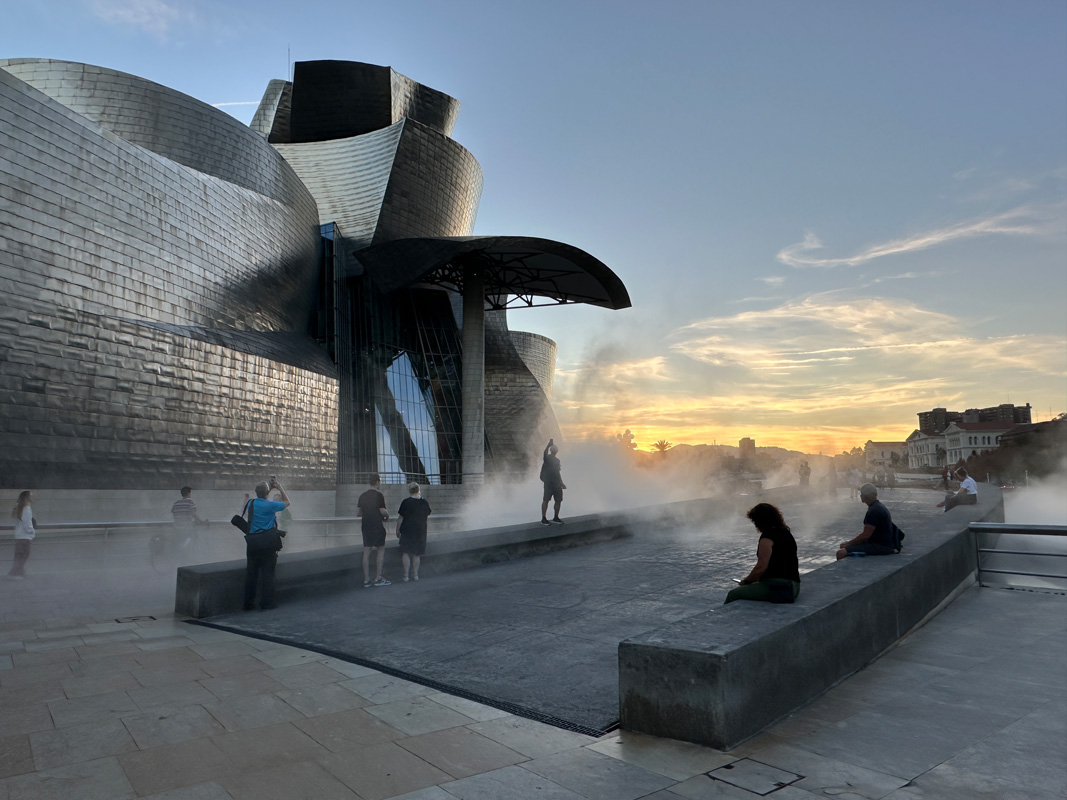
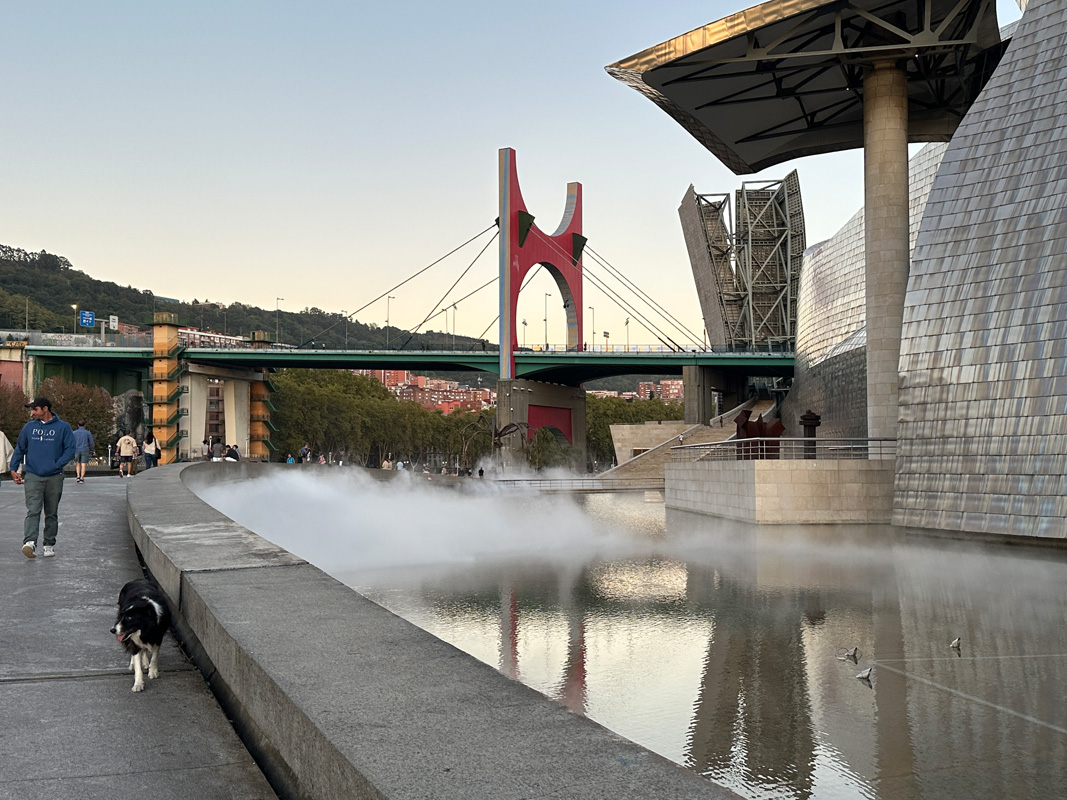
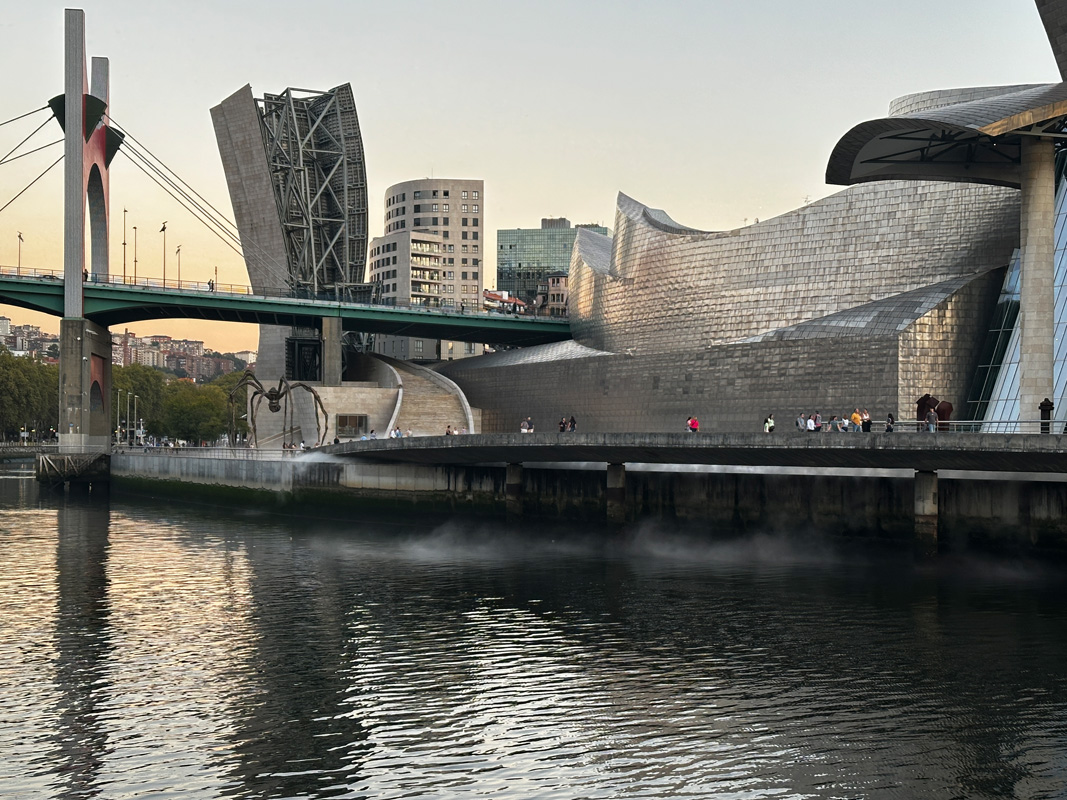
We witnessed the Fog Sculpture many times, on different days and from various locations including both sides of the river. We also viewed the fog at different times of day – from morning to evening. The gorgeous Guggenheim exterior enveloped in mist was photographic eye candy for Jack! (see photo below right)
-
- Guggenheim Enveloped in Fog / Credit: Jack Daulton
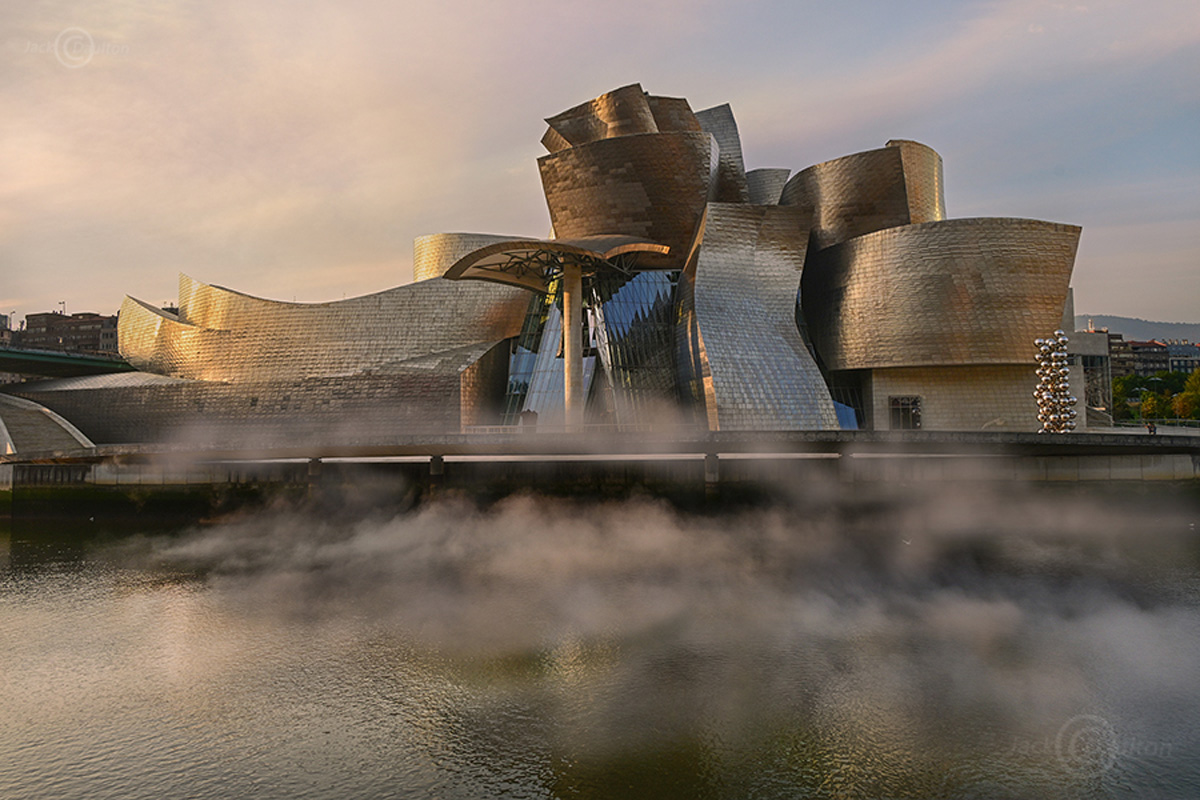
Japanese artist Fujiko Nakaya created the Fog Sculpture installation in 1998 specifically for the Guggenheim’s opening. So how is it done? A system of approximately 1,000 specialized nozzles and a high-pressure pump produce a fine mist of water droplets.
Fire Fountain
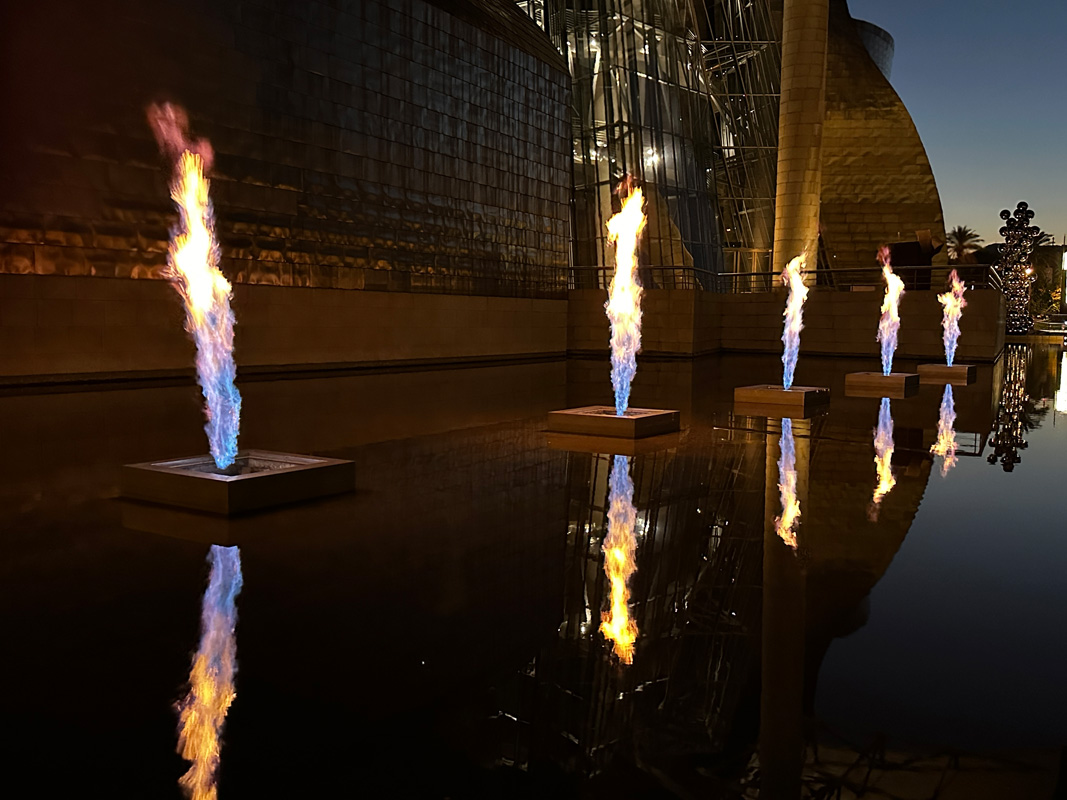
Unlike the Fog Sculpture, the “Fire Fountain” only operates in the evening around dusk. During our late September visit, the “shows” took place every 15 minutes, between 8:30pm & 9:30pm. And the flames were activated for just one minute.
Five flame-producing installations sit in a row within the museum’s pond. At scheduled intervals, tall flames are sent into the air, with their orange glow reflected in the water & against the museum’s metallic curves.
-
- Fire Fountain!
-
- Jack capturing the 9pm Fog show!
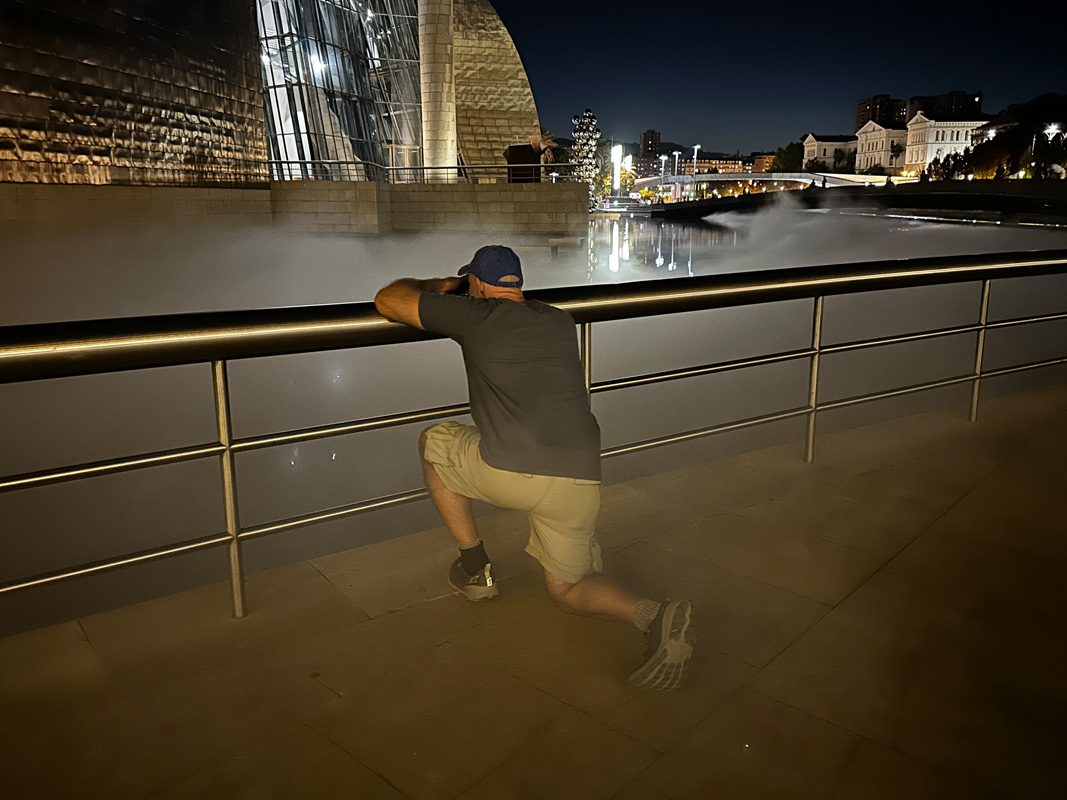
We made sure to witness the Fire Fountain on our final evening – starting at 8:30pm. We watched 3 shows in a row. The 9pm show was especially cool because the Fire Fountain was taking place as the Fog Sculpture mist was starting to flow. Yep, a visual “two-fer!”
Fire Fountain is the work of French artist Yves Klein. He originally conceived the idea for the work in 1961. But the permanent installation at the Guggenheim was not realized until 1997.
Riverside Walk South to the Old Town
We’ve now fully toured the Guggenheim Museum. So, let’s go explore some more great areas of central Bilbao – places that you’ll also want to see.
One morning, upon leaving our hotel, we walked south in the other direction along the riverside promenade. Our destination was Bilbao’s Old Town area (about a 15-minute walk plus stops).
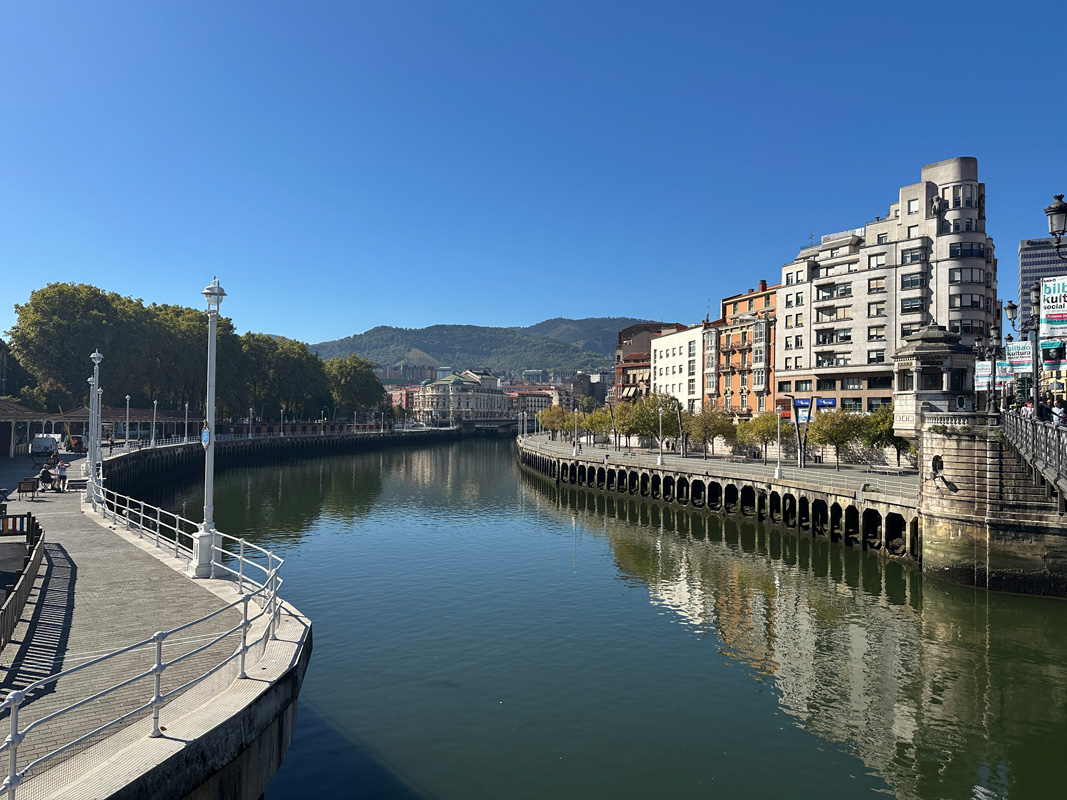
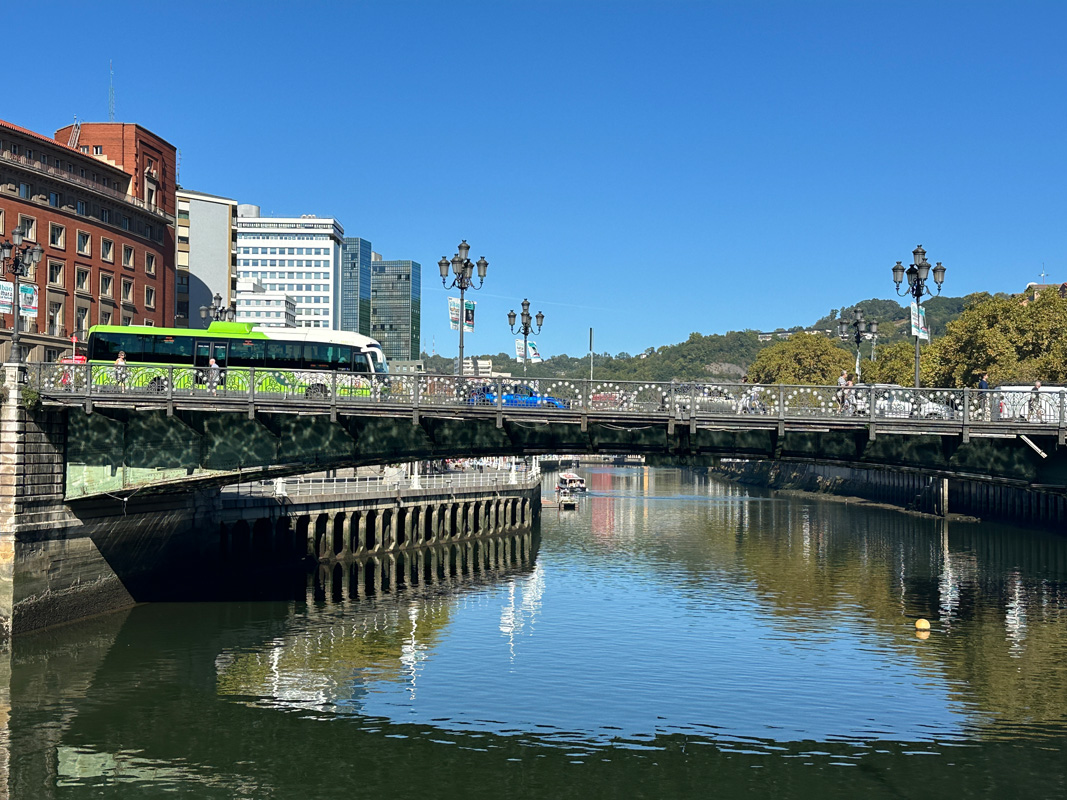
Along the way, the Nervion riverside views continued to be lovely, including offering some vivid reflections in the water. And there were more elegant bridges crossing over the river.
Grand Bilbao Architecture from the Past
Along the way, we passed some beautiful old buildings. Let me share three of them to give you a flavor of Bilbao’s great architecture. We didn’t go inside any of the buildings – just admired their grand facades.
Bilbao’s City Hall (Ayuntamiento)
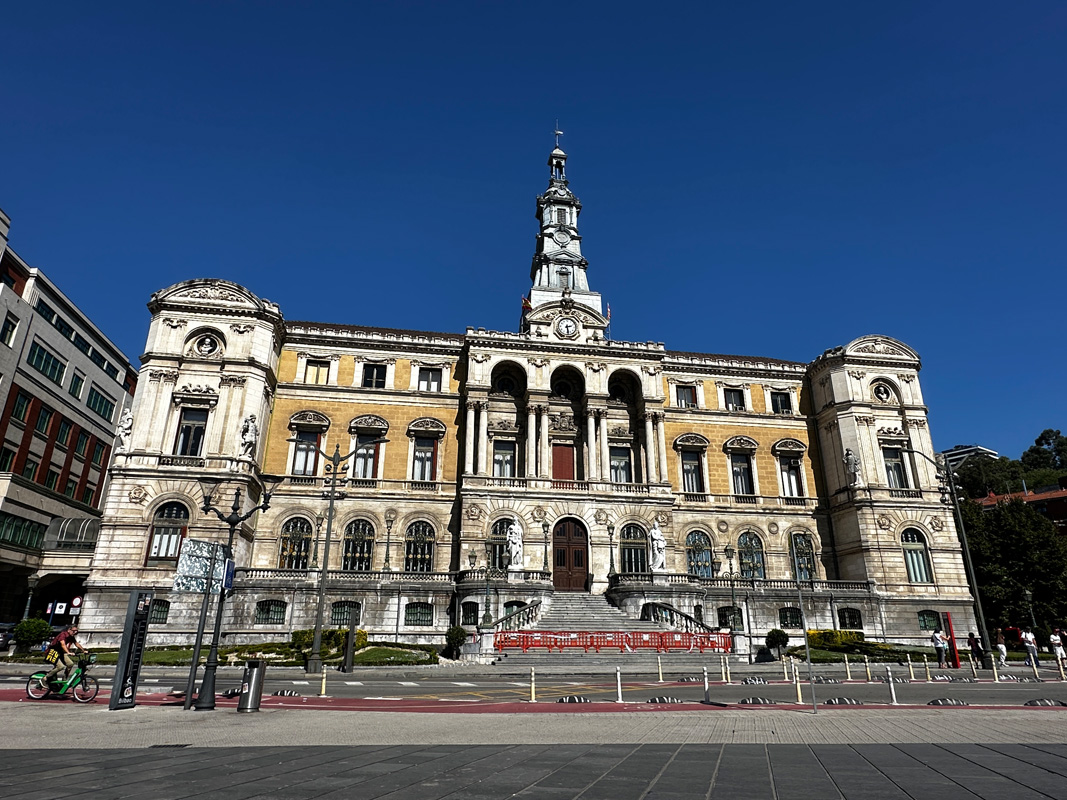
This impressive building is located near the river & the Ayuntamiento bridge. Its ornate stone façade is embellished with arches, columns, sculptures and a prominent clock tower.
-
- Town Hall / Ayuntamiento
-
- Town Hall with a Peaceful Protest (Sanitation Workers)

The City Hall was built in 1892 by the same architect who designed the Arriaga Theatre. These two lovely buildings were built in the late 19th century during the city’s tremendous growth due to prosperity gained from its industrial expansion.
Arriaga Theatre
The architecture of this beautiful theatre recalls the great opera houses of Europe. Its Neo-Baroque style was inspired, in part, by the Paris Opera House.
-

- Arriaga Theatre / Credit: ChatGPT from 20Minutos
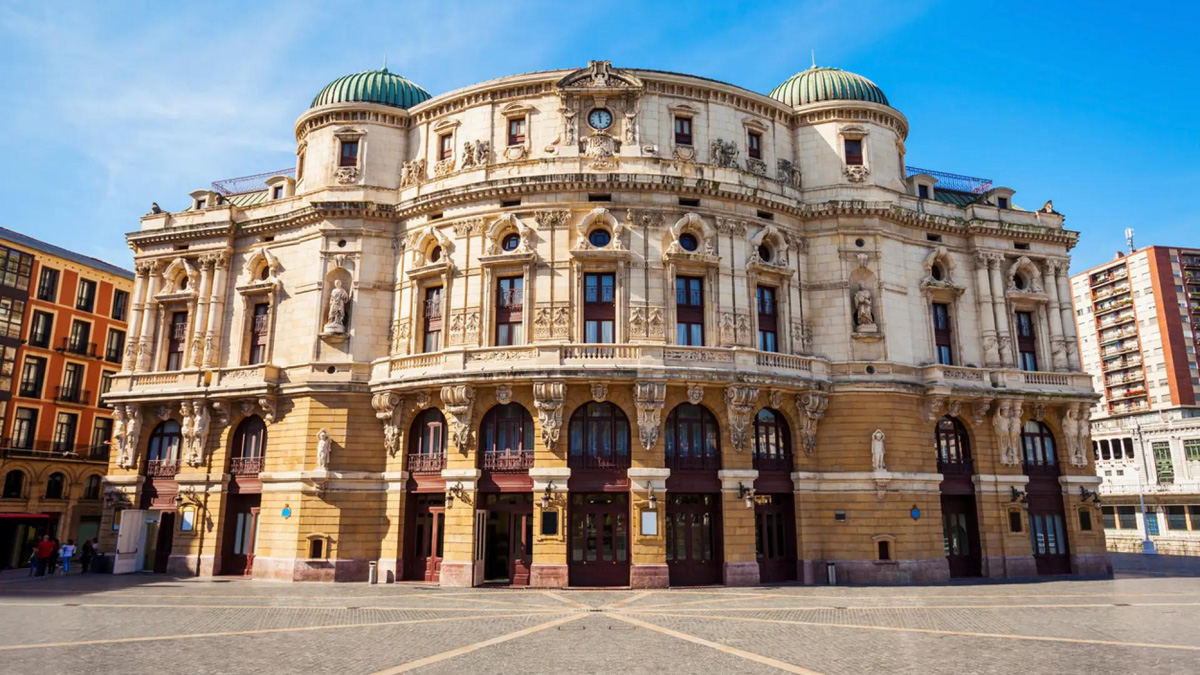
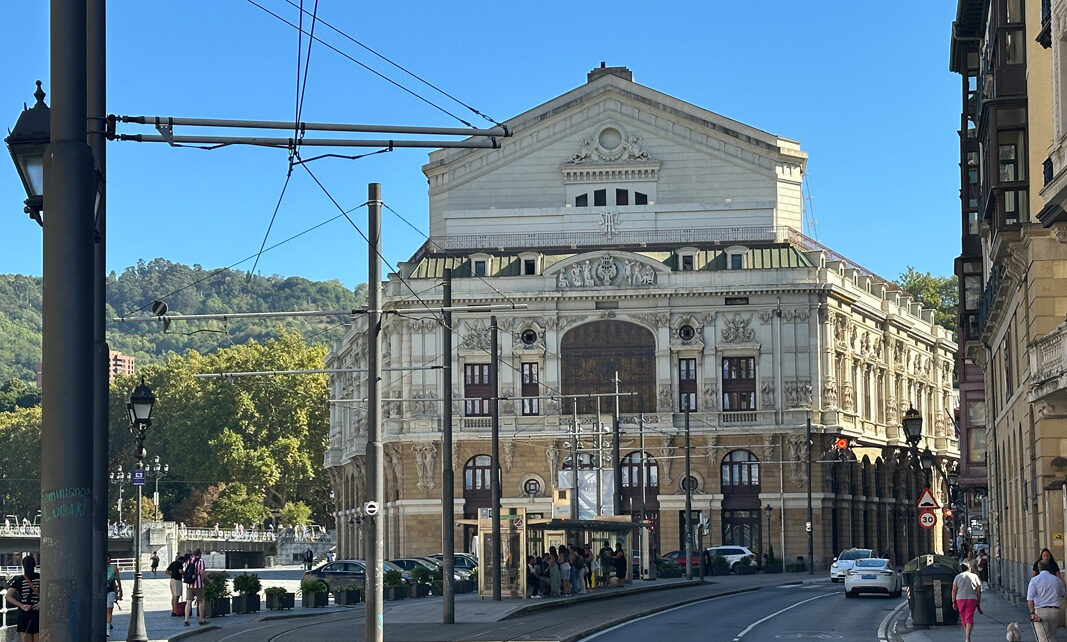
First opened in 1890, the theater suffered a devastating fire in 1914 and was rebuilt. It remains one of Bilbao’s most important performing arts venues, hosting theater, opera, ballet, and concerts.
Abando Railway Station (Estacion del Norte)
Walking along the river, I was captivated by an ornate façade in yellows and greens with a sign under a clock tower reading “F C de Santander a Bilbao.” I correctly deduced that it might be the train station (since ferro carrill means rail in Spanish).
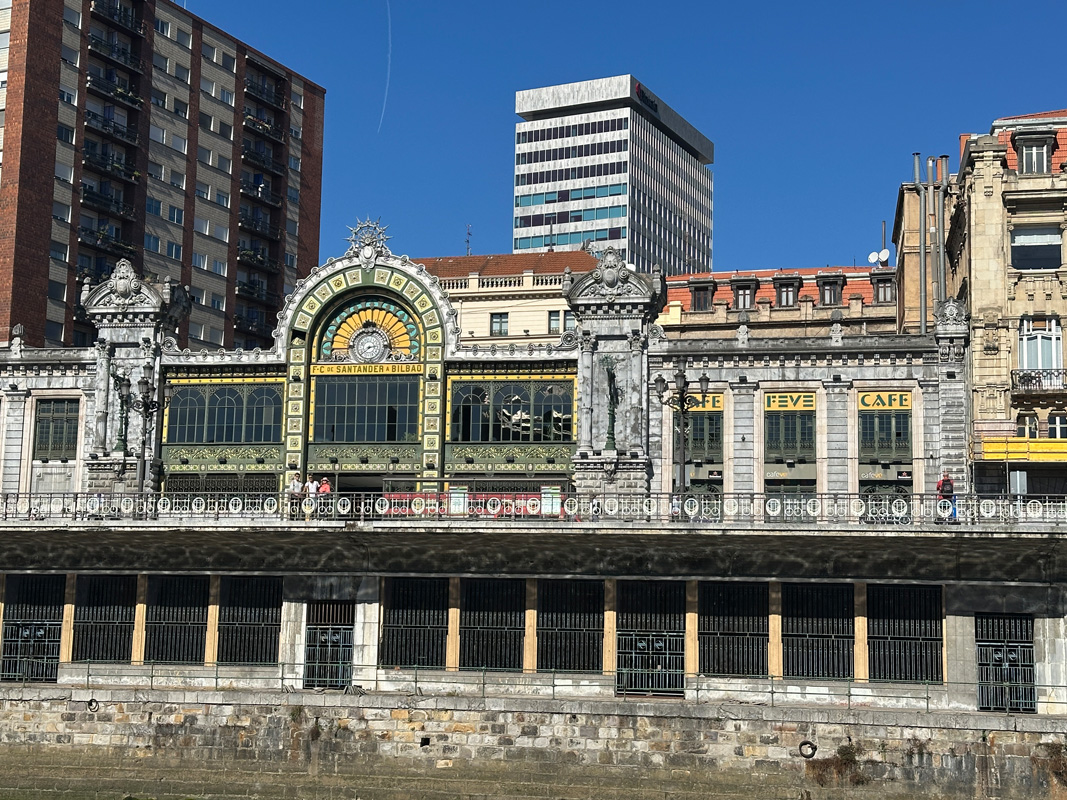
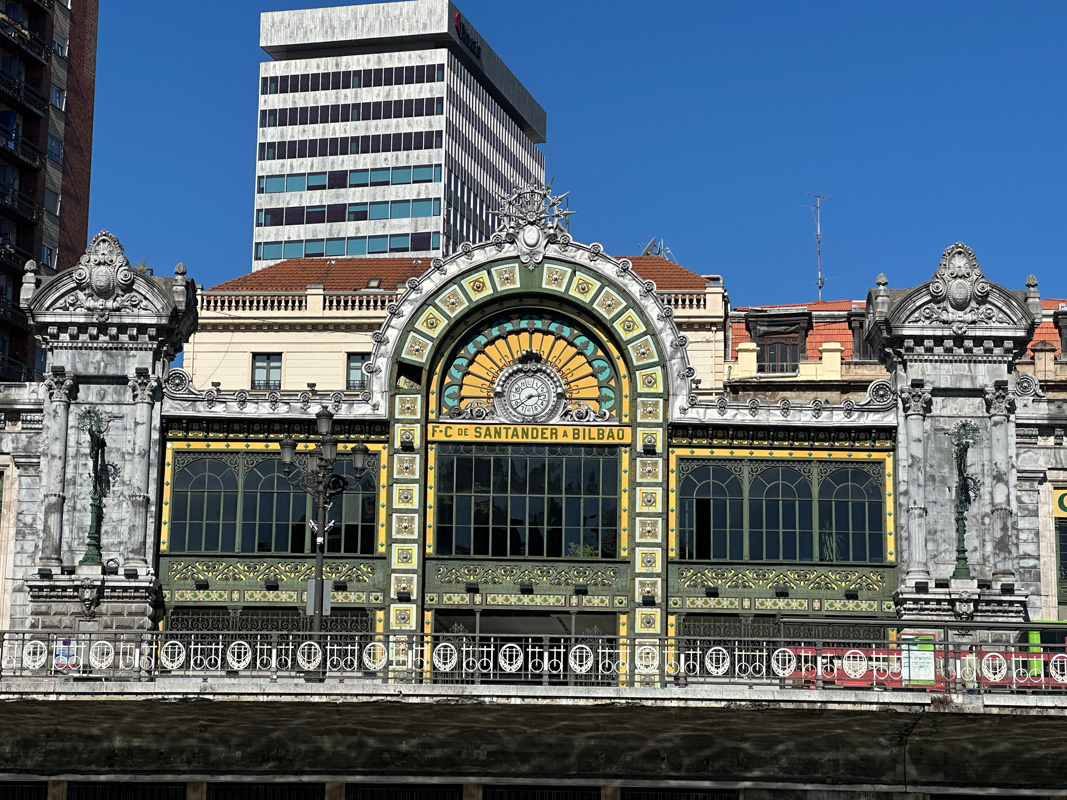
Train Station Stained Glass Window / Credit: ChatGPT / Click all photos to enlarge
Turns out, this is Bilbao’s main railway station for long-distance trains (primarily Spain’s Renfe). The present station opened in 1948, replacing an earlier one from the 19th century.
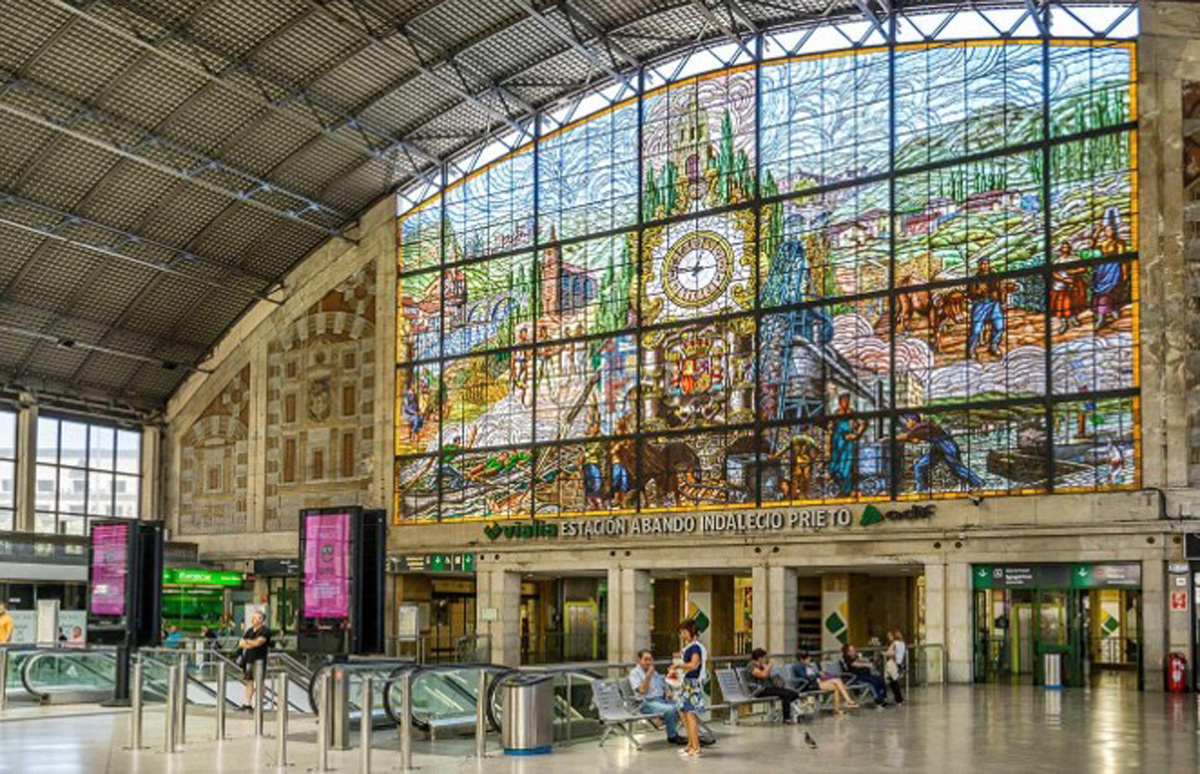
Apparently, the real treasure is inside the Abando station where there is an enormous, stained-glass window overlooking the train platforms.
Three hundred glass panels depict scenes from Basque life. Darn… I’m sorry we missed seeing this window! But here’s a photo from the internet to show you & me!…
La Ribera Market (Mercado)
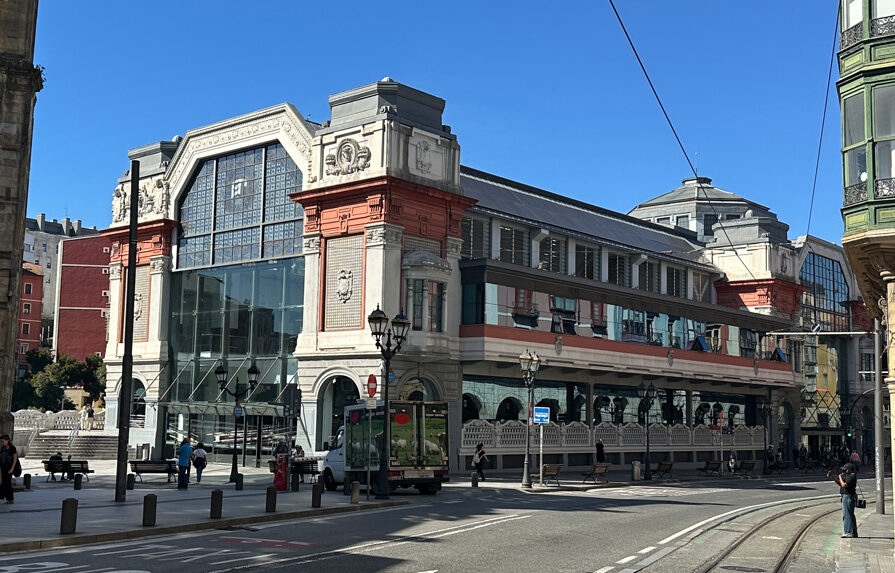
We continued our walk along the river until reaching La Ribera Market on the edge of Old Town. From our guidebook, we learned that La Ribera is one of the best places to experience Bilbao’s traditional food culture. Sounded great!
La Ribera’s History
The market’s origins date back to the 14th C. For centuries, because of its riverside location, the market was an important meeting point for merchants, farmers, fishermen, and townspeople.
-
- The other side of long market with stained glass windows
-
- The entry side with the escalator
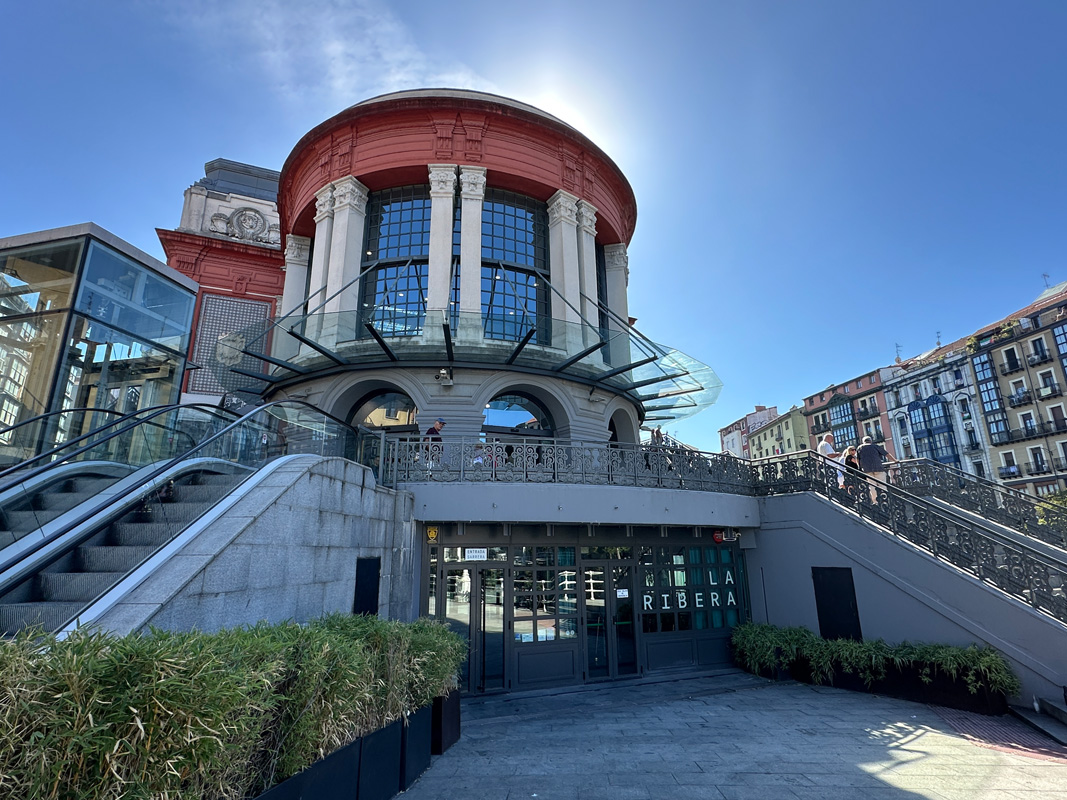
The present building opened in 1929. Extensive renovations took place after Bilbao’s devastating 1983 floods & again around 2010 to further modernize it. This lively 3-story food market combines a functional market-hall design and decorative Art Deco influences, including stained-glass windows.
La Ribera Market Today – What’s for Sale?
Traditionally, the market has brought together foods from the Basque Country and surrounding countryside, including:
- Fresh fish and seafood from the Bay of Biscay
- Meat, cheeses, and cured ham
- Seasonal fruits and vegetables
- Local ingredients used in traditional Basque cooking.
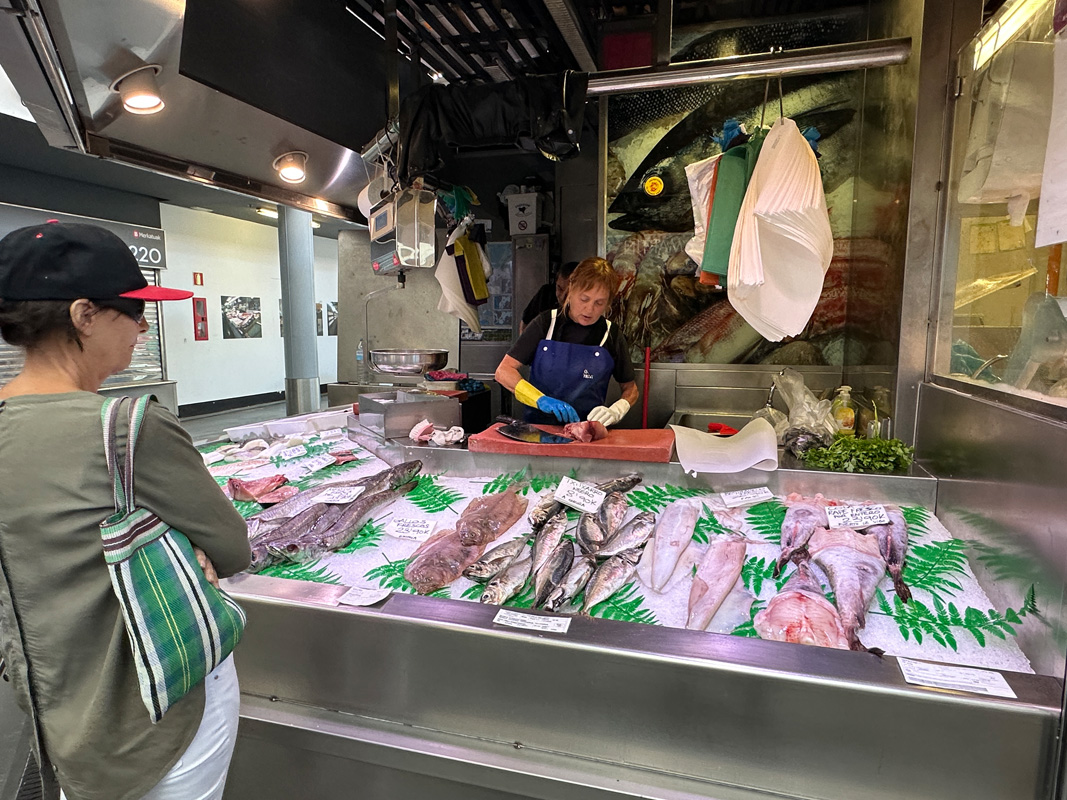
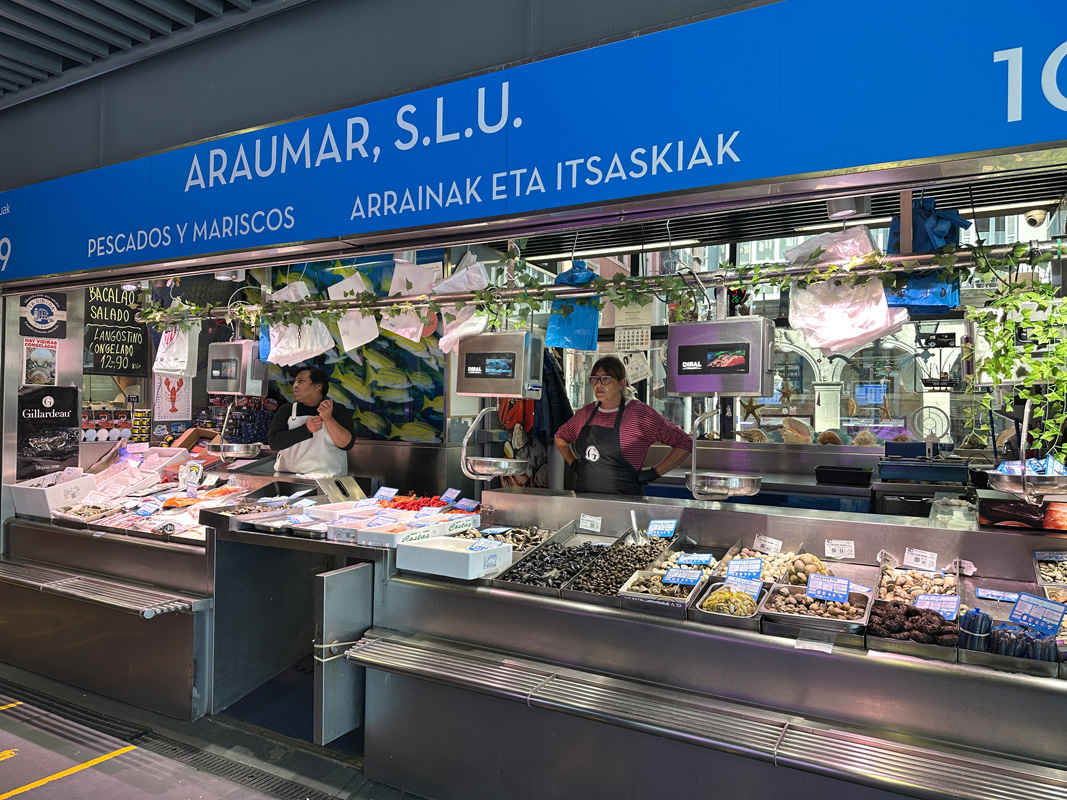
We had a great time exploring the fascinating market. We took the outside escalator up to La Ribera’s second floor. There we walked among the many food stalls & shops on both the 2nd and 3rd floors. It’s excellent people watching as this is clearly where the locals come to do their shopping.


The visual sight of the large number of stalls displaying all types of fresh seafood particularly blew us away! We saw one counter selling only olives & doing a booming business. (photo below on right)
La Ribera also had quite a few shops selling meat, including more unusual items like beef or pork “cheek” which is popular in Spain. I learned that cheek meat comes from the heavily exercised jaw muscles of the animal. Usually, I like to try local foods when I travel, but I had zero desire to try this delicacy.
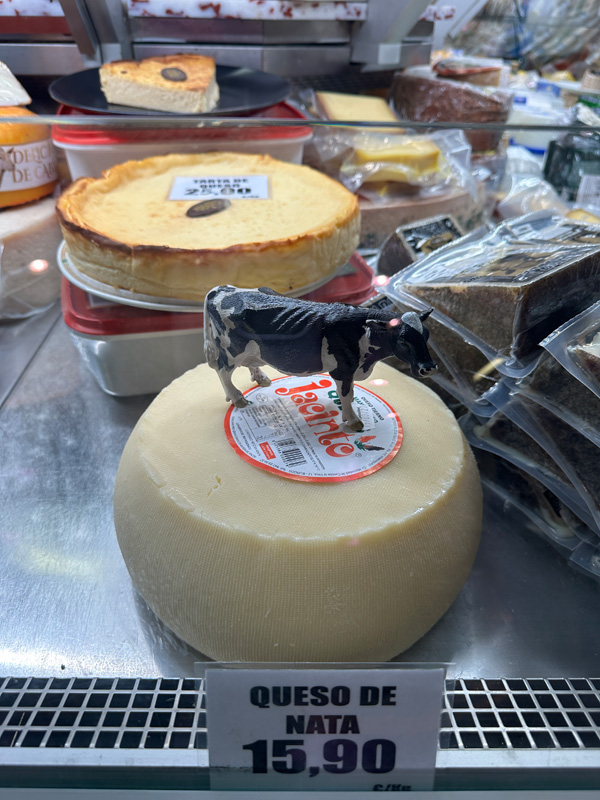
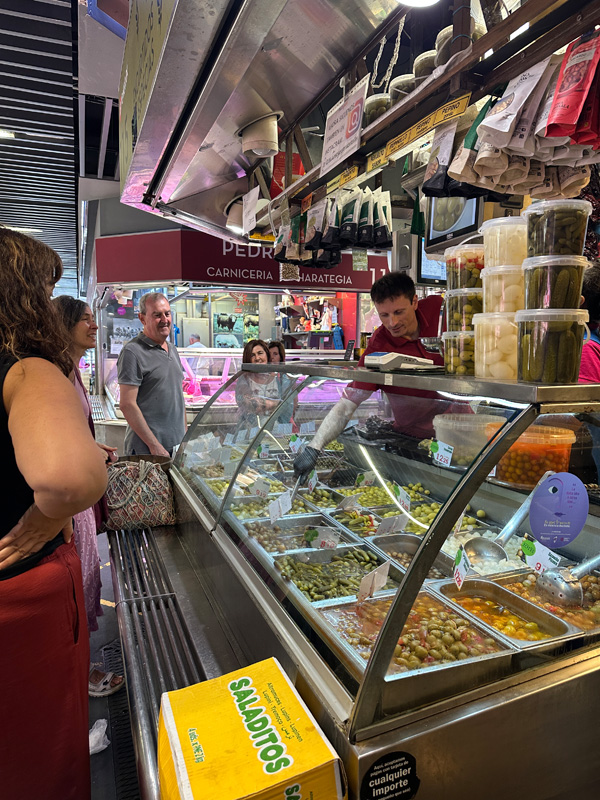
On the market’s second floor, there are also tapas bars & “gastrobars” where visitors can sit and enjoy a variety of pintxos (tapas), wine, and other local Basque foods. We didn’t have the extra time or requisite hunger to take advantage of this very convenient food option – but hopefully you will!
Exploring Bilbao’s Delightful Old Town
We exited La Ribera Market, crossed the busy street (Calle Ribera) right in front, and entered the Old Town (Casco Viejo). We spent 1.5 hours here to get a flavor of Bilbao’s historic heart dating back more than 700 years.
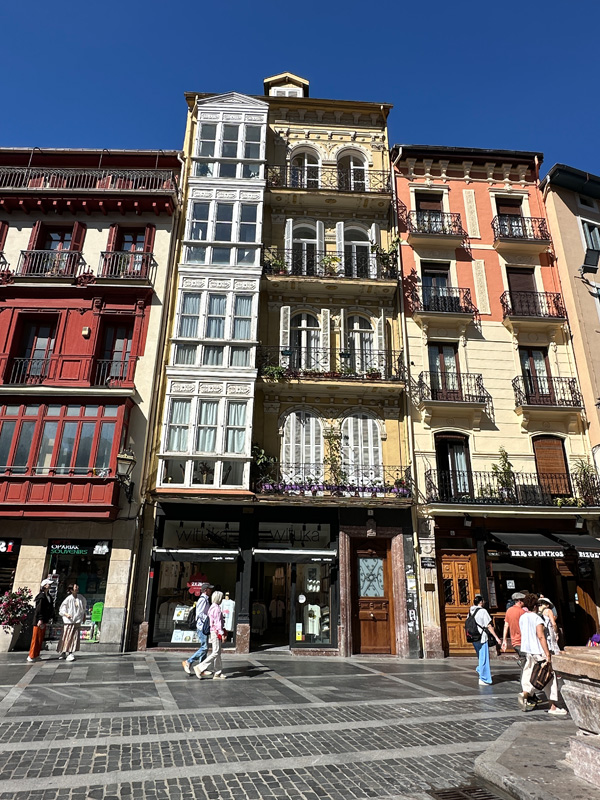
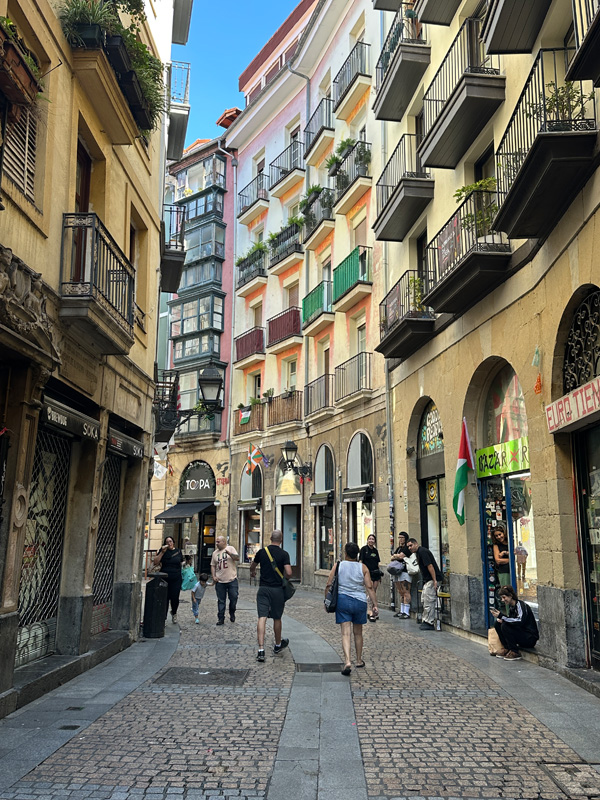
Bilbao’s Old Town is fairly small and perfect for leisurely strolling. Its narrow lanes are filled with historic buildings, traditional shops, cafés, and lively tapas bars.
Santiago Cathedral
We headed straight to the Santiago Cathedral, built primarily in the 14th and 15th centuries in a Gothic style. It was dedicated to the Apostle St. James (called Santiago in Spanish), who has been Bilbao’s patron saint since 1643.
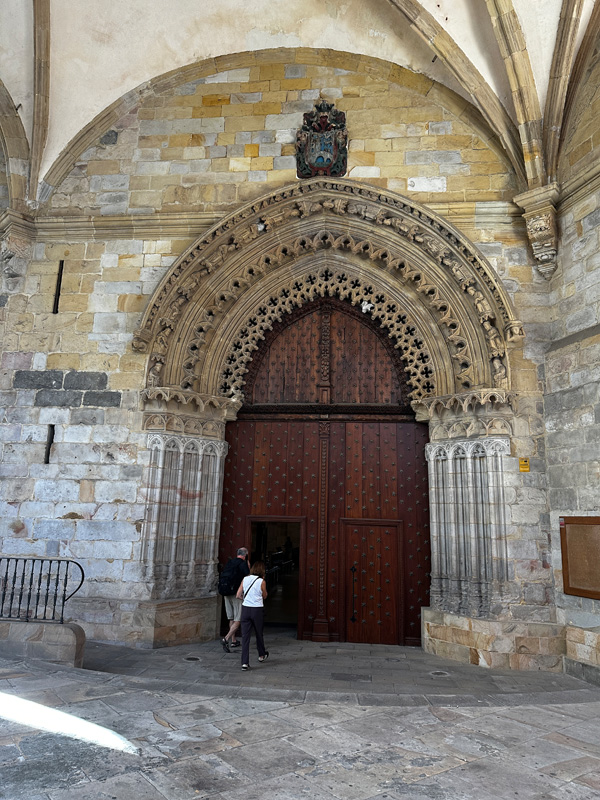
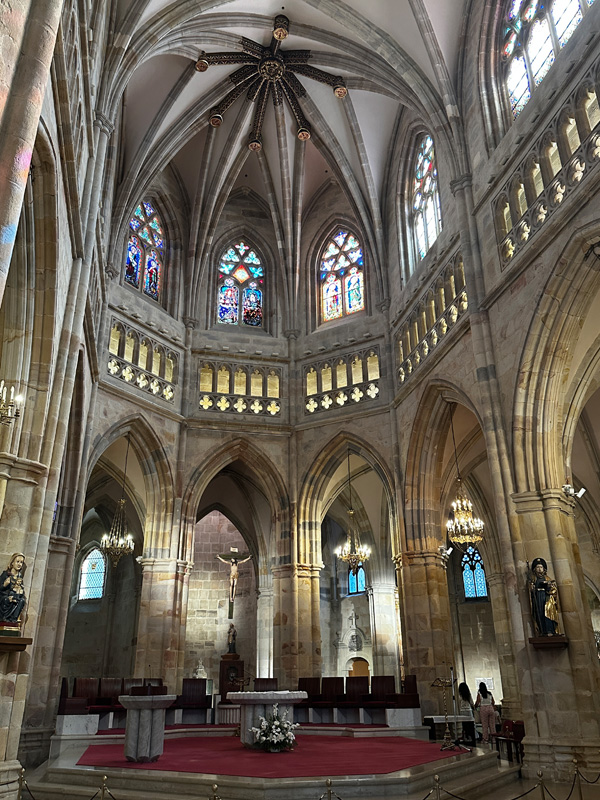
The cathedral is also connected to the Camino de Santiago. That’s because Bilbao lies on the northern coastal pilgrimage route (Camino de Norte) that leads to Santiago de Compostela (where Santiago’s relics are housed in the Cathedral).
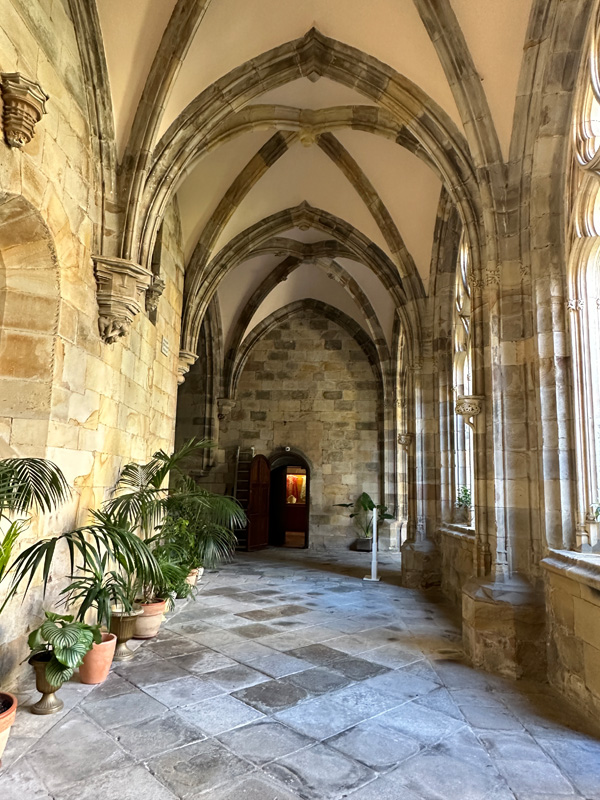
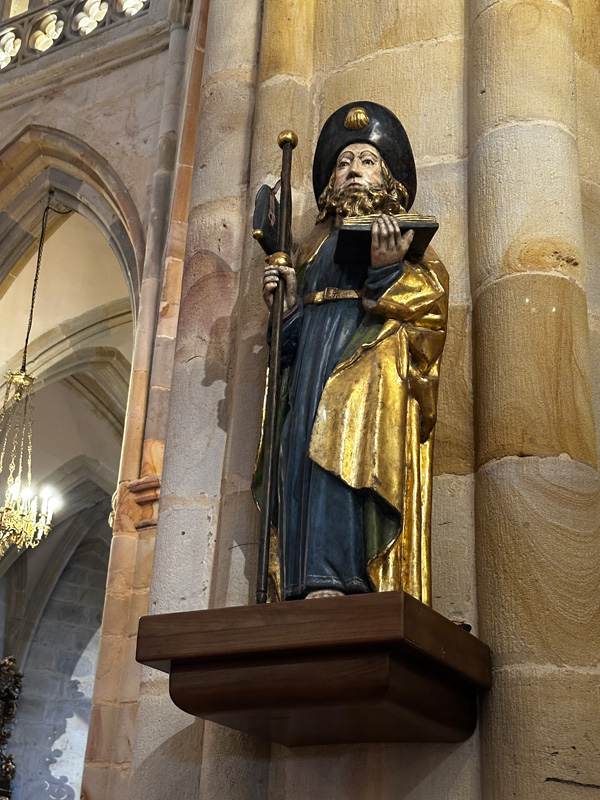
We went inside to take a look – it was “just” another beautiful cathedral with a pretty 16th C. cloister. Having walked a couple past Caminos de Santiago on a different route (the Camino Frances), I paid homage to the statue of Santiago inside the church (who is always pictured as a pilgrim). (photo above)
Dog Fountain
With the Cathedral visit complete, it was time to find a place for lunch. Since we were already in Old Town, it had to be a tapas/pintxos bar. The Rick Steves guidebook mentioned there were a few good places on Calle de Perro. (perro is dog in Spanish).
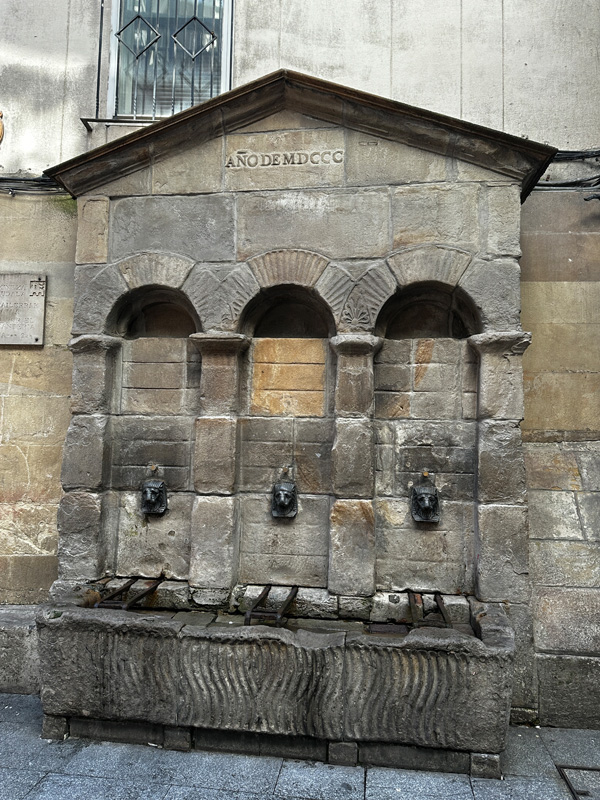
Upon finding “Dog Fountain” (Fuente del Perro), we knew we were on the right street. We made a quick stop at this historic fountain, which was renovated in 1800 in a Neoclassical style. Its façade features three rounded arches over three spouts.
-

- Hmm… Do you see a Dog or a Lion?
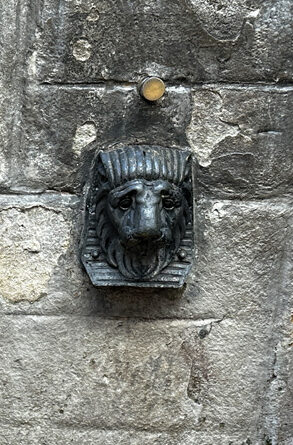
Apparently, the name was a case of mistaken identity. The three spouts were originally sculpted as lion heads, but locals felt they looked like dogs instead – so the nickname Dog Fountain stuck. Interestingly, the fountain water is still safely drinkable, so we filled up our water bottles.
Our Tapas Lunch / Pintxos Bar
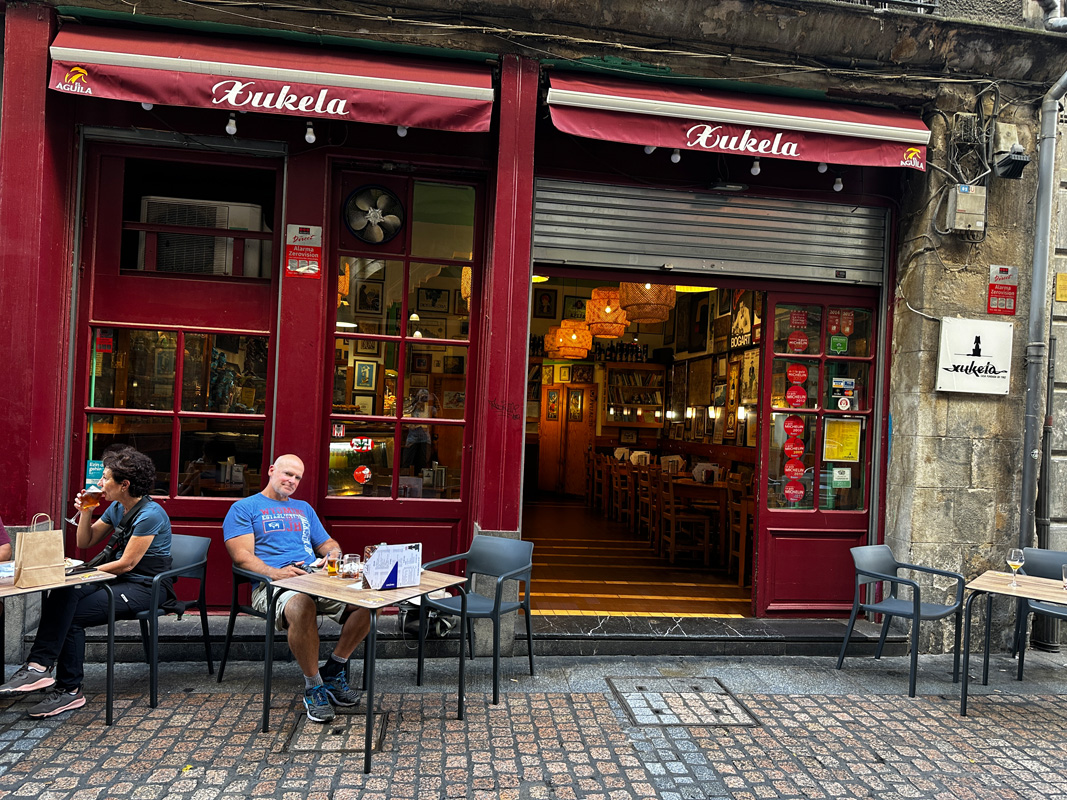
We located a good tapas bar – Xukela – a little further down Calle de Perro. We went inside the attractive bar to inspect the wide array of delicious tapas/pintxos on display at the counter.
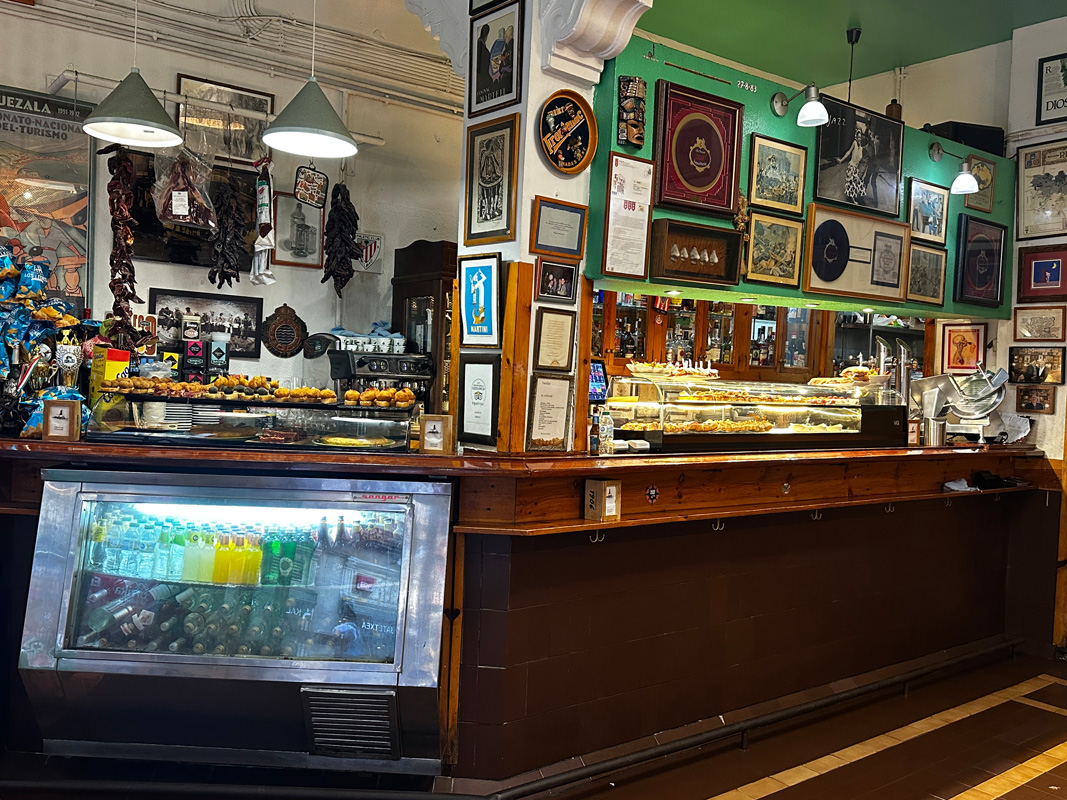
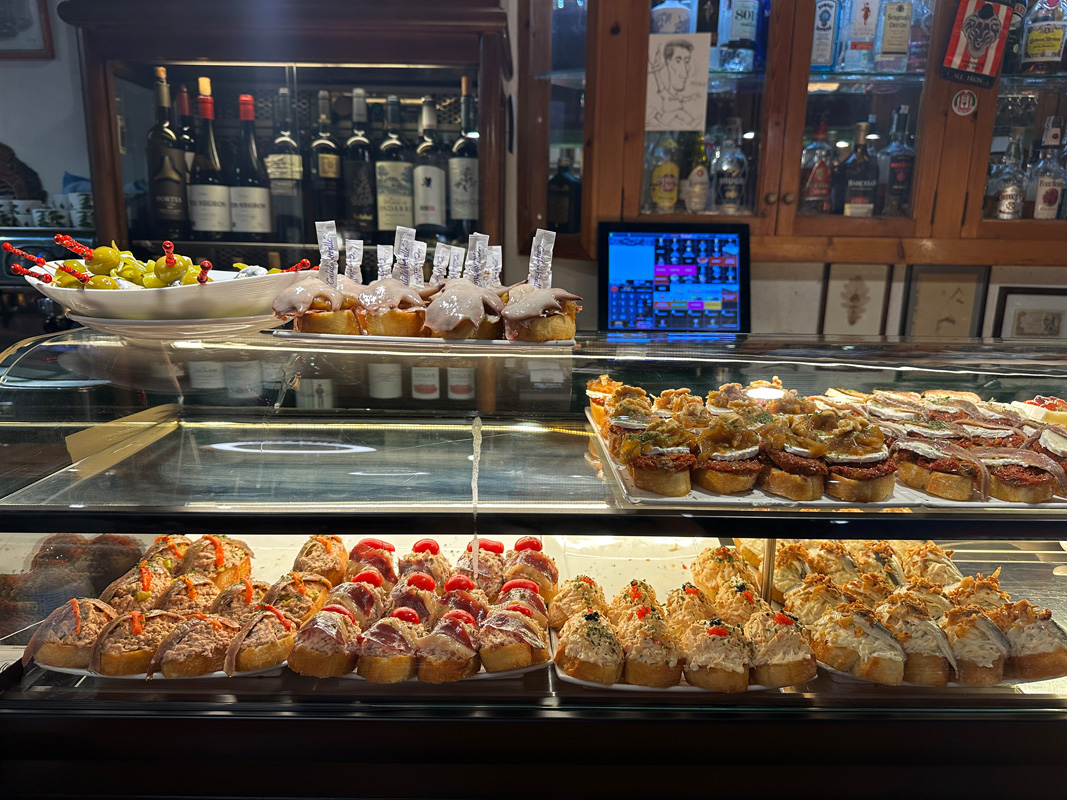
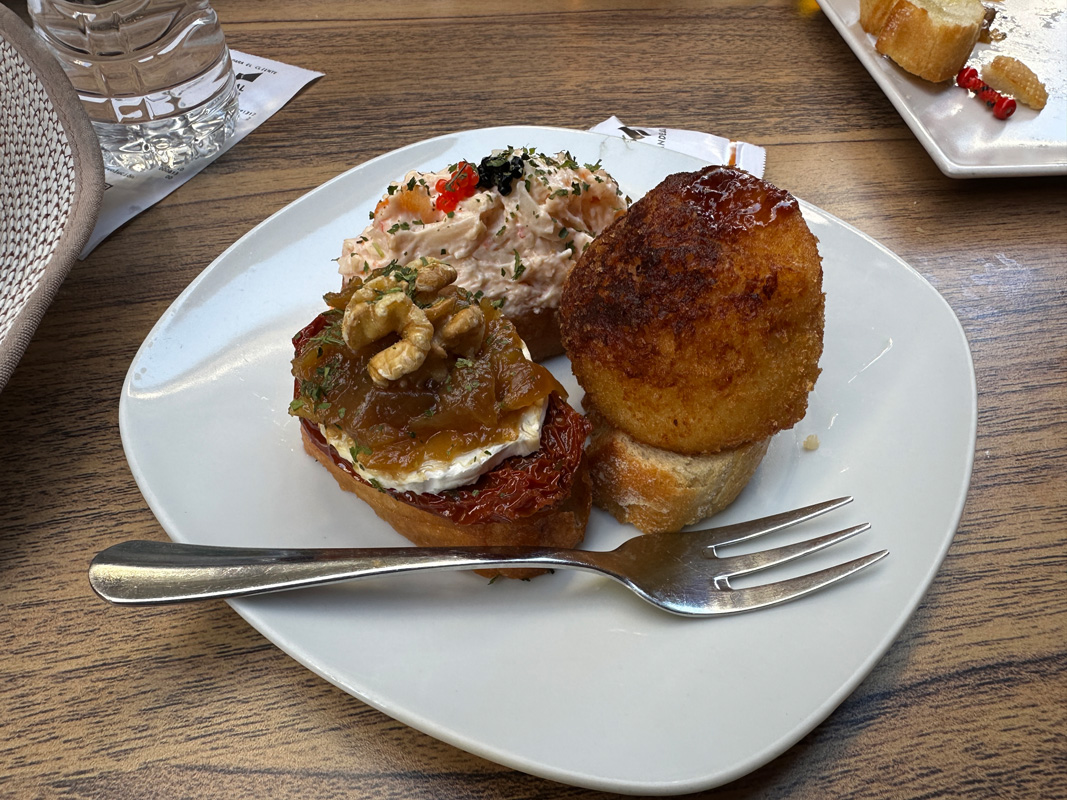
Jack & I each pointed to the three pintxos we wanted, which the bartender put onto a plate. We headed outside to a streetside table to enjoy a tasty and quick lunch. The cost for 6 pintxos & 2 bottles of water was 20.5 euros ($23 USD). Not bad!
More About Pintxos – Basque Tapas
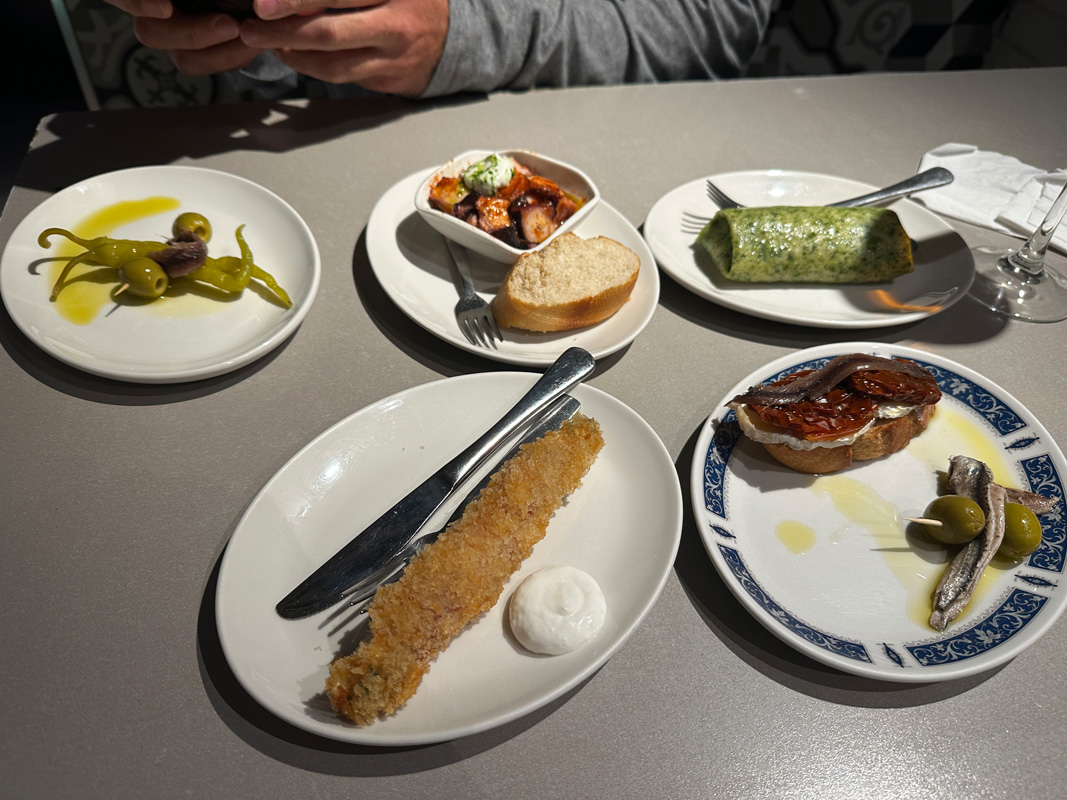
One of the pintxos meals we enjoyed in Pamplona / Click to enlarge
One of the most enjoyable ways to experience Basque Country’s food culture is through pintxos – so-called cousins of the Spanish tapas that we’re all familiar with. These small, carefully prepared bites are served in bars.
Pintxos frequently feature a piece of bread topped with ingredients such as seafood, anchovies, cheese, peppers, or ham. Many places also offer creative versions that resemble miniature works of culinary art. You betcha – we ate lots of great pintxos during our week in Basque Country.
The Funicular de Artxanda
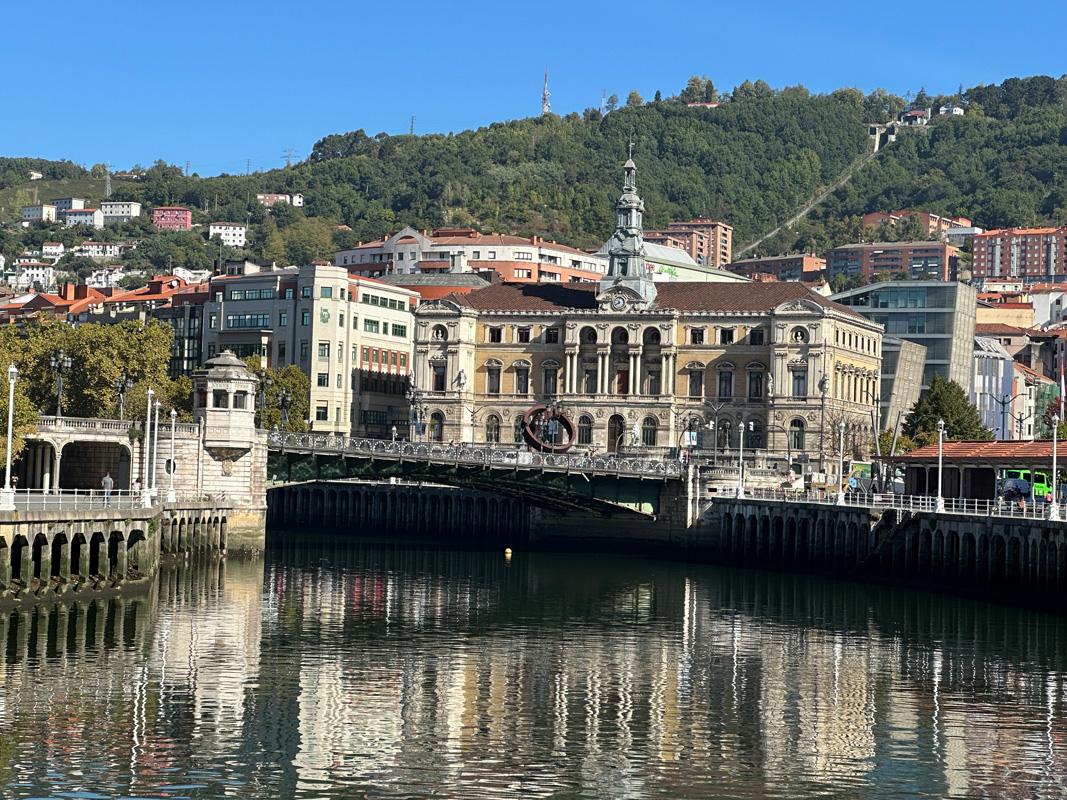
View of Town Hall (in the middle) – with funicular track behind on the hill
I wanted to tell you about one more Bilbao activity that sounded great but unfortunately, we didn’t have the time to do. It’s a historic funicular (opened in 1915) that takes you on a 3-minute ride to the top of Mount Artxanda.
Apparently, the top offers beautiful panoramic views of the Bilbao city below with its river, bridges, buildings and surrounding bridges. Also, there is a park, restaurant and sports complex on the top of Mount Artxanda
Our Hotel – Bilbao Plaza
I want to share the lovely hotel where we stayed for 3 nights – the Bilbao Plaza. It had been listed in Rick Steves guidebook, along with good reviews on Booking.com. In addition to its reasonable price, the hotel had an underground parking garage – an important factor since we had a rental car.
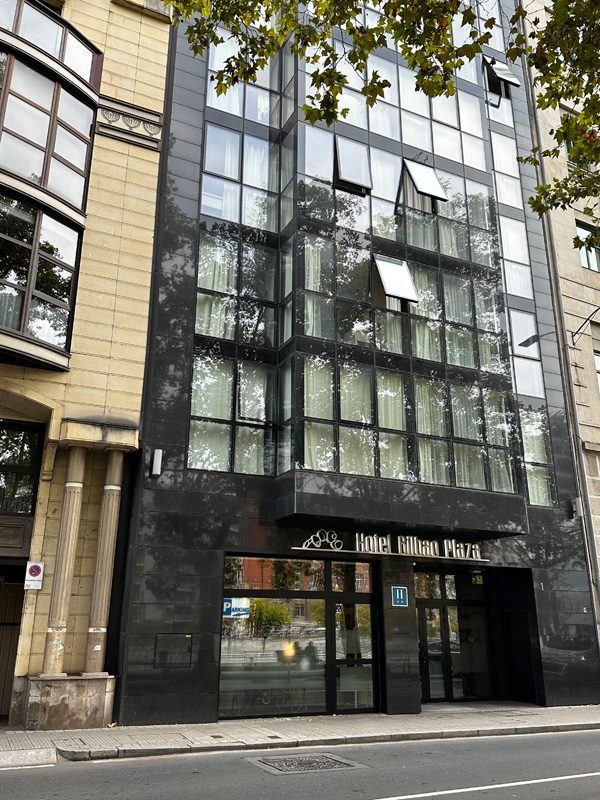
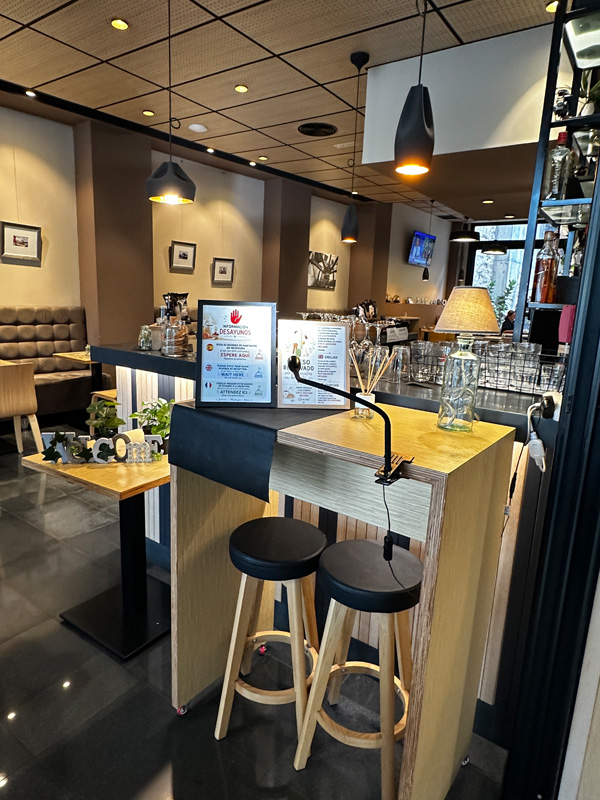
The best feature was its fabulous location along the river, offering a short walk to both the Guggenheim and Old Town. Plus, this mid-range modern hotel had a warm, welcoming lobby and friendly staff. So, Bilbao Plaza is definitely a hotel I would recommend for your visit.
CLOSING FINAL REMARKS
Note: I used AI (ChatGPT & Claude) for some of my Bilbao research for this article. I especially liked how Chat summarized why Bilbao is so special – here’s what it wrote:
Perhaps Bilbao’s greatest appeal is this combination of experiences. It offers world-class architecture and art, a fascinating history, wonderful food, attractive walking routes, and an authentic sense of regional identity. It feels sophisticated without being stuffy and cosmopolitan without losing its local soul.
How Much Time to Spend in Bilbao
There is certainly no right answer to this question. It all depends on how much overall time you would have to enjoy the many sights in Basque Country.
As mentioned, Jack & I spent 3 nights in Bilbao & 3 nights in nearby San Sebastian and it was perfect! I’d recommend no less than 2 nights in Bilbao so you will have time to enjoy all the town’s key sights, including adequate time at the Guggenheim.
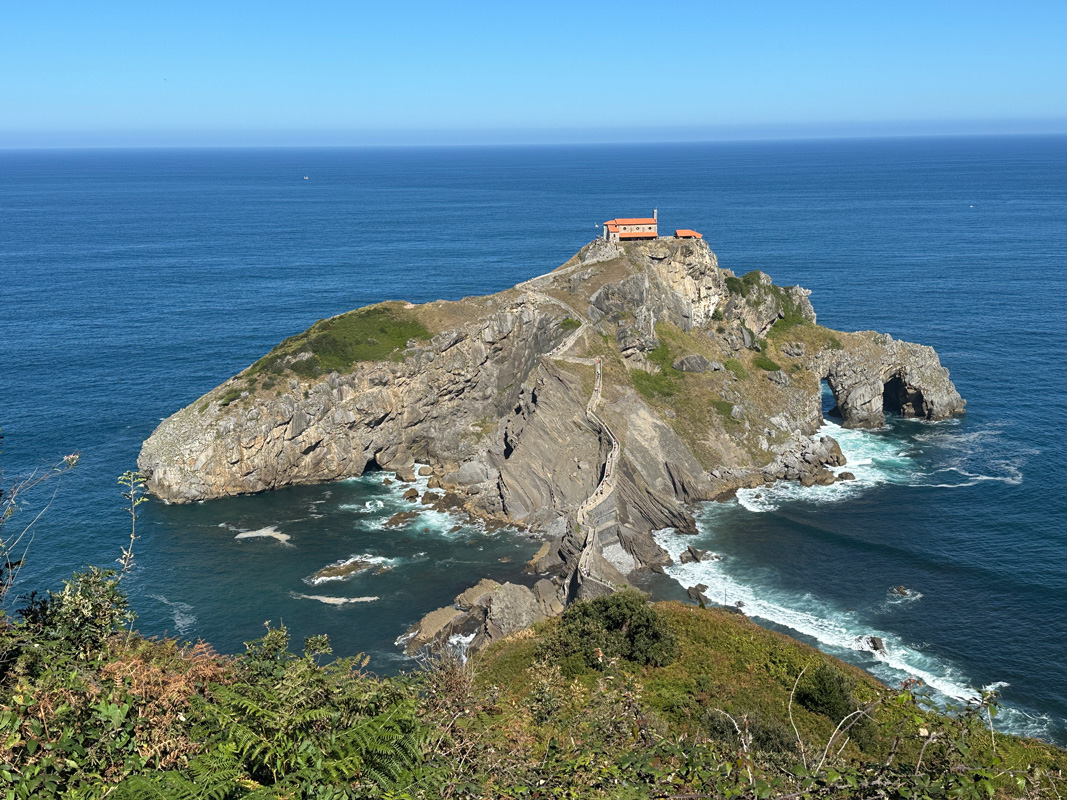
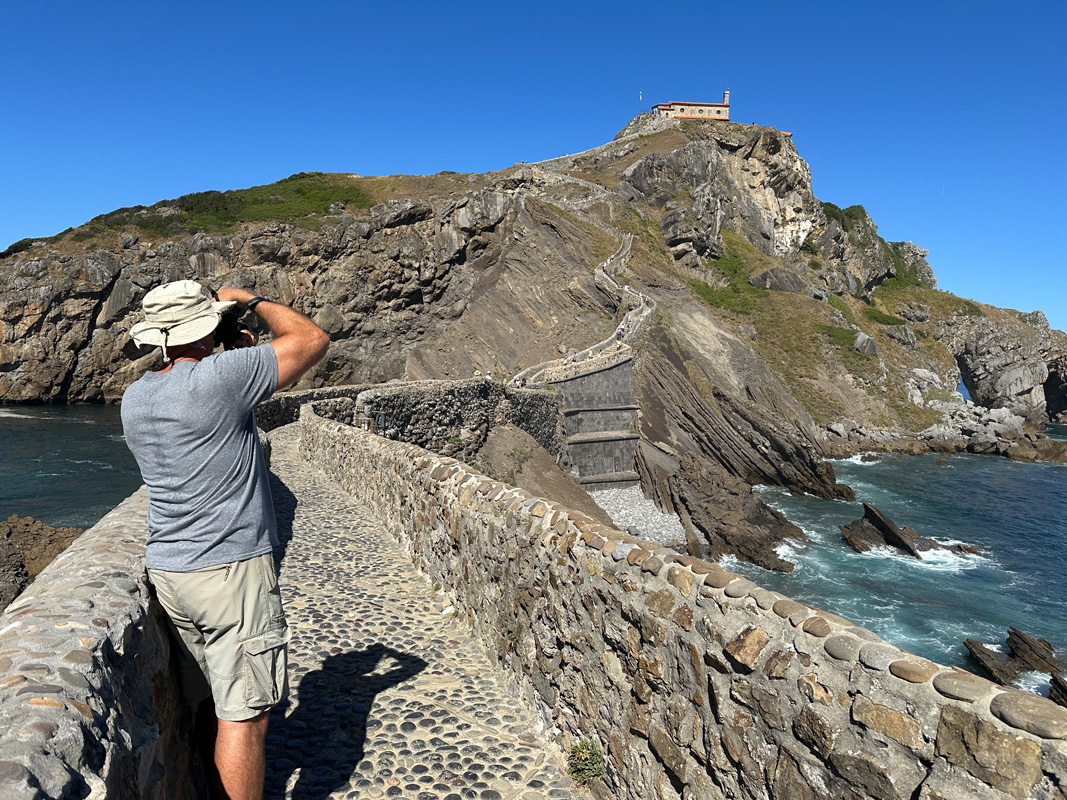
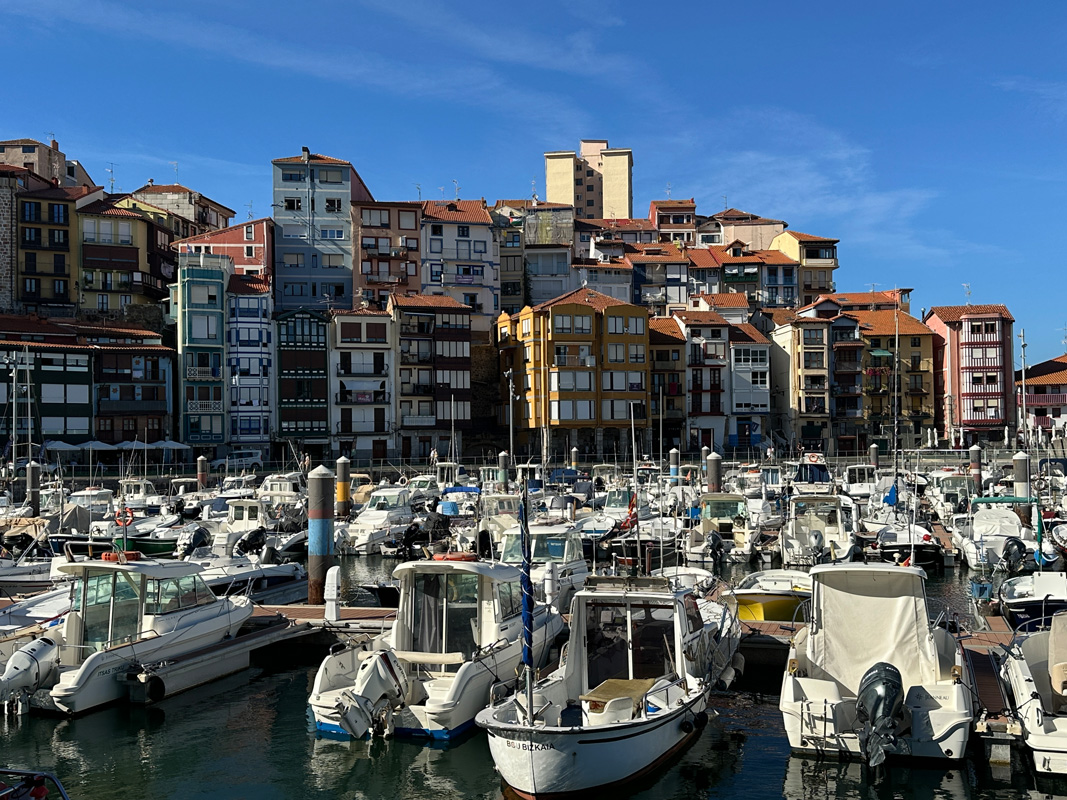
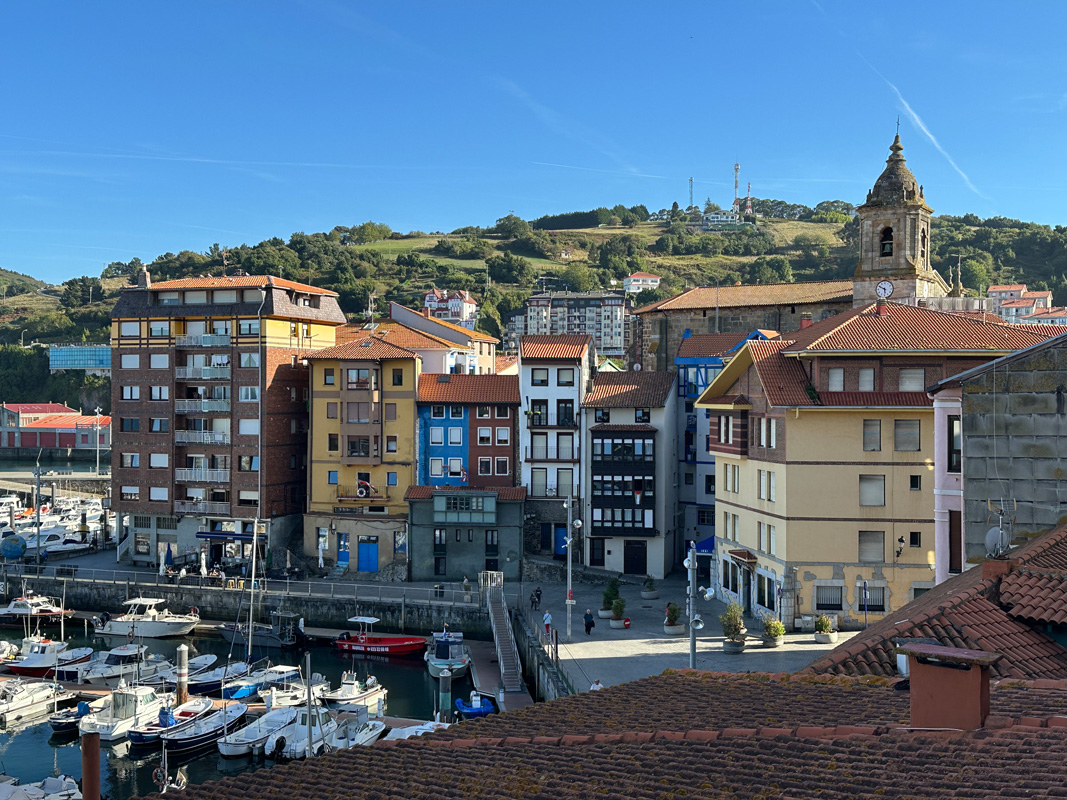
Even though we stayed 3 nights (and 2.5 days) in Bilbao, we were only exploring the actual town for 1.5 days. That’s because we also did a full day excursion to Gaztelugatxe (Dragon Stone) & the fishing port town of Bermeo – both located on the coast (Bay of Biscay) about an hour’s drive from Bilbao city center. (a few photos below)
-
- Gaztelugatxe (Dragonstone) – as featured in Game of Thrones
-
- Jack at Gaztelugatxe on Stone Bridge
-
- Bermeo Fishing Harbor
Next, I plan to write a blog post about San Sebastian – also a wonderful town yet very different from Bilbao – so stay tuned.
The town of Pamplona is also considered part of Basque Country. I’ve written a blog post about Pamplona (from a prior visit) entitled Spain’s Splendid Pamplona – Hemingway, Bull Runs, The Camino & Tapas Bars. Click here to read.
To Read More Info About Bilbao from Spain’s Official Tourism Web Site – Click here
More About Basque Country
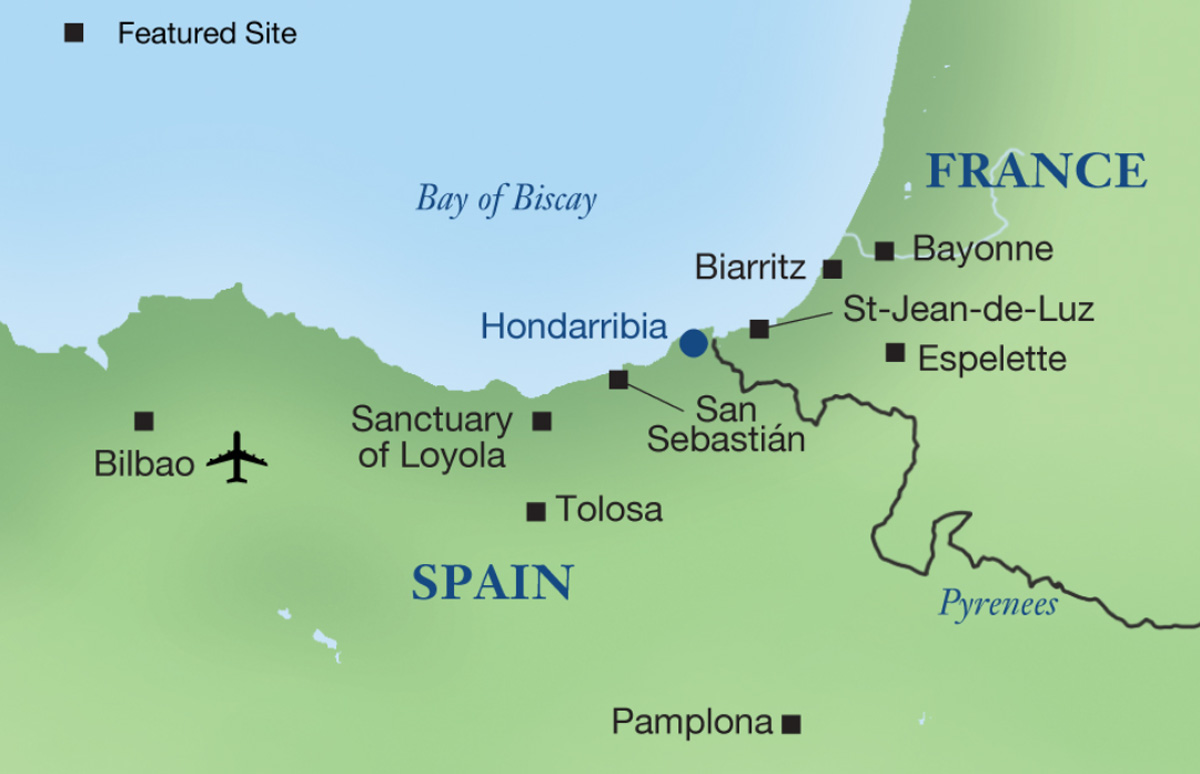
Basque Country Map / Credit: Smithsonian Journeys
The Basque Country, or Euskadi in the Basque language, is a distinctive region in the western Pyrenees. It straddles the border between northern Spain and southwestern France along the Bay of Biscay. It includes Spain’s Bilbao & San Sebastian.
This Basque region offers dramatic landscapes from green mountains & rural villages to rugged Atlantic coastlines and lively seaside towns. During our week-long visit to the area, we had a chance to experience much of the area – and we were mesmerized!
The Basque people have a strong cultural identity, owing in part to having their own ancient language, called Euskara – one of Europe’s oldest living languages (and very different from Spanish or French!).
The Basque people are often described as fiercely independent, proud of their heritage, hardworking, and free-spirited. In addition to being sociable, they have a passion for food & celebration.
History of the Guggenheim Bilbao
The idea for a Guggenheim branch in Bilbao emerged in the late 1980s as part of a broader strategy for the city’s urban renewal. The project was jointly funded by the Guggenheim Foundation (based in New York City), the Basque government, and the Spanish government.
In 1991, the Guggenheim Foundation held a competition to select an architect. Known for his innovative designs, Frank Gehry was chosen. Gehry’s vision for the museum would redefine the relationship between art, architecture, and the urban environment.
Construction began in 1993 and required advanced engineering techniques due to the complex, organic shapes of Gehry’s design. The Guggenheim Museum officially opened its doors on October 18, 1997.
The success of Bilbao’s Guggenheim Museum inspired similar projects in other cities, establishing its model for urban renewal through cultural development.
FINAL COMMENTS: Have you visited Bilbao & the Guggenheim Museum? What did you think? Any other recommendations to see while there?


Post a Comment