


Devil’s Throat – Iguazu Falls / Photo Credit: Jack Daulton
A visit to breathtaking Iguazu Falls is one of South America’s top attractions. In fact, Iguazu is one of world’s top three waterfalls, along with Niagara Falls (Canada/USA), and Victoria Falls (Zambia/Zimbabwe).
Located on the border of Brazil & Argentina in the Atlantic Rain Forest, Iguazu Falls is famous for its sheer scale. There are nearly 275 individual falls stretching for almost 2 miles around a wide horseshoe canyon. Its largest waterfall – the massive Devil’s Throat – is about 260-270 feet tall.
Touring Iguazu Falls / This Blog Post

Map of OAT Iguazu Falls Extension / Credit: Overseas Adventure Travel
I visited Iguazu Falls in March 2026 at the end of a South America tour with Overseas Adventure Travel (OAT). The main trip was to Buenos Aires & Patagonia (Chile & Argentina). OAT offered a 3-day post-trip to Iguazu Falls, so I jumped at the chance to finally visit this bucket list sight!
Our group of 13 flew from Buenos Aires to Iguazu International Airport on the Argentine side – and stayed in the nearby town of Puerto Iguazu for 3 nights. As most people do, we visited both sides of Iguazu Falls – on separate days – to maximize the experience.
In this blog post, I share my wonderful Iguazu Falls experience through narrative and many photos (and some video). Words alone can’t do justice to this incredible wonder of nature! My group & I really enjoyed everything we did – so I highly recommend them for your future visit.
More About Iguazu Falls
Unlike Niagara or Victoria Falls, which are essentially one or two massive drops, Iguazú isn’t a single waterfall – it’s a system of roughly 275 individual falls & cascades spread across nearly 1.7 miles (2.7 km) of the Iguazú River.

Devil’s Throat Viewing Platform / Click on all photos to enlarge
To that point, Iguazu Falls stretches so wide that you can’t take it all in from one viewpoint; it feels more like an entire waterfall-filled canyon than a single feature.
That is why you really want to visit both the Brazil & Argentine sides – as they offer very different, yet equally spectacular views of the falls.
In 1934, Argentina created Iguazú National Park and five years later, Brazil established Iguaçu National Park. Both were major steps toward protecting these amazing waterfalls and the surrounding Atlantic Rain Forest – a subtropical forest rich in flora and fauna.
In 1984, international recognition followed when UNESCO added Argentina’s Iguazú National Park to the World Heritage List. And in 1986, Brazil’s Iguaçu National Park was added.
In addition, Iguazu Falls was selected in 2011 as one of the “New7Wonders of Nature!” This accolade further strengthened its place among the world’s most internationally recognized natural attractions.
Arrival in Puerto Iguazu / Our Riverside Hotel
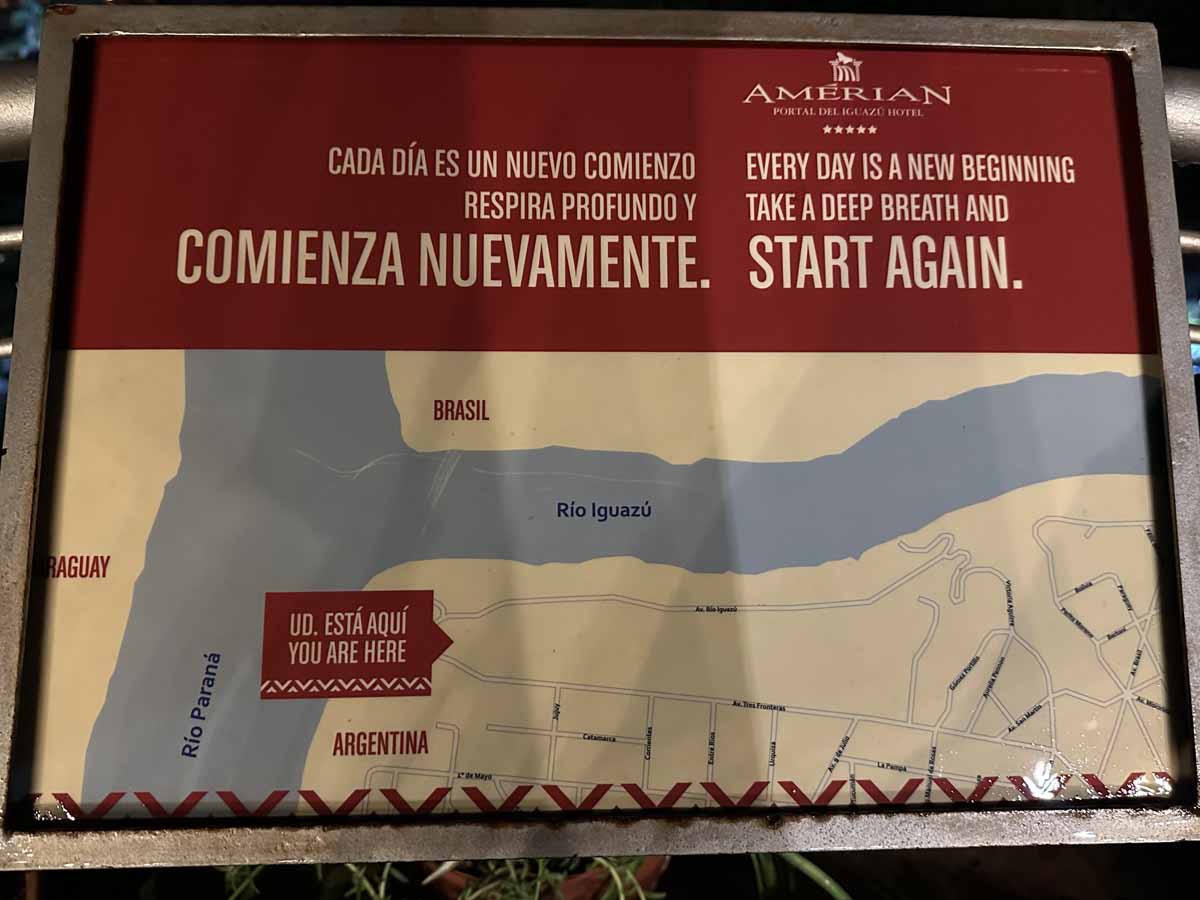
We stayed in the Argentine town of Puerto Iguazu at the nice (3-4 star) Amérian Portal del Iguazú hotel, which has 117 rooms & a lovely pool area. It’s located near the confluence of the two rivers – Rio Iguazu & Rio Parana – that divide Argentina, Brazil & Paraguay (making a Triple Border).
-

- Good map showing location of hotel near the Rivers Parana & Iguazu / Click to enlarge
-
- Our Hotel – Amerian Portal del Iguazu

It was a short walk down to the riverside plaza with its Three Borders Landmark, which we did one afternoon (discussed later in the post). However, the first evening, my boyfriend Jack & I discovered the hotel’s 5th floor terrace & bar with beautiful night views of the river and illuminated bridge (between Brazil & Paraguay). (photo)
-
- View of hotel’s lovely pool area

-
- Night view of rivers & illuminated bridge from hotel’s 5th floor bar & terrace

The hotel directly overlooks Rio Iguazu, which at this point is about 15 km (9 miles) upriver from the actual Falls. Thus, to visit both the Brazil & Argentine side of Iguazu Falls, we took a small tour bus each day to get to the different parks.
Tour Day #1 – Visit to the Brazil Side of Iguazu Falls
Crossing Borders

Distant view of the International Bridge that crosses the Rio Iguazu between Argentina & Brazil / Click photo to enlarge
I awoke that Monday morning (in early March) incredibly excited. We were about to head off to Brazil for our first viewing of Iguazu Falls. I truly had no idea what to expect but I knew it would be great!
We departed the hotel promptly at 8am to allow time for the Argentina-Brazil border crossing, which can be a bit variable (usually taking between 1-2 hours). We had a tour group of 12 Americans, plus our OAT Trip Leader Luis (from Buenos Aires), an excellent local guide Romina, and the tour bus driver.
We passed through the town of Puerto Iguazu (with a population of roughly 50 – 60,000) and made our first border crossing stop just before driving over the International Bridge (which crosses Rio Iguazu & separates Argentina & Brazil).
This first stop was to officially exit Argentina, which took 40 minutes. We Americans stayed on the bus while Romina got off, taking all our passports to handle the formalities. Then it was a short drive (including over the bridge) to formally enter Brazil.
-

- Standing in line to show our Brazil e-visas in the office at the border crossing

-
- Libby & Patricia outside the Brazil office building with passports in hand

This time, we all exited the bus and stood in line to enter the Brazilian office to get our entry stamp. We Americans had come prepared with our passports & Brazil e-visas (which we had gotten ahead of the trip). The lines moved pretty fast, so we were back on the bus at 9:25am. From here, it was approximately a 30-minute drive to the park.
Arrival Brazil’s Iguazu National Park – The Waterfall Walk
We entered the park’s very large Visitor Center for a quick stop to show our tickets & use the facilities. We got back on our bus and drove another 12 km (7.5 miles) into the park to where we would start our walking tour.
-
- Brazil’s Iguazu Falls Visitor Center

-
- The pink Hotel das Cataratas – across from the start of our Brazil-side falls walk

It was around 10:30am when we stopped to begin the walk. Across the street, we learned the “Pretty in Pink” hotel was the Hotel das Cataratas (part of the upscale Belmond Hotel brand). Built in 1958, it’s known for its distinctive Portuguese-colonial architecture – and is the only hotel in Brazil’s National Park.
From a grassy hillside (high above the river canyon below), we got our first wide-angle view of many of Iguazu Falls’ beautiful cascades on the Argentine side. They were located just behind San Martin Island.
-
- Our first view of a series of waterfalls over on the Argentine side / Click all photos to enlarge

-
- Closer view of the same falls & the dirt beach of San Martin Island (in middle area)

We also got introduced to the local wildlife when Romina pointed out some coati foraging there in the grass. She said these South American racoon-like mammals were “relatively” harmless but strictly warned us not to pet or feed them – it was best to just ignore them.
-

- Coati / Photo: Jack Daulton

-

- Photo Credit (on left): Jack Daulton / (above) another coati on our walking path / Click to enlarge

Apparently, you’ll see coati (also called coatimundis) with their long ringed tails and pointy snouts roaming in packs all over both the Argentine and Brazilian park areas. (more about the coati later!).
We then began the wonderful “Waterfall Walk” north along the “Iguazu Falls Trail.” This relatively flat & paved (along with being wheelchair-friendly!) trail is around 1.5 km (0.9 miles) long. We passed through lush rainforest landscape, with falls visible at many points along the trail.


It’s best to walk the same direction that we did (south to north), so that you can end with the most dramatic scenery (can you say Devil’s Throat?)! Signage here was in three languages – Portuguese, English & Spanish.


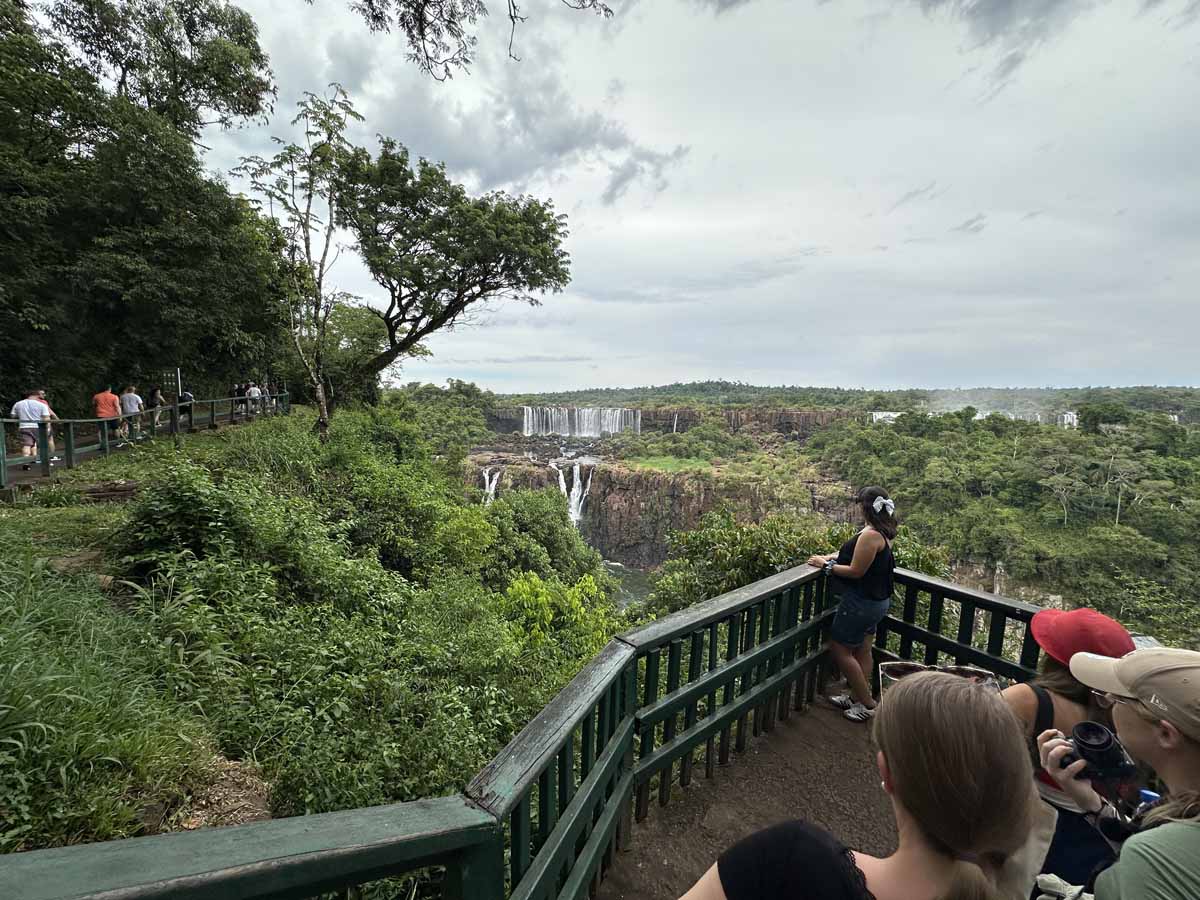
Along the way, there were a few viewpoints (miradores) – ie, wooden balconies (photos below) that jutted out for unobstructed views of the falls & river canyon below. As you can imagine, they were crowded with tourists lining up to get photos of themselves with the falls in the background.
-
- One of the balcony pop-outs along the trail designed for views & photos!
-
- Another pop-out further up the trail – with our first view of Devil’s Throat (to the left)

Approaching “Devil’s Throat” Falls – Garganta del Diablo
Near the end of the forest trail, you pop out into an open area framed in the background by the broad & mighty 55-meter (180 ft) cataract named Floriano Falls. (below) Here, the oft-photographed Devil’s Throat Viewing Platform (a metal walkway) extends over a shallow, boulder-filled body of flowing water which plunges down to the river far below.


-
- The elevator (upper left) that takes you from path level up to the top parking lot

-
- View from elevator platform back across the water to the Falls lookout & pathway.

Sitting right on the Argentina-Brazil border, Devil’s Throat is a horseshoe-shaped gorge that stretches about 700 meters (2,300 ft) along its curved edge with 14 individual waterfalls converging here. However, it’s only around 150 meters (490 ft) if you measure straight across at its widest point.
Clearly, this amazing waterfall is the centerpiece of the entire Iguazu Falls system. Devil’s Throat falls plunge about 82 meters (269 ft) into the gorge below & the sheer volume of the water creates a permanent cloud of mist. It’s breathtaking!
-
- Great Egret hunting for fish in the shallow waters near the elevated pathway

-
- Great view of the massive Devil’s Throat waterfall from the platform!

This platform was clearly the highlight of today’s walk, offering classic panoramic views of Devil’s Throat falls at the top of the river gorge. Of course, prepare to get wet with the constantly blowing mist and spray – which is all part of the fun! I was less worried about my iPhone. However, Jack had to use a plastic shower cap to help protect his DSLR camera lens.


After spending time taking photos and enjoying the incredible views, Jack & I walked back at noon to the lower viewing deck of the tower (at trail’s end). Here we stood in line for the panoramic glass elevator which soon whisked us up to the top level (with another viewpoint and a restaurant).
Turns out, our group were all there (with the bus nearby) waiting for us photographing laggards. It’s hard to tear an excellent photographer like Jack Daulton away from such amazing shots!
As for the weather, we got lucky today! It was overcast and not too hot, so we were all fairly comfortable. I had read that the weather in Iguazu at this time of year could be in the 90s F with 90% humidity. (spoiler alert – we got a taste of the heat the next day!).
Back to Argentina for Lunch
We departed the park for the border crossings in reverse – and of course, it was easier this direction. Goodbye & Thank You Brazil – We enjoyed our very short visit to your country (just a total of 4 hours!). It was 1:20pm when we drove across the International Bridge back into Argentina.
We stopped for lunch at a lovely eco-sustainable hotel – El Pueblito Iguazu Hotel Tematico – which is surrounded by a private natural reserve. It serves regional dishes and local river fish.
-
- Lunch stop at El Pueblito Iguazu Hotel Tematico

-
- Our tasty “sampling” lunch of upscale Guarani favorites

We enjoyed an upscale version of a typical Guarani meal. The tasty sampling plate (photo above) included 3 empanadas, hearts of palm, 2 corn cakes, a local fish ceviche, and a cheese square with brown sweet tree bark. Dessert was a delicious passionfruit mousse.
Quick Note: The Mbya-Guaraní are the indigenous group of the Iguazu region. They are part of the broader Guaraní people who span Argentina, Brazil, Paraguay, and parts of Bolivia. They’ve inhabited this stretch of jungle for centuries with a deep spiritual connection to the land and rainforest, living in harmony with nature!
-
- BioCentro Iguazu – butterflies, orchids, bromeliads & more


After lunch, we took a short walk through the adjacent BioCentro Iguazú with one of its staff. This nature theme park has an aquarium, serpentarium, butterfly garden, orchid garden, and a lagoon on-site. We particularly enjoyed the butterfly enclosure with a wide variety of beautiful butterflies fluttering all around us!
-
- We visited their fascinating butterfly enclosure

-

- Photo: Jack Daulton

Tour Day #2 – Visit to the Argentine Side of Iguazu Falls
Today’s visit was another opportunity for more waterfall views – this time from the Argentine side. Here you get a very different vantage point of the falls (more up close & personal)! (see map)
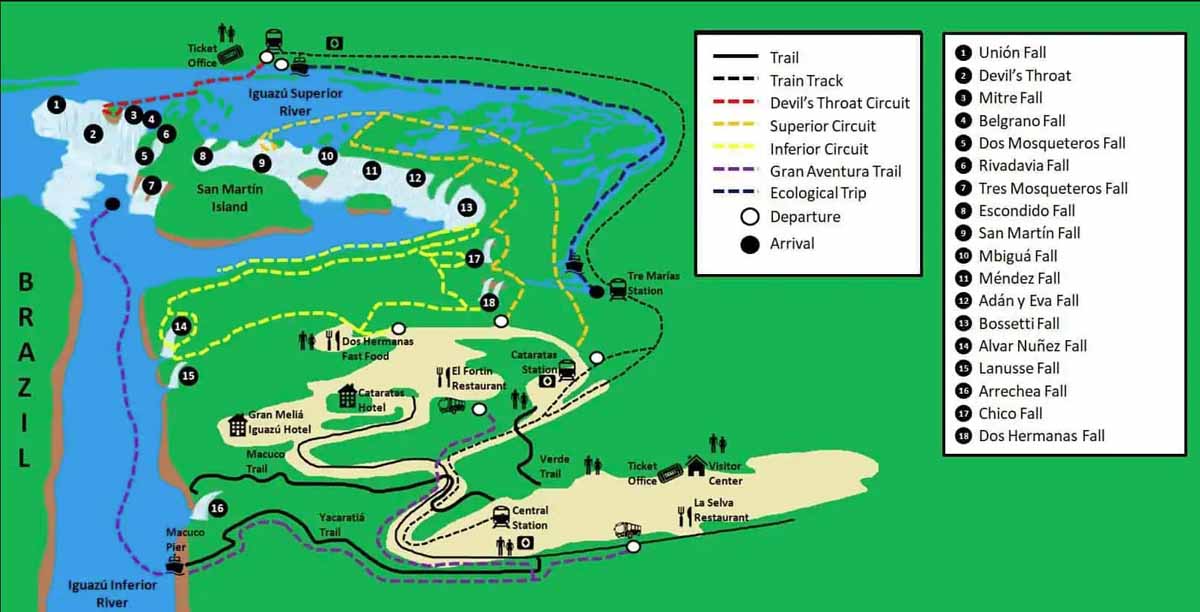
Detailed Iguazu Falls Trail Map for Argentine side (on right) / Click to enlarge
 We departed the hotel at 7:30am for the approximately half-hour drive to Argentina’s Iguazu Falls National Park. We arrived at the large & bustling Visitor’s Center around 8am. We had a little free time before gathering again with our local guide Romina.
Romina (photo below) shared that she was also a Certified Professional Guide for the Argentina Park. With her deep knowledge, she shared there are around 400 bird species across the two Iguazu national parks. (see photo below of one of the local beauties!) My birder friends would be in heaven here!

-

- Beautiful Bird – Plush-crested Jay / Photo: Jack Daulton

We walked to the nearby Central Station to get in line for our 9am train tickets. The little green narrow-gauge Ecological Rainforest Train would carry us to the top of the park to the Devil’s Throat station. It was an enjoyable 25-minute ride through the rainforest, saving us a lot of walking!


Walk #1 – Devil’s Throat Circuit
Exiting the train station, we followed Romina to the start of the Devil’s Throat Circuit. This must-see trail would lead us out to a massive viewing platform situated right above the most powerful section of Devil’s Throat falls.
The entire trail was on elevated metal walkways that crossed over sections of the wide Upper Iguazu River and a few small, forested islands in its delta. The water was calm with very gentle flow until we got close to the actual falls.
-
- The great elevated metal walkways throughout the Argentina Falls park

-
- Passing over shallow delta of the Rio Iguazu before it flows into Devil’s Throat falls

As we got closer to the falls, we started to see mist & spray rising up into the air. The photos (and video) will give you a good idea of the amazing scene & experience.


As mentioned, Devil’s Throat is comprised of 14 individual waterfalls that converge to drop about 82 meters (269 ft) into the gorge below. Standing on the metal platform and gazing down into this massive volume of roiling, tumbling, never-ending powerful white water is truly awe-inspiring!
-
- Closeup of Devil’s Throat falls

-
- Central view of massive Devil’s Throat falls

The end of the walkway circles around in a loop giving visitors many different vantage points of Devil’s Throat – including where the river water enters the falls and the other side where you can see the falls drop precipitously down to the Lower Iguazu River and continue flowing down the canyon.


Just like the Brazil side’s platform, there was a lot of spray & mist here at the Falls – so you will certainly get wet! Luckily, it’s warm out so the mist feels refreshing.


There was one intrepid professional Park Photographer standing on a ladder taking photos for a fee – and trying his best to keep his camera dry by holding up an umbrella. Of course, Terri & I said yes to his offer of $10/photo – how could we resist? (FYI, you pick up and pay for the photos later – back in the central area.)

We headed back on the same walkway to the Devil’s Throat Circuit entrance to meet our group. We had spent 1 ¼ hours on this spectacular circuit – which is the highlight of the Argentine park! Then it was back to the nearby train station to catch the 11am train south to Cataratas Station.


Walk #2 – The Upper Circuit (Circuito Superior)
The Argentine park has a few different trails that you can walk. The Upper Circuit is another popular one. Our full group walked this trail with Romina, starting around 11:45am. She led the way and OAT Trip Leader Luis was the trusty “sweep” at the back.
-
- View of Lower Iguazu river & San Martin island (middle)

-
- Lower Circuit view of San Martin waterfall (big one on the left side of all the falls)

Like Devil’s Throat circuit, the path is a network of elevated metal walkways. Generally, it’s a one-way direction that’s well marked and flat (ie, no stairs so it’s wheelchair and stroller accessible!) We spent about an hour on this trail, which was quite enjoyable.
-
- The walkways are easy to follow and are one way in parts!

-
- The signs are in Spanish & English

The Upper Circuit is roughly 1,700 meters long (~1 mile), forming a loop. You walk along the top edge of the river gorge, looking down over the lip of each waterfall just before the water makes its plunge. You pass a string of named falls, such as Salto Bossetti & Salto Mbiguá. (Note: Salto means waterfall in Spanish.)

-
- The iconic “88” Butterfly – I finally saw one on the path!

You finally cross a footbridge over the upper river to a very popular viewpoint at Salto San Martín, which is the park’s 2nd-largest waterfall. The viewpoint sports a large blue & white Argentina flag, which is visible from many points around the park.
-
- Salto San Martin – the largest falls in this area of the park. The overlook flies the blue Argentine flag.

-
- The “sisters” posing at San Martin falls – Patricia, Terri & Sue!

Lunch Stop / Pesky Food-Seeking Coatis
From the Upper Circuit trail exit, we returned to the central area (near Cataratas station) around 12:50pm. People split up to get their choice of food & enjoy a well-deserved break! Fortin Cataratas was the area’s main restaurant serving a buffet style lunch. Jack & I opted instead for a nice gelato to cool off.
-

- Our lunch place – Fortin Cataratas restaurant /Photo Credit: TripAdvisor

-

- Food Court eating area – wired enclosure!

Important Warnings About the Coati
The Coati are naturally food-driven foragers (fruit, insects, small lizards, eggs). However, decades of tourists sneaking snacks to them have made them boldly beg for food. It’s especially become a problem around the park’s cafeterias and picnic areas.
Romina warned us that coatis can become aggressive when looking for food, including biting or scratching. This is almost always food-related – ie, a coati grabbing something off a table, out of a hand, or out of an open bag, and biting if a person tries to take it back or gets too close while they’re eating.
Coati bites are common enough that park rangers post large warning signs – and this is why food areas are located behind doors and metal cages!
-

- Coati in tree / Photo: Jack Daulton

-
- Important Sign – Danger from Monkeys & Coatis – “They are NOT PETS!”

The sign (in the photo) says “Danger. Monkeys & Coatis Are Not Pets! Do Not Feed Them. They Can Bite & Transmit Disease.”
Yes (per AI), there are also Capuchin monkeys (monos) in the park, but they are less of a nuisance. They are more opportunistic and sneaky than aggressive like the coati. During our visit, we never saw any monkeys. Apparently, they are mostly concentrated in densely forested trails on the Argentine side, particularly the Lower Circuit.
BOTTOM LINE: PRACTICAL ADVICE (for Coati & Monkeys): Never feed the coati, keep food fully zipped away and out of sight, and don’t try to shoo one away from a bag or table – just let the animal have whatever it grabbed rather than fighting for it.
Lastly, if someone does get a bite or deep scratch by a coati, talk to a park ranger. The person will need medical evaluation the same day and possibly rabies shots (to be extra safe).
I don’t mean to scare you, but I felt it was important to pass along important cautions about the coati who can look so darn cute! Of course, we had no problems (following the cautions) and I’m sure you won’t either.
Walk #3 – Lower Circuit Trail (Circuito Inferior)
After lunch, the group collected at 2pm for a final optional walk – on the Lower Circuit trail. Today’s weather had been clear skies and sunny all day. By this time in the afternoon, it had become uncomfortably hot! However, 7 of us brave (or is that crazy!) folks still opted to do the walk with Romina & Luis.


We spent an hour on the trail. However, I’ve read that the full Lower Circuit can take 2 hours, so I’m sure Romina took us on a shorter loop due to the heat. We started the walk by going down a steep paved trail to meet up with the metal walkways for most of the circuit loop.
There were some steep up and down sections & stairs to get us closer to (but not down at) the river level, allowing views of the falls from below.


Highlights were the large viewing terrace (with its own Argentine flag!) where we enjoyed picturesque views of the river curve in front of San Martin Island with all the many falls behind and to the right. (above) Plus, we had a nice view up the river gorge to Devil’s Throat at the end. (below) By now, it was really hot & humid!
-
- This lower deck was a great photo op area!

-
- View up Lower Iguazu River to Devil’s Throat

Near the end of our walk, we passed by the Two Sisters (Dos Hermanas) waterfalls located in a very peaceful setting. (below)
-
- Two Sisters (Dos Hermanas) Waterfalls


Luckily, we survived the walk and successfully returned to the Central Food area at 3pm to search for cold water to drink. There, we met up with the rest of our group – for the bus ride immediately back to our hotel. It was time to hit the hotel’s swimming pool after a quick nap. (both were heaven!)
Grand Adventure River Boat Tour – Another Fun Falls Option
I wanted to tell you about a very cool river boat trip at the Falls – called the Grand Adventure – offered in the Argentine National Park. It was on our schedule that afternoon as an optional tour (for $60/pp), which I was hoping to do! Unfortunately, boat trips were cancelled that day due to low water levels. Darn!

Iguazu Falls map showing route of the Gran Aventura boat ride to 2 sets of falls / Click to enlarge
Here’s what the 2-hour “Gran Aventura” trip entails:
- A “Jungle Safari” – you start with a 25-minute open truck ride through the park’s forest to the boat launch area.
- At the riverbank at Puerto Macuco, you get life jackets and waterproof bags for your gear.
- The Boat Ride – you enjoy an exhilarating 6 km speed boat ride on the Lower Iguazu River toward the heart of the waterfalls area. You approach the base of two separate sets of falls – San Martin & Tres Mosqueteros – getting close & VERY WET! You’ll also get great views of Devil’s Throat.
- It’s a physically active adventure so it’s not for everyone!
-

- Gran Aventura boat ride / Photo Credit: Viator

-

- Gran Aventura boat ride / Photo Credit: Viator

FYI – I later googled why our boat ride was cancelled that day (March 10th, 2026). Turns out, Iguazú Jungle (the official Argentine boat tour operator) suspended all Gran Aventura excursions specifically due to low river flow – a marked drop in the river’s water level. The boats need sufficient water depth to safely navigate the rapids and get close to the falls.
 However, I was encouraged to learn (especially for you!) that these boat suspensions are not common. They happen roughly twice a year, either from extreme high water or extreme low water. So, it was just unlucky timing on our part – but our visits to the Brazil & Argentine sides of Iguazu Falls were still wonderful!
In addition, the Brazilian side offers a similar but different boat journey called Macuco Safari. It includes a 2km ride through the National Park and a forest walk, followed by a boat ride near the falls (Tres Mosqueteros) where you also get soaked!
Interestingly, the Brazil side did not cancel their boat tours on March 10th. (see my photo of two of their boats very close to the falls).
Here’s a good webpage about the Gran Aventura (Argentine side) – Click Here
Here’s a webpage about the Macuco Safari (Brazil side) – Click Here

Map of Iguazu Falls & the Triple Frontier / Credit: IguazuFalls.com / Click to enlarge
Visit to Puerto Iguazu’s Riverside Plaza – To Enjoy a Taste of Local Life
One of the afternoons in Puerto Iguazu, we joined OAT Trip Leader Luis at 5:45pm to take a short “neighborhood walk” from our hotel.
We headed over to the nearby riverside plaza – to enjoy great views & a taste of local Iguazu life.
The plaza offered picturesque views of the “Triple Frontier” where the Iguazu & Parana Rivers meet, delineating the borders of the three adjoining countries – Argentina, Brazil and Paraguay (see map).
-
- Harpist playing on the riverside plaza

-
- Arial & Sherry, Jim & Mary, Jack & Janet

The view was graced by the new “suspension bridge” (named Integration Bridge) which crosses the Rio Parana. It connects Brazil (the city of Foz de Iguacu) to Paraguay (to the smaller town of Presidente Franco, just south of Ciudad del Este). The main (and older) Friendship Bridge crosses a few miles further up the river.
-
- View of Integration Bridge & Riverside Promenade

-
- Three Borders Monument with flag poles

This lovely & lively riverside plaza was constantly filled with locals and visitors alike. The square contains a small obelisk (built in 1903) painted in Argentina’s national colors (sky-blue and white). In its Three Borders complex, there is a Monument to Fraternity/Friendship with poles that fly the flags of the three countries. (photo)
-
- Jack & I posing in front of the Iguazu (and toucan) sign!

-
- Local couple enjoying end of day river views along with a thermos of local mate tea

Also popular is the large white Iguazu sign – crowned by a large Toucan – for getting your photo taken (which we all did!) At night, the sign lights up in a variety of colors.
-
- The bustling riverside plaza at night & blue-white obelisk

-
- The beautifully lit suspension bridge

On the west side of the plaza is a crafts fair & stalls selling artisan work, regional products, and typical tourist mementos. Jack & I did some browsing & came home with big purchases – Iguazu Falls fridge magnets & bottle openers (cheap & easy to pack!). Mostly, we just enjoyed the people watching around the plaza.
-
- Community street dancing – all welcome!

-
- The Iguazu sign changes colors at night!

Jack & I left the plaza around 7:30pm to return to the hotel for dinner. The place was still hopping with people enjoying themselves, including some street dancers! Overall, it was a very fun & friendly scene along with beautiful night views!
Final Comments / Resources
 I hope you’ve enjoyed our visit together to spectacular Iguazu Falls. Perhaps you’ve been inspired to make your own visit to the Falls, as part of a future South America trip.
As you’ve seen, our 3-day OAT trip to Iguazu was great. The itinerary gave us the opportunity to fully explore both the Brazil & Argentine sides of the Falls, as well as enjoy a little slice of life in delightful, low-key Puerto Iguazu with its lovely riverside setting.
Here’s some final information…
How to Fly To Iguazu Falls
You can fly into Iguazu International Airport on the Argentine side (at Puerto Iguazu) or Cataratas International Airport on the Brazil side (at Foz do Iguacu). (see map)

Excellent Iguazu Falls Map / Credit: EmersonKent.com

Aerolineas Argentinas Airport Check-in (Buenos Aires)
Brazil’s airport is the larger and more connected of the two airports with daily flights from major Brazilian cities as well as some other South American cities. The Argentine Iguazu airport mainly connects to Buenos Aires.
As mentioned, my group flew from Buenos Aires (and back) to Argentina’s Iguazu Airport. Our Aerolineas Argentinas flight was an easy 1.5 hours. (photo) Plus, we were able to fly out of Buenos Aires’ domestic airport both ways.
So What is the Correct Spelling of Iguazu Falls?
I will confess I had been confused by the different spellings of Iguazu falls, depending on which language you’re using or even which version in English. Plus, what about all those various accents?! So, I asked AI (Claude) for some guidance:
The spelling really does vary by source. Here’s the breakdown:
- Iguazu Falls — the most common spelling in English-language travel writing overall, and standard for the Argentina side (Spanish: Cataratas del Iguazú, though English drops the accent).
- Iguaçu Falls — the Portuguese/Brazilian spelling (with the cedilla), used on the Brazil side and by Brazilian tourism boards, hotels, and the national park itself (Foz do Iguaçu, Parque Nacional do Iguaçu).
- Iguassu Falls — an older anglicized spelling, still used by some legacy travel/hospitality brands (like my OAT tour operator & Belmond hotels).
Devil’s Throat Photo Credit: Jack Daulton
Good Web Sites for Iguazu Falls Travel Information
- IguazuFalls.com – extensive website with excellent info – Click Here
- iguazu-falls.org – Click Here
COMMENTS: Have you visited Iguazu Falls? Did you see both sides? What was your impression? Any other recommendations?
Want To Read More About Fabulous Waterfalls? Check Out My Blog Post About Africa’s Victoria Falls (another one of the Big Three!) – Click Here




Janet, this was a thorough and enjoyable description of the tour. Your photos and videos of the falls were spectacular! This site is now on my wish list.
Thanks, Virginia. I’m very glad you enjoyed the Iguazu Falls blog post – and that you’ve been inspired to make a visit to the Falls one day. I know you won’t be disappointed!
We’re big believers in seeing both sides of the falls too — the contrast between the wide panoramas from the Brazil side and the up-close walkways on the Argentine side really sells the scale of the place. Your warning about the coatis is one we’ll remember; food-seeking wildlife at a lunch stop is exactly the sort of practical tip that only comes from actually being there. The evening at the riverside plaza with the harpist sounds like the perfect way to wind down after a day on the trails.
Thanks and well said!